


A possible role of class 1 plant hemoglobin at the early stage of legume-rhizobium symbiosis
- PMID: 19721749
- PMCID: PMC2652528
- DOI: 10.4161/psb.4.3.7796
A possible role of class 1 plant hemoglobin at the early stage of legume-rhizobium symbiosis
Abstract
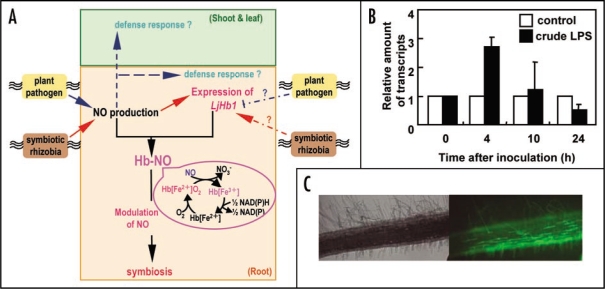
Leguminous plants form root nodules, in which symbiotic rhizobia fix atmospheric nitrogen and supply the fixation products to their host plants as a nitrogen source. On the process of establishing the symbiosis, rhizobia induce genes involved in the defense system of their host plants. However, the host defense responses will be cancelled by unknown mechanism. We focused on nitric oxide (NO) as a key molecule of plant defense system and class 1 plant hemoglobin (Hb) as a scavenger of NO. The inoculation of a symbiotic rhizobium, Mesorhizobium loti MAFF303099, induced transiently NO production and expression of a class 1 Hb gene LjHb1 in the roots of a model legume Lotus japonicus. In this addendum, we show that the lipopolysaccharide of M. loti induces NO production and expression of LjHb1 in L. japonicus, and we propose the role of NO and Hb at the early stage of symbiosis.
Keywords: Lotus japonicus; Mesorhizobium loti; defense; hemoglobin; lipopolysaccharide; nitric oxide; rhizobium; symbiosis.
Figures
Comment on
-
Expression of a class 1 hemoglobin gene and production of nitric oxide in response to symbiotic and pathogenic bacteria in Lotus japonicus.Mol Plant Microbe Interact. 2008 Sep;21(9):1175-83. doi: 10.1094/MPMI-21-9-1175. Mol Plant Microbe Interact. 2008. PMID: 18700822
References
-
- Lerouge P, Roche P, Faucher C, Maillet F, Truchet G, Promé JC, et al. Symbiotic host-specificity of Rhizobium meliloti is determined by a sulphated and acylated glucosamine oligosaccharide signal. Nature. 1990;344:781–784. - PubMed
-
- Baron C, Zambryski PC. The plant response in pathogenesis, symbiosis and wounding: Variations on a common theme? Annu Rev Genetics. 1995;29:107–129. - PubMed
-
- Mishina TE, Zeier J. Pathogen-associated molecular pattern recognition rather than development of tissue necrosis contributes to bacterial induction of systemic acquired resistance in Arabidopsis. Plant J. 2007;50:500–513. - PubMed
Publication types
LinkOut - more resources
Full Text Sources
