


Rooting of carnation cuttings: the auxin signal
- PMID: 19721760
- PMCID: PMC2652539
- DOI: 10.4161/psb.4.3.7912
Rooting of carnation cuttings: the auxin signal
Abstract
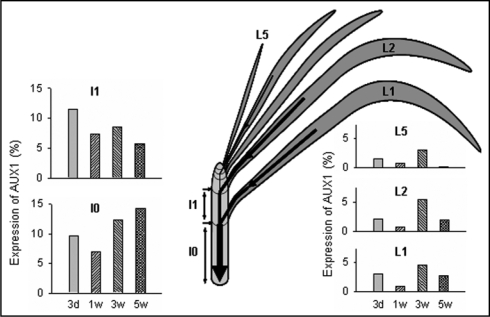
The rooting of stem cuttings is a common vegetative propagation practice in many ornamental species. Among other signals, auxin polarly transported through the stem plays a key role in the formation and growth of adventitious roots. Unlike in other plant species, auxin from mature leaves plays a decisive role in the rooting of carnation (Dianthus caryophyllus. L) cuttings. The gene DcAUX1, which codifies an auxin influx carrier involved in polar auxin transport, has now been cloned and characterized in carnation. The expression pattern of this gene was seen to depend on the organ, the cultivar and the time of cold storage. The variations observed in its expression could be related with the rooting ability of different carnation cultivars.
Keywords: Dianthus caryophyllus; auxin carrier; auxin transport; carnation cutting; rooting.
Figures
Comment on
-
Isolation and characterization of a cDNA clone encoding an auxin influx carrier in carnation cuttings. Expression in different organs and cultivars and its relationship with cold storage.Plant Physiol Biochem. 2008 Dec;46(12):1071-6. doi: 10.1016/j.plaphy.2008.07.009. Epub 2008 Jul 30. Plant Physiol Biochem. 2008. PMID: 18762430
References
-
- Jarvis BC. Endogenous control of adventitious rooting in non woody cuttings. In: Jackson MB, editor. New Root Formation in Plant and Cuttings. Martinus-Nijhoff Kluwer Academic Publisher Group; 1986. pp. 191–222.
-
- Gaspar T, Hofinger M. Auxin metabolism during root formation. In: Davis TD, Haissig BE, Sankhla N, editors. Adventitious Root Formation in Cuttings. Advances in Plant Sciences Series. Vol. 2. Dioscorides Press; 1988. pp. 117–131.
-
- Haissig BE. Influence of indole-3-acetic acid on adventitious root primordia of brittle willow. Planta. 1970;95:27–35. - PubMed
-
- Eliasson L, Areblad K. Auxin effects on rooting in pea cuttings. Physiol Plant. 1984;61:293–297.
-
- Katsumi M, Chiba Y, Fukuyama M. The roles of the cotyledons and auxin in the adventitious root formation of hypocotyl cuttings of light-grown cucumber seedlings. Physiol Plant. 1969;22:993–1000.
Publication types
LinkOut - more resources
Full Text Sources
