. 2009 Mar;7(1):50-9.
doi: 10.2174/157015909787602797.

Hypocretin/Orexin neuropeptides: participation in the control of sleep-wakefulness cycle and energy homeostasis

Affiliations

Hypocretin/Orexin neuropeptides: participation in the control of sleep-wakefulness cycle and energy homeostasis

A Nuñez et al. Curr Neuropharmacol. 2009 Mar.

Abstract

Hypocretins or orexins (Hcrt/Orx) are hypothalamic neuropeptides that are synthesized by neurons located mainly in the perifornical area of the posterolateral hypothalamus. These hypothalamic neurons are the origin of an extensive and divergent projection system innervating numerous structures of the central nervous system. In recent years it has become clear that these neuropeptides are involved in the regulation of many organic functions, such as feeding, thermoregulation and neuroendocrine and cardiovascular control, as well as in the control of the sleep-wakefulness cycle. In this respect, Hcrt/Orx activate two subtypes of G protein-coupled receptors (Hcrt/Orx1R and Hcrt/Orx2R) that show a partly segregated and prominent distribution in neural structures involved in sleep-wakefulness regulation. Wakefulness-enhancing and/or sleep-suppressing actions of Hcrt/Orx have been reported in specific areas of the brainstem. Moreover, presently there are animal models of human narcolepsy consisting in modifications of Hcrt/Orx receptors or absence of these peptides. This strongly suggests that narcolepsy is the direct consequence of a hypofunction of the Hcrt/Orx system, which is most likely due to Hcrt/Orx neurons degeneration.The main focus of this review is to update and illustrate the available data on the actions of Hcrt/Orx neuropeptides with special interest in their participation in the control of the sleep-wakefulness cycle and the regulation of energy homeostasis. Current pharmacological treatment of narcolepsy is also discussed.

Keywords: Posterior lateral hypothalamic area; food intake.; hypocretin neurons; orexin neurons; perifornical area; sleep-wakefulness.


Figures
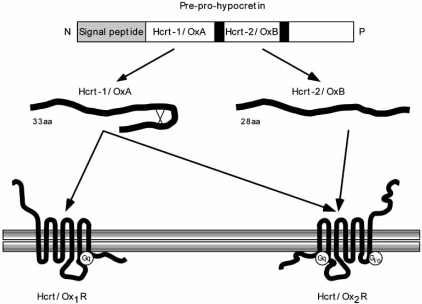
Fig. (1)
Fig. (1)
Schematic depiction of hypocretin/orexin system. Hypocretin-1/Orexin A (Hcrt-1/OrxA) and hypocretin-2/Orexin B (Hcrt-2/OrxB) are derived from a common precursor peptide, pre-pro-hypocretin. After removal of the N-terminal secretory signal sequence, pre-prohypocretin is cleaved at specific sites having basic amino acid residues to yield the two mature peptides. Hcrt-1/OrxA possesses two disulfide bridges while Hcrt-2/OxB is linear. The actions of hypocretins are mediated through interaction with two heterotrimeric G protein-coupled receptors (Hcrt/Orx1R and Hcrt/Orx2R), whose distribution in the central nervous system is regionally specific. Hcrt/Orx1R is more selective for Hcrt-1/OrxA, while Hcrt/Orx2R is equally specific for both peptides. Hcrt-1/OrxA is linked exclusively to excitatory G proteins of the Gq subclass, whereas Hcrt-2/OxB couples in vitro to excitatory Gq and/or inhibitory Gi/o. Signaling through Gq pathway results in increase of intracellular Ca2+, most probably via activation of phospholipase C-b with subsequent triggering of the phosphatidylinositol cascade and activation of protein kinase C. The Ca2+ influx likely induces depolarization. Signaling via inhibitory Gi/o pathway may occur through hyperpolarization due to K+ efflux (GIRK channel-mediated). Figure modified from [9].
Fig. (2)
Fig. (2)
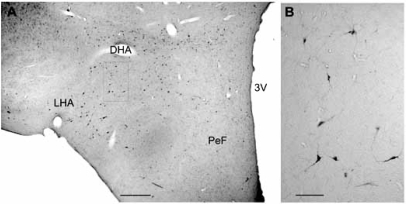
Distribution of Hcrt/Orx neurons in the cat hypothalamus. A: Microphotograph of a coronal section of cat hypothalamus showing the distribution of orexinergic neurons as result of the immunoreaction for anti-Orexin A antiserum. No counterstaining. B: High magnification of area squared in A. DHA. dorsal hypothalamic area, LHA: lateral hypothalamic area, PeF: perifornical region, 3V: third ventricle. Calibration bars: A, 500 µm, B, 100 µm.
Fig. (3)
Fig. (3)
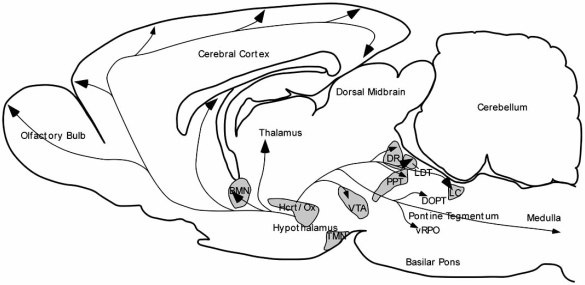
Sagittal scheme of the rat brain illustrating hypocretinergic influences on the cerebral cortex and wakefulness-promoting structures. Hypocretin/orexin (Hcrt/Orx) hypothalamic neurons send axons to both the cerebral cortex and neurochemically-specific neuronal groups projecting to the cortex, which are most involved in wakeulness maintenance and cortical activation. These groups are the noradrenergic locus coeruleus (LC), serotonergic dorsal raphe nucleus (RDo), cholinergic laterodorsal tegmental (LDT) and peduculopontine tegmental (PPT) nuclei, dopaminergic ventral tegmental area (VTA), histaminergic tuberomammilary nucleus (TMN) and cholinergic basal forebrain (BF) In the pontine tegmentum, Hcrt/Orx axons reach DOPT, where Hcrt/Orx enhance wakeulness, and also vRPO, where Hcrt/Orx suppress REM. Figure modified from [19].
Fig. (4)
Fig. (4)
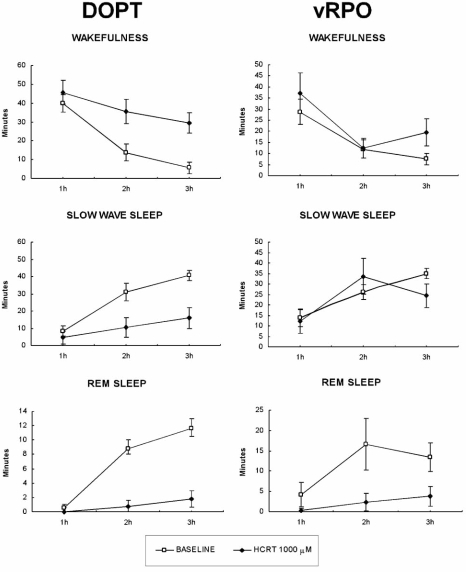
Mean time spent ± SEM of the sleep-wakefulness cycle states by animals with Hcrt-1 microinjections in either the dorsal oral pontine tegmentum (DOPT) or the ventral oral pontine tegmentum (vRPO) in each of the first 3 h of polygraphic recordings in baseline and after Hcrt-1 1000 mM dose experiments. *Statistically significant difference in comparison with baseline. Post hoc analyses (Fisher's test, P < 0.05).

References

    1. Abrahamson EE, Leak RK, Moore RY. The suprachiasmatic nucleus projects to posterior hypothalamic arousal systems. Neuroreport. 2001;12:435–440. - PubMed
    1. Alam MN, Gong H, Alam T, Jaganath R, McGinty D, Szy-musiak R. Sleep-waking discharge patterns of neurons recorded in the rat perifornical lateral hypothalamic area. J. Physiol. (London) 2002;538:619–631. - PMC - PubMed
    1. Bassetti C, Aldrich MS. Narcolepsy. Neurol. Clin. 1996;14:545–571. - PubMed
    1. Bayer L, Eggermann E, Saint-Mleux B, Machard D, Jones BE, Mühlethaler M, Serafin M. Selective action of orexin (hypocretin) on nonspecific thalamocortical projection neurons. J. Neurosci. 2002;22:7835–7839. - PMC - PubMed
    1. Bayer L, Serafin M, Eggermann E, Saint-Mleux B, Machard D, Jones BE, Mühlethaler M. Exclusive postsynaptic action of hypocretin-orexin on sublayer 6b cortical neurons. J. Neurosci. 2004;24:6760–6764. - PMC - PubMed

LinkOut - more resources