


Signal transducer and activator of transcription-3, inflammation, and cancer: how intimate is the relationship?
- PMID: 19723038
- PMCID: PMC3141289
- DOI: 10.1111/j.1749-6632.2009.04911.x
Signal transducer and activator of transcription-3, inflammation, and cancer: how intimate is the relationship?
Abstract
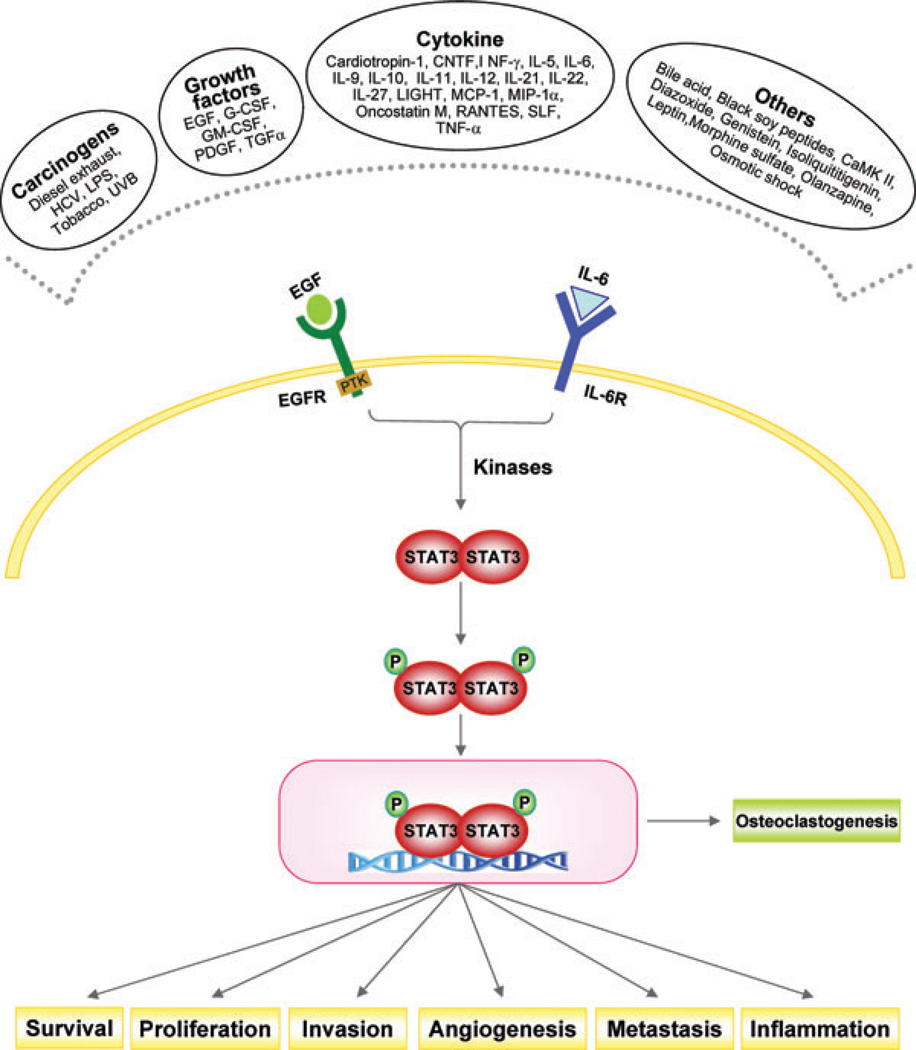
Signal transducer and activator of transcription-3 (STAT-3) is one of six members of a family of transcription factors. It was discovered almost 15 years ago as an acute-phase response factor. This factor has now been associated with inflammation, cellular transformation, survival, proliferation, invasion, angiogenesis, and metastasis of cancer. Various types of carcinogens, radiation, viruses, growth factors, oncogenes, and inflammatory cytokines have been found to activate STAT-3. STAT-3 is constitutively active in most tumor cells but not in normal cells. Phosphorylation of STAT-3 at tyrosine 705 leads to its dimerization, nuclear translocation, DNA binding, and gene transcription. The phosphorylation of STAT-3 at serine 727 may regulate its activity negatively or positively. STAT-3 regulates the expression of genes that mediate survival (survivin, bcl-xl, mcl-1, cellular FLICE-like inhibitory protein), proliferation (c-fos, c-myc, cyclin D1), invasion (matrix metalloproteinase-2), and angiogenesis (vascular endothelial growth factor). STAT-3 activation has also been associated with both chemoresistance and radioresistance. STAT-3 mediates these effects through its collaboration with various other transcription factors, including nuclear factor-kappaB, hypoxia-inducible factor-1, and peroxisome proliferator activated receptor-gamma. Because of its critical role in tumorigenesis, inhibitors of this factor's activation are being sought for both prevention and therapy of cancer. This has led to identification of small peptides, oligonucleotides, and small molecules as potential STAT-3 inhibitors. Several of these small molecules are chemopreventive agents derived from plants. This review discusses the intimate relationship between STAT-3, inflammation, and cancer in more detail.
Conflict of interest statement
The authors declare no conflicts of interest.
Figures
References
-
- Akira S, et al. Molecular cloning of APRF, a novel IFN-stimulated gene factor 3 p91-related transcription factor involved in the gp130-mediated signaling pathway. Cell. 1994;77:63–71. - PubMed
-
- Zhong Z, Wen Z, Darnell JE., Jr Stat3: a STAT family member activated by tyrosine phosphorylation in response to epidermal growth factor and interleukin-6. Science. 1994;264:95–98. - PubMed
-
- Yu CL, et al. Enhanced DNA-binding activity of a Stat3-related protein in cells transformed by the Src oncoprotein. Science. 1995;269:81–83. - PubMed
Publication types
MeSH terms
Substances
Grants and funding
LinkOut - more resources
Full Text Sources
Other Literature Sources
Molecular Biology Databases
Research Materials
Miscellaneous
