Composite outcomes of chronically critically ill patients 4 months after hospital discharge
- PMID: 19723866
- PMCID: PMC2882850
- DOI: 10.4037/ajcc2009580
Composite outcomes of chronically critically ill patients 4 months after hospital discharge
Abstract
Background: Data on likely postdischarge outcomes are important for decision making about chronically critically ill patients. It seems reasonable to categorize outcomes into "better" or overall desirable states and "worse" or generally undesirable states. Survival, being at home, and being cognitively intact are commonly identified as important to quality of life and thus may be combined to describe composite outcome states.
Objective: To categorize postdischarge outcome states of chronically critically ill patients and identify predictors of better and worse states.
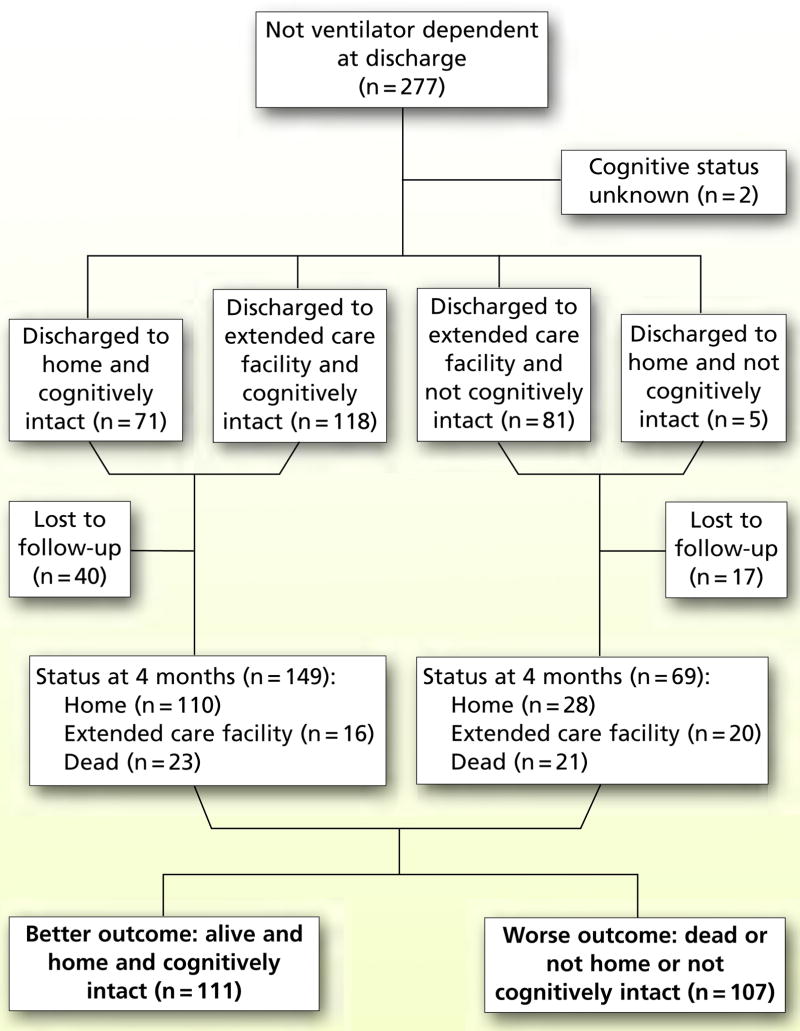
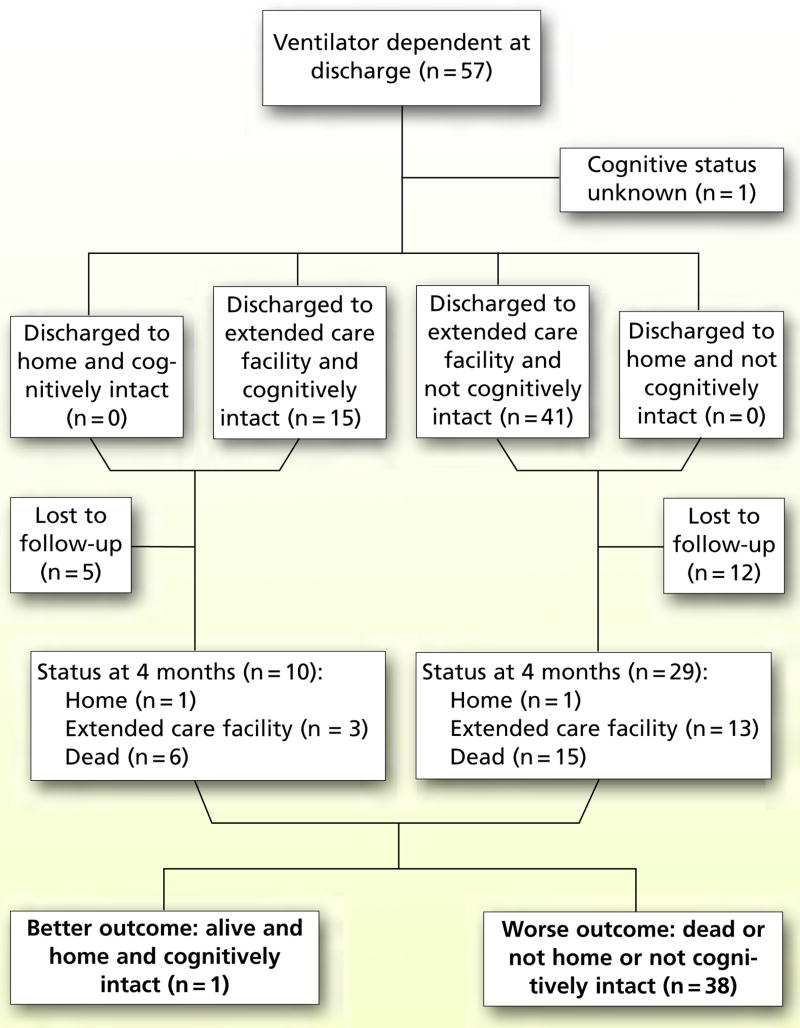
Methods: Reanalysis of data from a trial of a disease management program for chronically critically ill patients. Two composite outcomes were created: (1) the "better" outcome: no cognitive impairment at 2 months after discharge and alive and at home at 4 months (ie, met all 3 criteria), and (2) the "worse" outcome: cognitive impairment 2 months after discharge, or death after discharge, or not living at home 4 months after discharge (ie, met at least 1 of these criteria).
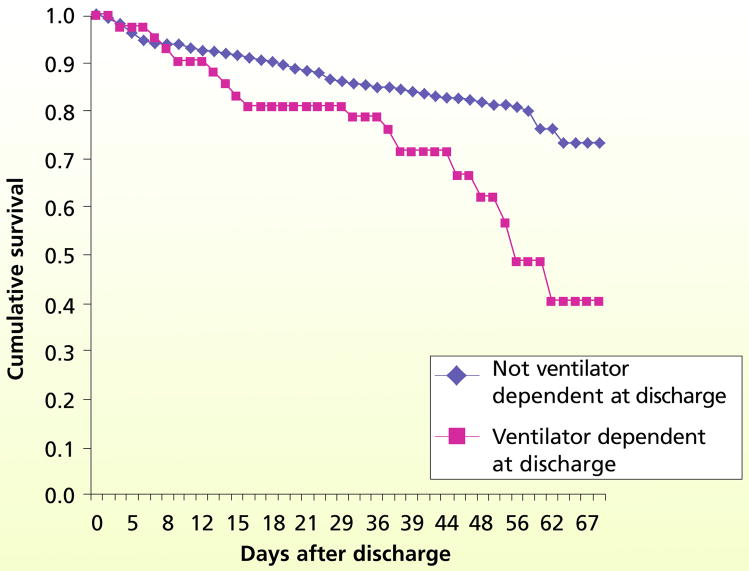
Results: Of 218 patients not requiring ventilatory support at discharge, 111 (50.9%) had a better outcome. Of 159 patients who were cognitively intact at discharge, 111 (69.8%) had a better outcome. Of the 39 patients who required ventilatory support at discharge, only 1 (3%) achieved the better outcome. Of 98 patients who were cognitively impaired at discharge, only 29 (30%) had the better outcome.
Conclusion: Need for mechanical ventilatory support and persistent cognitive impairment at discharge were associated with worse outcomes 4 months after discharge.
Figures
References
-
- Girard K, Raffin TA. The chronically critically ill: To save or let die? Resp Care. 1985;30(5):339–347. - PubMed
-
- Douglas SL, Daly BJ, Gordon N, Brennan PF. Survival and quality of life: short-term versus long-term ventilator patients. Crit Care Med. 2002;30:2655–2662. - PubMed
-
- Daly BJ, Douglas SL, Kelley CG, O’Toole E, Montenegro H. Trial of a disease management program to reduce hospital readmissions of the chronically critically ill. Chest. 2005;128:507–517. - PubMed
-
- MacIntyre NR, Epstein SK, Carson S, et al. Management of patients requiring prolonged mechanical ventilation: report of a NAMDRC consensus conference. Chest. 2005;128:3937–3954. - PubMed
-
- Im K, Belle SH, Schultz R, Mendelsohn AB, Chelluri L QOL-MV Investigators. Prevalence and outcomes of caregiving after prolonged (>48 hours) mechanical ventilation in the ICU. Chest. 2004;125:597–606. - PubMed
MeSH terms
Grants and funding
LinkOut - more resources
Full Text Sources
Miscellaneous