. 2009 Dec;29(6):41-55 quiz 1 p following 55.
doi: 10.4037/ccn2009612.
Epub 2009 Sep 1.
Patient-ventilator dyssynchrony: clinical significance and implications for practice
Affiliations
- PMID: 19724065
- PMCID: PMC3742330
- DOI: 10.4037/ccn2009612
Item in Clipboard
Patient-ventilator dyssynchrony: clinical significance and implications for practice
Crit Care Nurse.
2009 Dec.
No abstract available
Figures
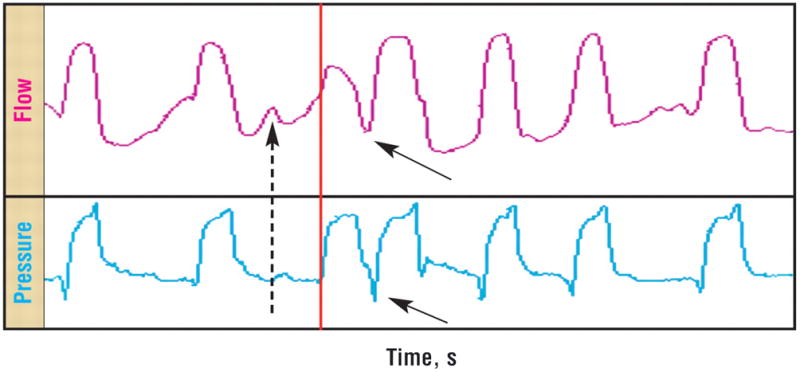
Trigger dyssynchrony, double trigger. Display of flow (top) and pressure (bottom) vs time. Note the start of the third successfully triggered breath (red line). In this breath cycle, patient effort initiates a second breath (solid arrows), represented by a quick decrease in pressure at the trigger threshold, such that flow increases. In addition, an ineffective missed effort (dashed arrow) just before the double trigger is demonstrated by an increase in flow and a decrease in pressure.
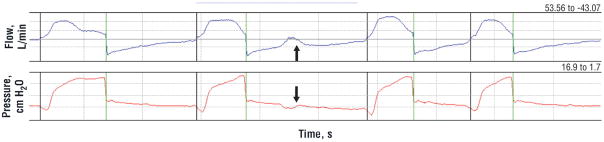
Trigger dyssynchrony, ineffective effort. Display of flow (top) and pressure (bottom) vs time. An ineffective effort, or failure to trigger dyssynchrony event, is noted at the arrow. Note the negative deflection of the pressure waveform and the transient positive flow deflection after the second breath.
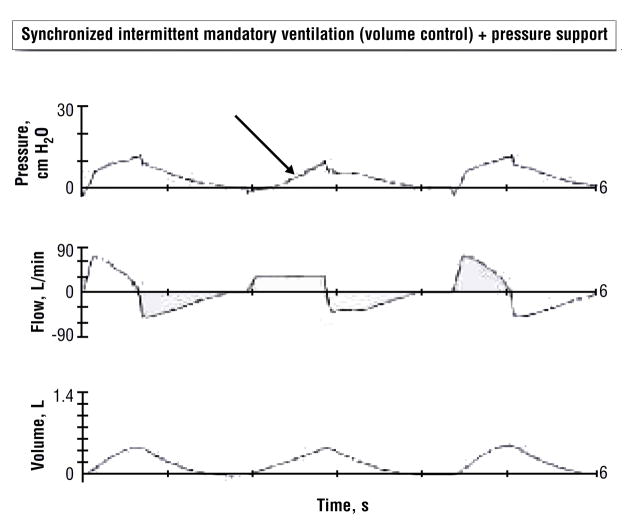
Flow dyssynchrony. Display of pressure (top), flow (middle), and volume (bottom) vs time. During second breath, the ventilator square-wave flow is not adequate (pressure trace is dished out). Figure courtesy of Jon Nilsestuen, PhD, RRT, University of Texas Medical Branch, School of Allied Health, Galveston.
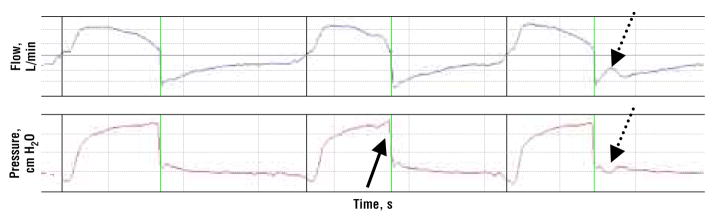
Termination dyssynchrony. Display of flow (top) and pressure (bottom) versus time reveals an example of “delayed termination dyssynchrony” (solid arrow) as the patient attempts exhalation before completion of the inspiratory breath, and “premature termination dyssynchrony” (dotted arrows) as the patient makes an inspiratory effort early in the expiratory phase.
References
-
- Cheng EY. The cost of sedating and paralyzing the critically ill patient. Crit Care Clin. 1995;11(4):1005–1019. - PubMed
-
- Burns SM, Earven S, Fisher C, et al. Implementation of an institutional program to improve clinical and financial outcomes of mechanically ventilated patients: one-year outcomes and lessons learned. Crit Care Med. 2003;31(12):2752–2763. - PubMed
-
- Tobin MJ. Advances in mechanical ventilation. N Engl J Med. 2001;344(26):1986–1996. - PubMed
-
- Tobin MJ, Laghi F, Jubran A. Respiratory muscle dysfunction in mechanically ventilated patients. Mol Cell Biochem. 1998;179(1–2):87–98. - PubMed
-
- Sessler CN. Comfort and distress in the ICU: scope of the problem. Sem Respir Crit Care Med. 2001;22(2):111–114. - PubMed
Publication types
MeSH terms
Grants and funding
LinkOut - more resources
Full Text Sources
Other Literature Sources