


doi: 10.1186/1897-4287-5-4-183.
A short guide to hereditary diffuse gastric cancer
Affiliations
- PMID: 19725995
- PMCID: PMC2736978
- DOI: 10.1186/1897-4287-5-4-183
Item in Clipboard
A short guide to hereditary diffuse gastric cancer
Hered Cancer Clin Pract.
.
Abstract
Hereditary diffuse gastric cancer (HDGC) is the only known predisposition syndrome dominated by carcinoma of the stomach and with a recognised genetic cause. Germline mutations in the E-cadherin gene (CDH1) co-segregate with the disease in about half of the families with multiple diffuse gastric cancer. In these families, identification of the CDH1 mutation allows for clinical measures to be taken. Importantly, clinical intervention is likely to be therapeutic and associated with tolerable morbidity. This review is thus aimed at providing a current overview of the clinical management and the underlying biology of HDGC.
Figures
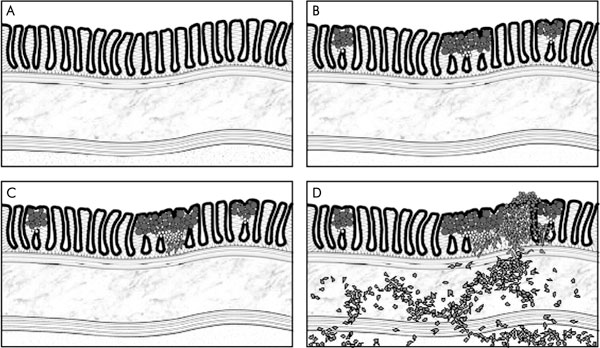
Early tumour stages in HDGC: A – normal gastric body mucosa; B – the first apparent disease stage in HDGC is multiple, minute foci of SRCC confined to the gastric mucosa (stage T1a). SRCs are the predominant cell type in these tumours, are typically located in the superficial mucosa underneath an intact surface epithelium and are mitotically inactive. Less differentiated and proliferating cancer cells are found in small numbers deep to the SRCs and are physically close to the gastric neck region; C – larger foci can acquire an increased amount of poorly differentiated cancer cells. These cells often have a fibroblastoid appearance consistent with an induction of an epithelial-mesenchymal transition; D – invasion through the muscularis mucosae and muscularis propria involves poorly and de-differentiated cancer cells. While the proliferative activity of stage T1a cancers is very low, more advanced cancers (≥ T1b) have a markedly increased proliferation rate.
References
-
- Kaurah P, MacMillan A, Boyd N, Senz J, De Luca A, Chun N, Suriano G, Zaor S, Van Manen L, Gilpin C, Nikkel S, Connolly-Wilson M, Weissman S, Rubinstein WS, Sebold C, Greenstein R, Stroop J, Yim D, Panzini B, McKinnon W, Greenblatt M, Wirtzfeld D, Fontaine D, Coit D, Yoon S, Chung D, Lauwers G, Pizzuti A, Vaccaro C, Redal MA, Oliveira C, Tischkowitz M, Olschwang S, Gallinger S, Lynch H, Green J, Ford J, Pharoah P, Fernandez B, Huntsman D. Founder and recurrent CDH1 mutations in families with hereditary diffuse gastric cancer. JAMA. 2007;297:2360–2372. doi: 10.1001/jama.297.21.2360. - DOI - PubMed
-
- Oliveira C, Bordin MC, Grehan N, Huntsman D, Suriano G, Machado JC, Kiviluoto T, Aaltonen L, Jackson CE, Seruca R, Caldas C. Screening E-cadherin in gastric cancer families reveals germline mutations only in hereditary diffuse gastric cancer kindred. Hum Mutat. 2002;19:510–517. doi: 10.1002/humu.10068. - DOI - PubMed
-
- More H, Humar B, Weber W, Ward R, Christian A, Lintott C, Graziano F, Ruzzo AM, Acosta E, Boman B, Harlan M, Ferreira P, Seruca R, Suriano G, Guilford P. Identification of seven novel germline mutations in the human E-cadherin (CDH1) gene. Hum Mutat. 2007;28:203. doi: 10.1002/humu.9473. - DOI - PubMed
LinkOut - more resources
Full Text Sources
Miscellaneous