


Varying uses of anticonvulsant medications
- PMID: 19727282
- PMCID: PMC2695747
Varying uses of anticonvulsant medications
Abstract
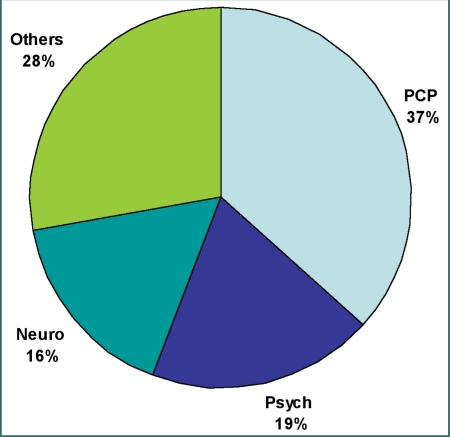
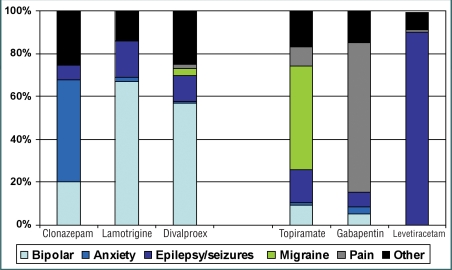
In this article, we identify commonly prescribed anticonvulsant medications and characterize central nervous system (CNS) reasons for use. Primary care physicians prescribe 37 percent of all anticonvulsant medications in the US. Psychiatrists are the second highest prescribers with a 19-percent share, and neurologists account for 16 percent of all anticonvulsant medication prescriptions. The top three agents prescribed by psychiatrists are clonazepam, lamotrigine, and divalproex; neurologists most commonly prescribe topiramate, gabapentin, and levetiracetam. Anticonvulsant medications most commonly prescribed by psychiatrists are primarily used for bipolar disorder and anxiety. In contrast, these indications account for less than 10 percent of uses for the top products commonly prescribed by neurologists.
Keywords: anticonvulsant medication; anxiety; bipolar disorder; carbamazepine; clonazepam; divalproex; epilepsy; gabapentin; lamotrigine; levetiracetam; migraine; pain; seizure medication; topiramate.
Figures
References
-
- Weisler RH, Cutler AJ, Ballenger JCet al. The use of antiepileptic drugs in bipolar disorders: a review based on evidence from controlled trials. CNS Spectr. 200211(10)788–799Review. - PubMed
-
- Rosenberg JM, Salzman C.Update: new uses for lithium and anticonvulsants. CNS Spectr. 200712(11)831–841Comment in: CNS Spectr. 2008;13(2):109–110; author reply 110. - PubMed
-
- Zwanzger P, Eser D, Rupprecht R.[Anticonvulsants in the treatment of anxiety— an alternative treatment option?] Nervenarzt. 200778(11)1274–1282 - PubMed
-
- Van Ameringen M, Mancini C, Pipe B, Bennett M.Antiepileptic drugs in the treatment of anxiety disorders: role in therapy. Drugs. 200464(19)2199–2220 - PubMed
-
- Nardi AE, Perna G.Clonazepam in the treatment of psychiatric disorders: an update. Int Clin Psychopharmacol. 200621(3)131–142 - PubMed
LinkOut - more resources
Full Text Sources