Outcomes and costs of primary care surveillance and intervention for overweight or obese children: the LEAP 2 randomised controlled trial
- PMID: 19729418
- PMCID: PMC2737607
- DOI: 10.1136/bmj.b3308
Outcomes and costs of primary care surveillance and intervention for overweight or obese children: the LEAP 2 randomised controlled trial
Abstract
Objective: To determine whether ascertainment of childhood obesity by surveillance followed by structured secondary prevention in primary care improved outcomes in overweight or mildly obese children.
Design: Randomised controlled trial nested within a baseline cross sectional survey of body mass index (BMI). Randomisation and outcomes measurement, but not participants, were blinded to group assignment.
Setting: 45 family practices (66 general practitioners) in Melbourne, Australia.
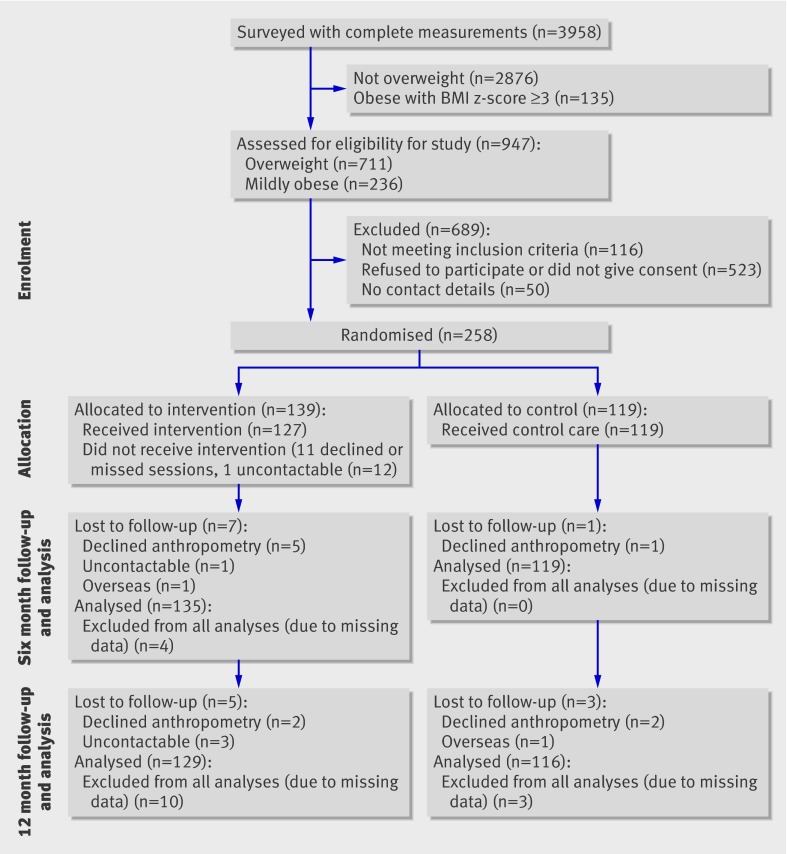
Participants: 3958 children visiting their general practitioner in May 2005-July 2006 were surveyed for BMI. Of these, 258 children aged 5 years 0 months up to their 10th birthday who were overweight or obese by International Obesity Taskforce criteria were randomised to intervention (n=139) or control (n=119) groups. Children who were very obese (UK BMI z score >or=3.0) were excluded.
Intervention: Four standard consultations over 12 weeks targeting change in nutrition, physical activity, and sedentary behaviour, supported by purpose designed family materials. Main outcomes measures Primary measure was BMI at 6 and 12 months after randomisation. Secondary measures were mean activity count/min by 7-day accelerometry, nutrition score from 4-day abbreviated food frequency diary, and child health related quality of life. Differences were adjusted for socioeconomic status, age, sex, and baseline BMI.
Results: Of 781 eligible children, 258 (33%) entered the trial; attrition was 3.1% at 6 months and 6.2% at 12 months. Adjusted mean differences (intervention - control) at 6 and 12 months were, for BMI, -0.12 (95% CI -0.40 to 0.15, P=0.4) and -0.11 (-0.45 to 0.22, P=0.5); for physical activity in counts/min, 24 (-4 to 52, P=0.09) and 11 (-26 to 49, P=0.6); and, for nutrition score, 0.2 (-0.03 to 0.4, P=0.1) and 0.1 (-0.1 to 0.4, P=0.2). There was no evidence of harm to the child. Costs to the healthcare system were significantly higher in the intervention arm.
Conclusions: Primary care screening followed by brief counselling did not improve BMI, physical activity, or nutrition in overweight or mildly obese 5-10 year olds, and it would be very costly if universally implemented. These findings are at odds with national policies in countries including the US, UK, and Australia.
Trial registration: ISRCTN 52511065 (www.isrctn.org).
Conflict of interest statement
Competing interests: None declared.
Comment in
-
Primary care screening and brief counselling for overweight or mildly obese children does not improve BMI, nutrition or physical activity.Evid Based Med. 2010 Feb;15(1):23-4. doi: 10.1136/ebm.15.1.23. Evid Based Med. 2010. PMID: 20176880 No abstract available.
-
Primary care screening and brief counselling for overweight or mildly obese children does not improve BMI, nutrition or physical activity.Evid Based Nurs. 2010 Feb;13(1):8-9. doi: 10.1136/ebn1006. Evid Based Nurs. 2010. PMID: 20179052 No abstract available.
References
-
- Wang Y, Lobstein T. Worldwide trends in childhood overweight and obesity. Int J Pediatr Obes 2006;1:11-25. - PubMed
-
- Lobstein T, Baur L, Uauy R, for IASO International Obesity Taskforce. Obesity in children and young people: a crisis in public health. Obes Rev 2004;5:4-85. - PubMed
-
- Gortmaker SL, Must A, Perrin MJ, Sobol AM, Dietz WH. Social and economic consequences of overweight in adolescence and young adulthood. N Engl J Med 1993;329:1008-12. - PubMed
-
- Ebbeling CB, Pawlak DB, Ludwig DS. Childhood obesity: public-health crisis, common sense cure. Lancet 2002;360:473-82. - PubMed
-
- Gerner B, McCallum Z, Sheehan J, Harris C, Wake M. Are general practitioners equipped to detect child overweight/obesity? Survey and audit. J Paediatr Child Health 2006;42:206-11. - PubMed
Publication types
MeSH terms
Associated data
LinkOut - more resources
Full Text Sources