


The Hedgehog transcription factor Gli3 modulates angiogenesis
- PMID: 19729595
- PMCID: PMC3175353
- DOI: 10.1161/CIRCRESAHA.109.206706
The Hedgehog transcription factor Gli3 modulates angiogenesis
Abstract
Rationale: The Gli transcription factors are mediators of Hedgehog (Hh) signaling and have been shown to play critical roles during embryogenesis. Previously, we have demonstrated that the Hh pathway is reactivated by ischemia in adult mammals, and that this pathway can be stimulated for therapeutic benefit; however, the specific roles of the Gli transcription factors during ischemia-induced Hh signaling have not been elucidated.
Objective: To investigate the role of Gli3 in ischemic tissue repair.
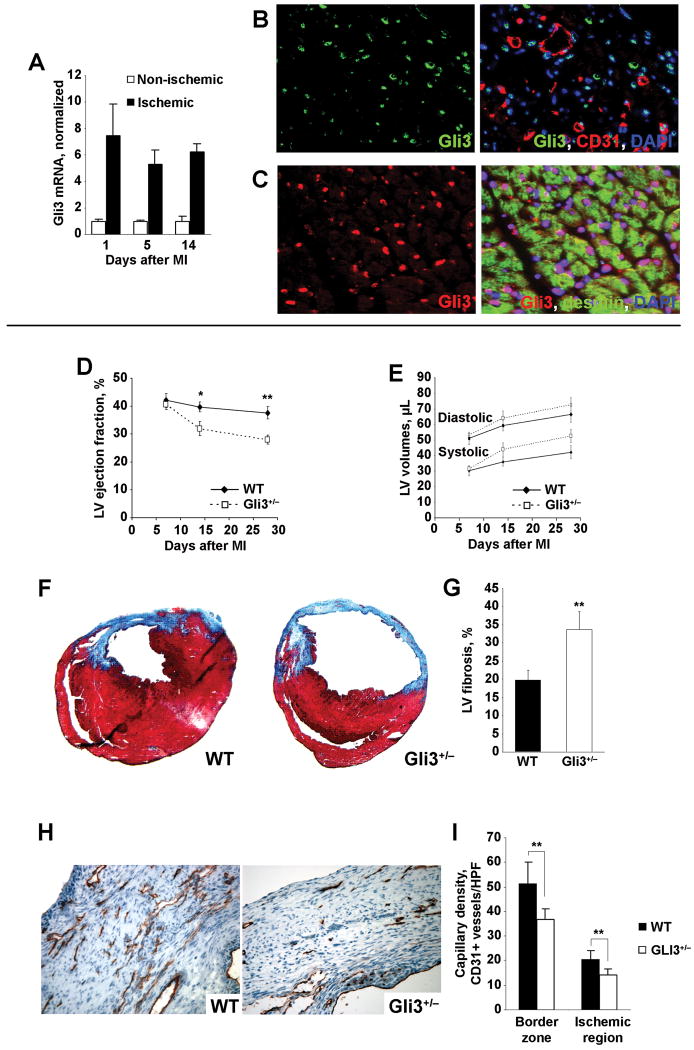
Methods and results: Gli3-haploinsufficient (Gli3(+/-)) mice and their wild-type littermates were physiologically similar in the absence of ischemia; however, histological assessments of capillary density and echocardiographic measurements of left ventricular ejection fractions were reduced in Gli3(+/-) mice compared to wild-type mice after surgically induced myocardial infarction, and fibrosis was increased. Gli3-deficient mice also displayed reduced capillary density after induction of hindlimb ischemia and an impaired angiogenic response to vascular endothelial growth factor in the corneal angiogenesis model. In endothelial cells, adenovirus-mediated overexpression of Gli3 promoted migration (modified Boyden chamber), small interfering RNA-mediated downregulation of Gli3 delayed tube formation (Matrigel), and Western analyses identified increases in Akt phosphorylation, extracellular signal-regulated kinase (ERK)1/2 activation, and c-Fos expression; however, promoter-reporter assays indicated that Gli3 overexpression does not modulate Gli-dependent transcription. Furthermore, the induction of endothelial cell migration by Gli3 was dependent on Akt and ERK1/2 activation.
Conclusions: Collectively, these observations indicate that Gli3 contributes to vessel growth under both ischemic and nonischemic conditions and provide the first evidence that Gli3 regulates angiogenesis and endothelial cell activity in adult mammals.
Conflict of interest statement
Figures


References
-
- Sasaki H, Nishizaki Y, Hui C, Nakafuku M, Kondoh H. Regulation of Gli2 and Gli3 activities by an amino-terminal repression domain: implication of Gli2 and Gli3 as primary mediators of Shh signaling. Development. 1999;126:3915–3924. - PubMed
-
- Hui CC, Slusarski D, Platt KA, Holmgren R, Joyner AL. Expression of three mouse homologs of the Drosophila segment polarity gene cubitus interruptus, Gli, Gli-2, and Gli-3, in ectoderm- and mesoderm-derived tissues suggests multiple roles during postimplantation development. Dev Biol. 1994;162:402–413. - PubMed
-
- Walterhouse D, Ahmed M, Slusarski D, Kalamaras J, Boucher D, Holmgren R, Iannaccone P. gli, a zinc finger transcription factor and oncogene, is expressed during normal mouse development. Dev Dyn. 1993;196:91–102. - PubMed
-
- Litingtung Y, Chiang C. Specification of ventral neuron types is mediated by an antagonistic interaction between Shh and Gli3. Nat Neurosci. 2000;3:979–985. - PubMed
-
- Rallu M, Machold R, Gaiano N, Corbin JG, McMahon AP, Fishell G. Dorsoventral patterning is established in the telencephalon of mutants lacking both Gli3 and Hedgehog signaling. Development. 2002;129:4963–4974. - PubMed
Publication types
MeSH terms
Substances
Grants and funding
LinkOut - more resources
Full Text Sources
Other Literature Sources
Medical
Molecular Biology Databases
Miscellaneous
