


Regulation of histone acetylation in the nucleus by sphingosine-1-phosphate
- PMID: 19729656
- PMCID: PMC2850596
- DOI: 10.1126/science.1176709
Regulation of histone acetylation in the nucleus by sphingosine-1-phosphate
Erratum in
- Science. 2009 Oct 16;326(5951):366
Abstract
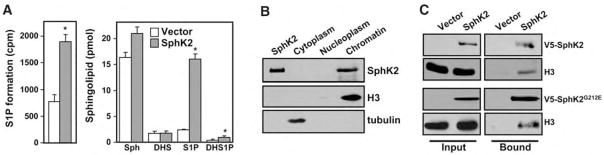
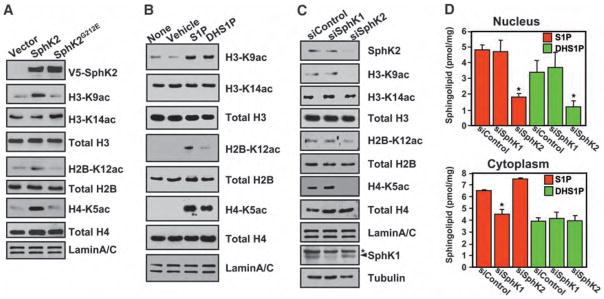
The pleiotropic lipid mediator sphingosine-1-phosphate (S1P) can act intracellularly independently of its cell surface receptors through unknown mechanisms. Sphingosine kinase 2 (SphK2), one of the isoenzymes that generates S1P, was associated with histone H3 and produced S1P that regulated histone acetylation. S1P specifically bound to the histone deacetylases HDAC1 and HDAC2 and inhibited their enzymatic activity, preventing the removal of acetyl groups from lysine residues within histone tails. SphK2 associated with HDAC1 and HDAC2 in repressor complexes and was selectively enriched at the promoters of the genes encoding the cyclin-dependent kinase inhibitor p21 or the transcriptional regulator c-fos, where it enhanced local histone H3 acetylation and transcription. Thus, HDACs are direct intracellular targets of S1P and link nuclear S1P to epigenetic regulation of gene expression.
Figures


References
-
- Irvine RF. Nat Rev Mol Cell Biol. 2003;4:349. - PubMed
-
- Cocco L, Maraldi NM, Manzoli FA, Gilmour RS, Lang A. Biochem Biophys Res Commun. 1980;96:890. - PubMed
-
- Albi E, Lazzarini R, Viola Magni M. Biochem J. 2008;410:381. - PubMed
-
- Spiegel S, Milstien S. Nat Rev Mol Cell Biol. 2003;4:397. - PubMed
-
- Chun J, Rosen H. Curr Pharm Des. 2006;12:161. - PubMed
Publication types
MeSH terms
Substances
Grants and funding
LinkOut - more resources
Full Text Sources
Other Literature Sources
Molecular Biology Databases
Miscellaneous
