. 2009 Dec 1;180(11):1042-7.
doi: 10.1164/rccm.200905-0665OC. Epub 2009 Sep 3.

TRPA1 agonists evoke coughing in guinea pig and human volunteers

Affiliations

TRPA1 agonists evoke coughing in guinea pig and human volunteers

Mark A Birrell et al. Am J Respir Crit Care Med. .

Abstract

Rationale: Cough is the most frequent reason for consultation with a family doctor, or with a general or respiratory physician. Treatment options are limited and one meta-analysis concluded that over-the-counter remedies are ineffective. There is also increasing concern about their use in children. Environmental irritants such as air pollution and cigarette smoke are thought to evoke cough by stimulating airway sensory nerves; however, how this occurs is not fully understood.

Objectives: We hypothesized that the TRPA1 (transient receptor potential cation channel, subfamily A, member 1) receptor may have a role as a novel target for tussive agents given that many potential irritants have been shown to activate this channel.

Methods: We investigated the effect of TRPA1 ligands on vagal sensory nerve activity in vitro and in guinea pig and human tussive challenge models.

Measurements and main results: We demonstrated that TRPA1 agonists such as acrolein activate cloned human TRPA1 channels in HEK293 cells and also vagal sensory nerves in murine, guinea pig, and human tissues. A role for TRPA1 was confirmed, using specific inhibitors and tissue from Trpa1(-/-) gene-deleted animals. Finally, TRPA1 ligands evoked reproducible tussive responses in both a guinea pig model and normal volunteers.

Conclusions: This study identifies the TRPA1 receptor as a promiscuous receptor, activated by a wide range of stimuli, making it a perfect target for triggering cough and as such one of the most promising targets currently identified for the development of antitussive drugs.


Figures
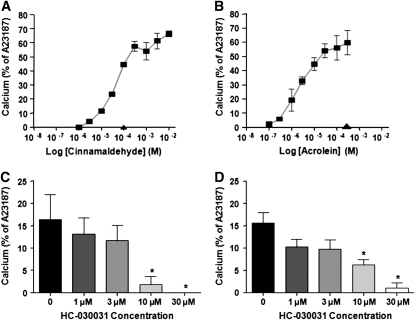
Figure 1.
Figure 1.
Calcium signaling was used to assess agonist induced activation of TRPA1-HEK cells and agonist-induced activation of TRPA1-HEK cells after preincubation with the antagonist HC-030031. (A) Cinnamaldehyde concentration–response curve (squares) in hTRPA1-HEK cells. hTRPV1-HEK cells failed to respond to 100 μM cinnamaldehyde (triangle). (B) Acrolein concentration–response curve (squares) in hTRPA1-HEK cells. hTRPV1-HEK cells failed to respond to 300 μM acrolein (triangle). (C) Effect of increasing HC-030031 concentrations on cinnamaldehyde (30 μM)-evoked calcium responses. (D) Effect of increasing HC-030031 concentrations on acrolein (3 μM)-evoked calcium responses. Results are expressed as means ± SEM of up to seven experiments, each performed in duplicate. *Statistical significance (P < 0.05) from vehicle-treated group.
Figure 2.
Figure 2.
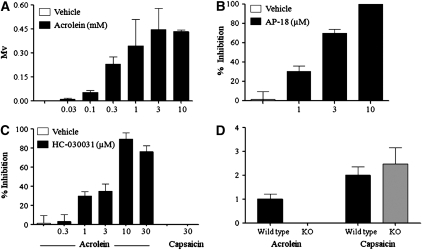
(A) Characterization of the depolarization (mV) responses elicited by isolated guinea pig vagus nerve preparations in response to the TRPA1 agonist acrolein. (B and C) Effect of TRPA1 channel blockers (AP-18, 1–10 μM; and HC-030031, 0.3–30 μM) on acrolein (300 μM)- or capsaicin (1 μM)-induced depolarization of isolated guinea pig vagus nerve preparations. Values are presented as means ± SEM of the percentage inhibition of depolarization before and after drug superfusion (n = 4). (D) Depolarization (mV) in response to TRPA1 (acrolein, 1 mM)/TRPV1 (capsaicin, 1 μM) agonists in vagal nerve tissue from wild-type and Trpa1−/− gene-deleted mice. Results are expressed as the mean ± SEM of four to six experiments. KO, knockout.
Figure 3.
Figure 3.
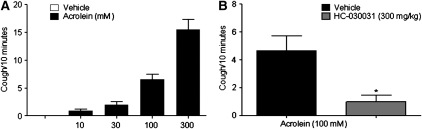
(A) Dose response to inhaled acrolein in conscious male guinea pigs (n = 12). (B) Blockade of the tussive response to acrolein with the TRPA1 ion channel blocker HC-030031 (300 mg/kg). Guinea pigs were dosed with vehicle or HC-030031 one hour before the tussive challenge (n = 12). Statistical significance was determined by Mann-Whitney U test for nonparametric data. Data are presented as means ± SEM and statistical significance is denoted as *P < 0.05.
Figure 4.
Figure 4.
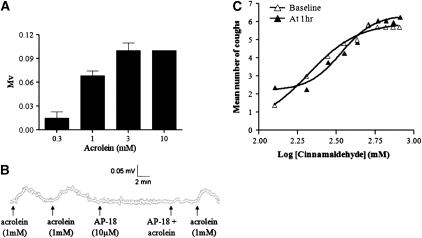
(A) Characterization of depolarization (mV) responses elicited by isolated human vagus nerve preparations in response to the TRPA1 agonist acrolein. Results are expressed as means ± SEM of three experiments. (B) A representative trace describing depolarization of isolated human vagus evoked by acrolein (1 mM) and inhibition in the presence of the TRPA1 antagonist AP-18 (10 μM). The response to acrolein is recovered after washout. (C) Concentration–response curve of cinnamaldehyde inhaled at baseline and repeated 1 hour later in human volunteers. Nebulizations were performed with the MEFAR MB3 dosimeter with a Respironics nebulizer chamber and mouthpiece. The dosimeter was set to nebulize for 1 second and 2 ml of the agent was instilled into the nebulizer chamber. Coughs induced were assessed during the subsequent 15 seconds after the nebulization.

References

    1. McCormick A, Fleming DM, Charlton J. Office of population censuses and surveys. In: Morbidity statistics from general practice, fourth national study 1991–1992. Series MB5 no 3. London: HMSO; 1995.
    1. Irwin RS, Corrao WM, Pratter MR. Chronic persistent cough in the adult: the spectrum and frequency of causes and successful outcome of specific therapy. Am Rev Respir Dis 1981;123:413–417. - PubMed
    1. Ford AC, Forman D, Moayyedi P, Morice AH. Cough in the community: a cross sectional survey and the relationship to gastrointestinal symptoms. Thorax 2006;61:975–979. - PMC - PubMed
    1. Schroeder K, Fahey T. Systematic review of randomised controlled trials of over the counter cough medicines for acute cough in adults. BMJ 2002;324:329–331. - PMC - PubMed
    1. Laude EA, Higgins KS, Morice AH. A comparative study of the effects of citric acid, capsaicin and resiniferatoxin on the cough challenge in guinea-pig and man. Pulm Pharmacol 1993;6:171–175. - PubMed

Publication types