Review
. 2009 Sep;119(9):2455-63.
doi: 10.1172/JCI38095.

A decade of molecular pathogenomic analysis of group A Streptococcus

Affiliations
Review

A decade of molecular pathogenomic analysis of group A Streptococcus

James M Musser et al. J Clin Invest. 2009 Sep.

Abstract

Molecular pathogenomic analysis of the human bacterial pathogen group A Streptococcus has been conducted for a decade. Much has been learned as a consequence of the confluence of low-cost DNA sequencing, microarray technology, high-throughput proteomics, and enhanced bioinformatics. These technical advances, coupled with the availability of unique bacterial strain collections, have facilitated a systems biology investigative strategy designed to enhance and accelerate our understanding of disease processes. Here, we provide examples of the progress made by exploiting an integrated genome-wide research platform to gain new insight into molecular pathogenesis. The studies have provided many new avenues for basic and translational research.


Figures
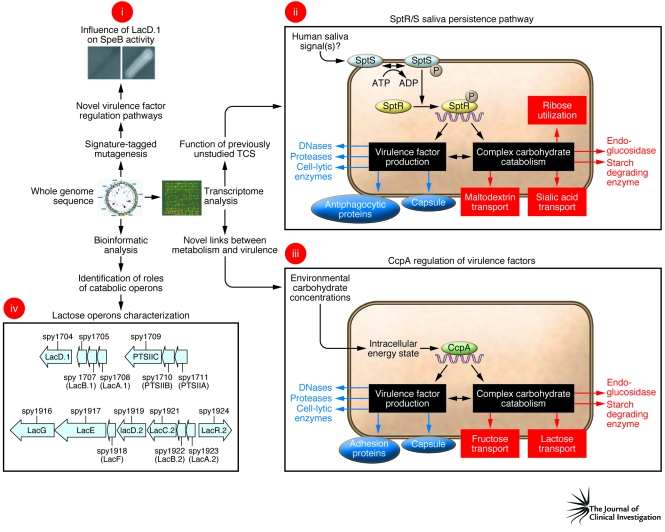
Figure 1
Figure 1. Schematic depicting how genome-wide analyses have revealed previously unsuspected links between carbohydrate metabolism and virulence.
Examples of recently discovered relationships between carbohydrate catabolism and virulence include (i) the role of LacD.1 in controlling SpeB production, (ii) identification of the SptR/S saliva persistence pathway, (iii) the discovery of regulation of virulence factors by CcpA, and (iv) the differential role in virulence factor regulation (bottom) and catabolism (top) of the 2 lactose operons. Panel i is reprinted with permission from EMBO Journal (79). Panels ii and iii are adapted from Proceedings of the National Academy of Sciences U. S. A. (ref. and ref. , respectively).
Figure 2
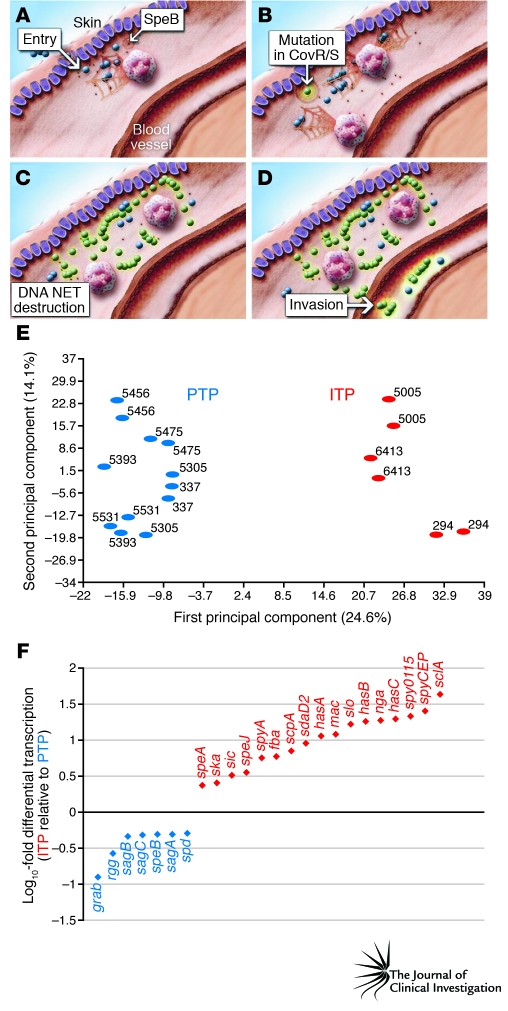
Figure 2. The role of the CovR/S TCS in the transition from mucosal to invasive disease.
(A) Upon entering subcutaneous tissue, GAS is confronted by neutrophils that produce NETs. (BD) Mutation in the CovR/S TCS (B) allows for high-level production of a GAS DNase that degrades NETs (C), thereby increasing pathogen survival and enhancing the probability of invasive infection (D). (E) Principal component analysis of expression microarray data demonstrates that mucosal (or pharyngeal) and invasive GAS isolates have strikingly different transcriptomes. (F) Examples of genes encoding critical virulence factors that are more highly expressed in invasive isolates (red) or pharyngeal isolates (blue). ITP, invasive transcriptome profile; PTP, pharyngeal transcriptome profile. AD are reprinted with permission from Nature Medicine (93). E and F are adapted from PLoS Pathogens (92).
Figure 3
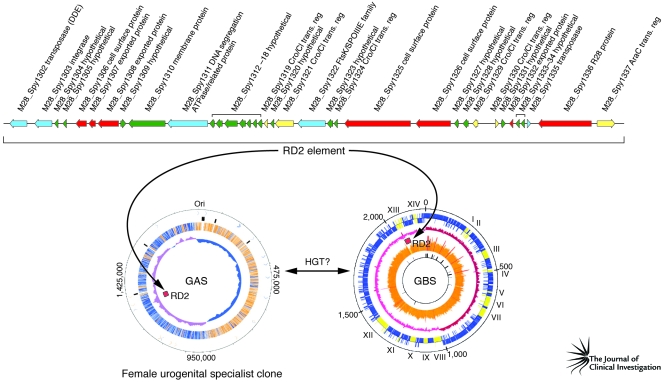
Figure 3. Molecular pathogenomic analysis reveals the contribution of a HGT event to the evolution of a female urogenital specialist GAS clone of serotype M28.
The 37-kb region of difference 2 (RD2) element is shared among GBS strains and serotype M28 GAS. An HGT event may have occurred directly between a GAS and GBS strain, or an unknown third-party donor may have participated. Adapted with permission from The Journal of Infectious Diseases (23) and Molecular Microbiology (125).

References

    1. Olsen R.J., Shelburne S.A., Musser J.M. Molecular mechanisms underlying group A streptococcal pathogenesis. Cell Microbiol. 2009;11:1–12. doi: 10.1111/j.1462-5822.2008.01225.x. - DOI - PubMed
    1. Pichichero M.E. Group A beta-hemolytic streptococcal infections. Pediatr. Rev. 1998;19:291–302. doi: 10.1542/pir.19-9-291. - DOI - PubMed
    1. Carapetis J.R., Steer A.C., Mulholland E.K., Weber M. The global burden of group A streptococcal diseases. Lancet Infect. Dis. 2005;5:685–694. doi: 10.1016/S1473-3099(05)70267-X. - DOI - PubMed
    1. Carapetis J.R., McDonald M., Wilson N.J. Acute rheumatic fever. Lancet. 2005;366:155–168. doi: 10.1016/S0140-6736(05)66874-2. - DOI - PubMed
    1. Tanz R.R., et al. Community-based surveillance in the United States of macrolide-resistant pediatric pharyngeal group A streptococci during 3 respiratory disease seasons. Clin. Infect. Dis. 2004;39:1794–1801. doi: 10.1086/426025. - DOI - PubMed

MeSH terms