


The grandmother effect: implications for studies on aging and cognition
- PMID: 19729883
- PMCID: PMC2874731
- DOI: 10.1159/000236045
The grandmother effect: implications for studies on aging and cognition
Abstract
Background: Women experience more years of vigorous life after ovulation has ceased than do females of other primate species. Is this an epiphenomenon of the greater life expectancy humans have enjoyed in the past century or so, or is long post-menopausal survival the result of an evolutionary selection process? Recent research implies the latter: Long post-menopausal survival came about through natural selection. One prominent line of thought explaining this selection process is the grandmother hypothesis.
Objective: To evaluate the implications of the hypothesis for non-human primate studies of aging and cognition.
Method: The author presents a synopsis of the hypothesis, evaluates the uniqueness of the 'grandmother effect' to humans, and discusses its implications for non-human primate models of cognitive aging.
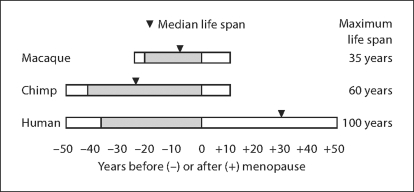
Results: The hypothesis contends that, in past epochs, women who remained vigorous beyond their fertile years may have enhanced their reproductive success by providing care for their grandchildren. This care would have enabled their daughters to resume reproduction sooner, endowing them with greater lifetime fertility. Genes of grandmothers possessing such old-age vigor would be more likely to persist in subsequent generations. Is midlife menopause a uniquely human phenomenon, or does the chimpanzee, our closest primate relative, also display this trait? If so, we might expect a grandmother effect in this species as well. However, female chimpanzees continue to cycle until near the end of their maximum life span of about 60 years.
Conclusion: Long survival beyond fertility and a long life expectancy are distinctive human adaptations. The robustness of ancestral human grandmothers necessarily included resistance to cognitive decline through preservation of functions present in many primates but also development of processes of social cognition unique to our species. Cognitive traits such as language and social cognitive functions may function in our species in particular as mechanisms to compensate for age-related decline. This has significant implications for research in which non-human primates are considered as models of human cognitive aging; it also means that some processes can be studied only in humans.
Copyright 2009 S. Karger AG, Basel.
Figures
Comment in
-
The grandmother effect and the uniqueness of the human aging phenotype.Gerontology. 2010;56(2):217-9. doi: 10.1159/000253884. Epub 2009 Oct 28. Gerontology. 2010. PMID: 19864883 Free PMC article.
-
When grandmothers matter.Gerontology. 2010;56(2):214-6. doi: 10.1159/000255170. Epub 2009 Nov 2. Gerontology. 2010. PMID: 19887768
References
-
- O'Connell J, Hawkes K, Blurton Jones NG. Grandmothering and the evolution of Homo erectus. J Hum Evol. 1999;36:461–485. - PubMed
-
- Charnov EL. Life History Invariants: Some Explorations of Symmetry in Evolutionary Ecology. Oxford: Oxford University Press; 1993.
-
- Kirkwood TBL, Rose MR. Evolution of senescence: late survival sacrificed for reproduction. Philos Trans Biol Sci. 1991;332:15–24. - PubMed
-
- Williams GC. Pleiotropy, natural selection, and the evolution of senescence. Evolution. 1957;11:398–411.
-
- Hawkes K. Grandmothers and the evolution of human longevity. Am J Hum Biol. 2003;15:380–400. - PubMed
Publication types
MeSH terms
Grants and funding
LinkOut - more resources
Full Text Sources
Medical
Miscellaneous
