. 2009 Sep;5(9):e1000634.
doi: 10.1371/journal.pgen.1000634. Epub 2009 Sep 4.

Molecular decay of the tooth gene Enamelin (ENAM) mirrors the loss of enamel in the fossil record of placental mammals

Affiliations

Molecular decay of the tooth gene Enamelin (ENAM) mirrors the loss of enamel in the fossil record of placental mammals

Robert W Meredith et al. PLoS Genet. 2009 Sep.

Abstract

Vestigial structures occur at both the anatomical and molecular levels, but studies documenting the co-occurrence of morphological degeneration in the fossil record and molecular decay in the genome are rare. Here, we use morphology, the fossil record, and phylogenetics to predict the occurrence of "molecular fossils" of the enamelin (ENAM) gene in four different orders of placental mammals (Tubulidentata, Pholidota, Cetacea, Xenarthra) with toothless and/or enamelless taxa. Our results support the "molecular fossil" hypothesis and demonstrate the occurrence of frameshift mutations and/or stop codons in all toothless and enamelless taxa. We then use a novel method based on selection intensity estimates for codons (omega) to calculate the timing of iterated enamel loss in the fossil record of aardvarks and pangolins, and further show that the molecular evolutionary history of ENAM predicts the occurrence of enamel in basal representatives of Xenarthra (sloths, anteaters, armadillos) even though frameshift mutations are ubiquitous in ENAM sequences of living xenarthrans. The molecular decay of ENAM parallels the morphological degeneration of enamel in the fossil record of placental mammals and provides manifest evidence for the predictive power of Darwin's theory.


Conflict of interest statement

The authors have declared that no competing interests exist.

Figures
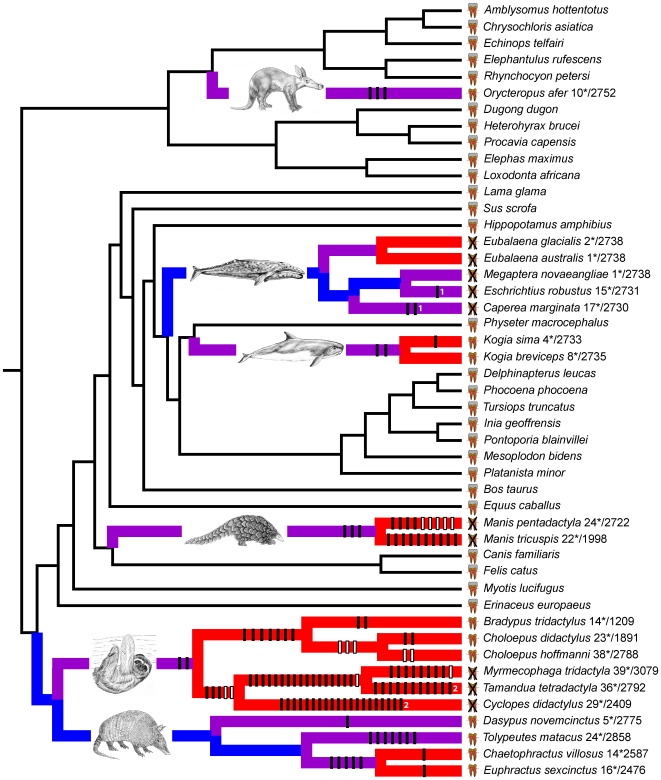
Figure 1
Figure 1. Species tree with frameshift mutations and dN/dS branch coding.
Symbols next to taxon names denote taxa having teeth with enamel, taxa having teeth without enamel, and edentulous taxa. Branches are functional (black), pre-mutation (blue), mixed (purple), and pseudogenic (red). Vertical bars on branches represent frameshift mutations (see Table S1). Frameshifts that map unambiguously onto branches are shown in black. Frameshifts shown in white are unique, but occur in regions where sequences are missing for one or more taxa (Figure S7) and were arbitrarily mapped onto the youngest possible branch. Homoplastic frameshifts (deltran optimization) are marked by numbers. Numbers after taxon names indicate the minimum number of stop codons in the sequence (before slashes) and the length of the sequence (after slashes).
Figure 2
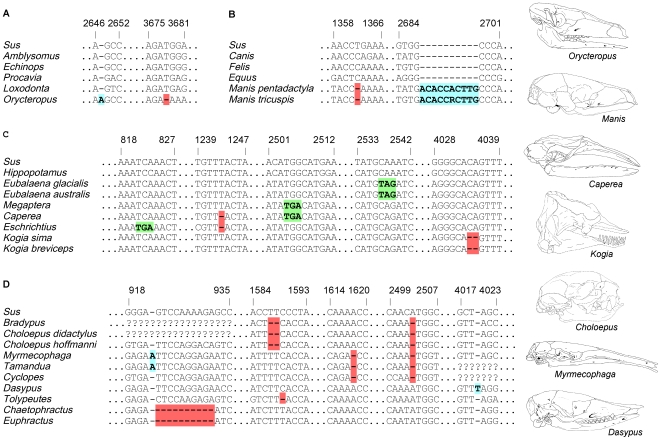
Figure 2. Examples of frameshift mutations and stop codons in edentulous and enamelless taxa.
(A) Orycteropus. (B) Manis. (C) Cetacea. (D) Xenarthra. Frameshift insertions are highlighted in blue, frameshift deletions are highlighted in red, and stop codons are highlighted in green. Also see Figure S5.
Figure 3
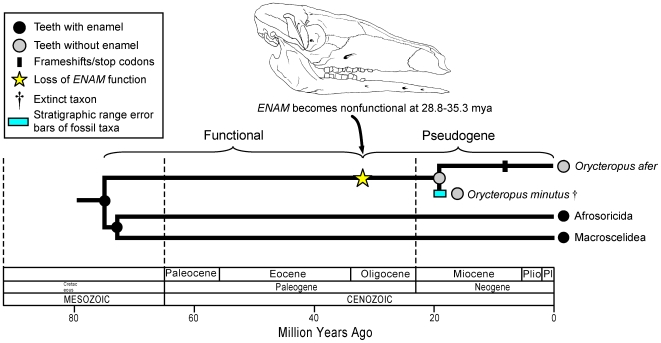
Figure 3. A synthetic interpretation of the history of enamel degeneration in Tubulidentata (aardvarks) based on fossils, phylogenetics, molecular clocks, frameshift mutations, and dN/dS ratios.
Estimates for the timing of the transition from functional gene to pseudogene are based on decomposition of mixed dN/dS history into two distinct episodes of evolution under purifying selection and neutral evolution, respectively. The divergence time between Tubulidentata and Afrosoricida (golden moles, tenrecs) + Macroscelidea (elephant shrews) is from Murphy and Eizirik . The age of the oldest aardvark, O. minutus, is from Milledge .
Figure 4
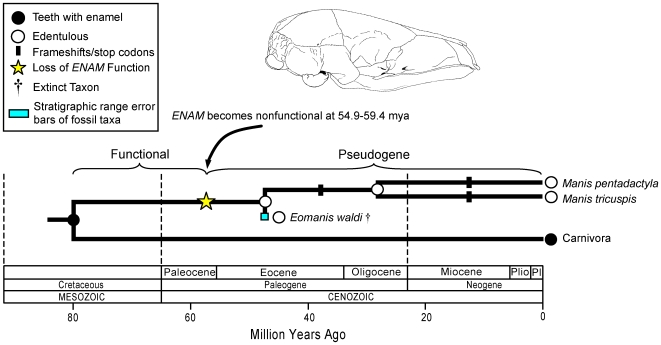
Figure 4. A synthetic interpretation of the history of enamel degeneration in Pholidota (pangolins) based on fossils, phylogenetics, molecular clocks, frameshift mutations, and dN/dS ratios.
Estimates for the timing of the transition from functional gene to pseudogene are based on decomposition of mixed dN/dS history into two distinct episodes of evolution under purifying selection and neutral evolution, respectively. The divergence time between Pholidota and Carnivora (79.8 mya) is from Murphy and Eizirik . The divergence time between Manis pentadactyla and M. tricuspis (27.9 mya) is based on molecular dating analyses with ENAM (see Methods). The age of the oldest pangolin, Eomanis from the Eocene Messel deposits of Germany, is ∼47 mya .
Figure 5
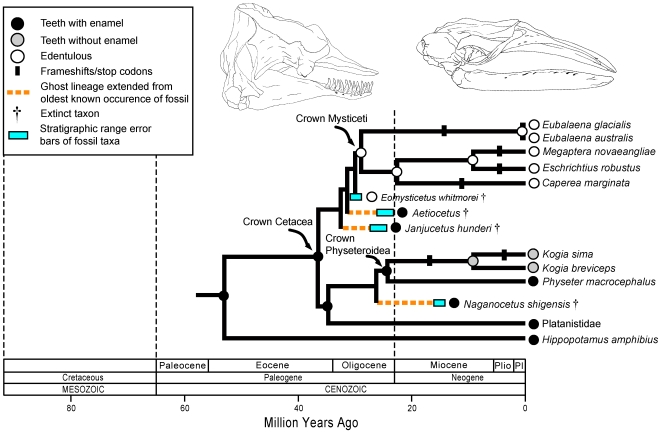
Figure 5. A synthetic interpretation of the history of enamel degeneration in Cetacea based on fossils, phylogenetics, molecular clocks, frameshift mutations, and dN/dS ratios.
The common ancestor of Cetacea was reconstructed as having teeth with enamel based on the occurrence of teeth with enamel in stem cetaceans, stem mysticetes, and stem odontocetes. The common ancestor of Mysticeti was reconstructed as toothless based on (1) the fossil record, which records the transition from ancestral forms that possessed teeth but not baleen (e.g., Janjucetus), to intermediate forms with teeth and baleen (e.g., Aetiocetus), to forms that are fully edentulous (e.g., Eomysticetus) and (2) a dN/dS ratio for ENAM in crown mysticetes that agrees with the null hypothesis of neutral evolution (dN/dS = 1). The common ancestor of physeteroids was reconstructed as having teeth with enamel based on the presence of enamel-capped teeth in stem physeteroids (e.g., Naganocetus) and Physeter. Cladistic relationships and divergence times among extant taxa are based on McGowen et al. . Cladistic relationships of basal mysticetes and basal physeteroids are based on Deméré et al. and Bianucci and Landini , respectively. Frameshift mutations and stop codons were mapped using deltran optimization. All extant mysticete lineages that were sampled have at least one frameshift or stop codon, but none are shared by all mysticetes. Acctran optimization suggests that some homoplastic frameshifts and stop codons within Mysticeti may have resulted from lineage sorting of ancestral polymorphisms .
Figure 6
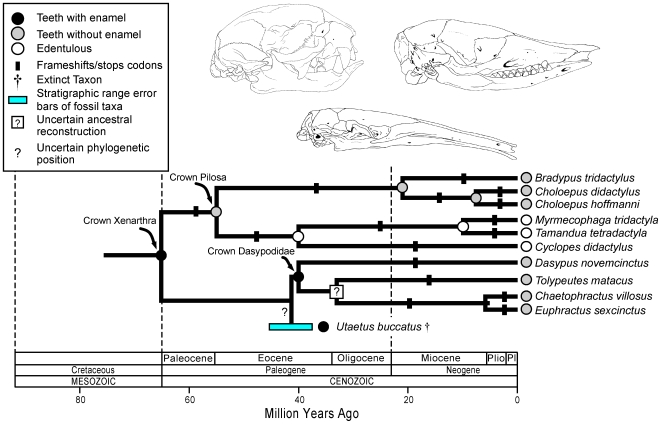
Figure 6. An integrated interpretation of the history of enamel degeneration in Xenarthra based on fossils, phylogenetics, molecular clocks, frameshift mutations, and dN/dS ratios.
No definitive stem xenarthrans have been described, but the common ancestor of Xenarthra was reconstructed as having teeth with enamel based on (1) purifying selection on the stem xenarthran branch (ω = 0.48), (2) a reconstructed ancestral ENAM sequence that contains no frameshifts and no stop codons, (3) at least one crown-group xenarthran (Utaetus) with enamel, which would be improbable to re-evolve if the common ancestor of Xenarthra lacked enamel and had a nonfunctional copy of ENAM, and (4) genomics observations. The common ancestor of Pilosa was reconstructed as having teeth without enamel based on the occurrence of shared frameshifts in ENAM on the stem pilosan branch. The dN/dS ratio in crown clade Dasypodidae agrees with the neutral evolution (dN/dS = 1) hypothesis. There are also frameshifts that result in premature stop codons in all dasypodid ENAM sequences; however, none are shared by all four dasypodids that were sampled in our analysis. We reconstructed the ancestor of living Dasypodidae as having enamel, which may have been very thin as in Utaetus, based on the absence of shared frameshift mutations in protein-coding sequences of AMELX, AMBN, ENAM, and MMP20. The sister group relationship and divergence time between Choloepus hoffmanni and C. didactylus is based on analyses with ENAM (Figure S1, Figure S2; Methods). All other relationships and divergence times are based on Figure 1 of Delsuc et al. . Utaetus is derived from Casamayoran age deposits, which are thought to be ?middle to late Eocene in age ,.

Comment in

  • Molecular tooth decay.
    DeSalle R. DeSalle R. PLoS Genet. 2009 Sep;5(9):e1000655. doi: 10.1371/journal.pgen.1000655. Epub 2009 Sep 18. PLoS Genet. 2009. PMID: 19763174 Free PMC article. No abstract available.

References

    1. Futuyma DJ. Sunderland: Sinauer; 1998. Evolutionary biology.
    1. Darwin C. London: John Murray; 1859. On the origin of species by means of natural selection, or the preservation of favoured races in the struggle for life. - PMC - PubMed
    1. Darwin C. London: John Murray; 1871. The descent of man, and selection in relation to sex.
    1. Bedjer L, Hall BK. Limbs in whales and limblessness in other vertebrates: mechanisms of evolutionary and developmental transformation and loss. Evol Dev. 2002;4:445–458. - PubMed
    1. Fong DW, Kane TC, Culver DC. Vestigialization and loss of nonfunctional characters. Annu Rev Ecol Syst. 1995;26:249–268.

Publication types