


Ulcerative colitis induces changes on the expression of the endocannabinoid system in the human colonic tissue
- PMID: 19730730
- PMCID: PMC2731878
- DOI: 10.1371/journal.pone.0006893
Ulcerative colitis induces changes on the expression of the endocannabinoid system in the human colonic tissue
Abstract
Background: Recent studies suggest potential roles of the endocannabinoid system in gastrointestinal inflammation. Although cannabinoid CB(2) receptor expression is increased in inflammatory disorders, the presence and function of the remaining proteins of the endocannabinoid system in the colonic tissue is not well characterized.
Methodology: Cannabinoid CB(1) and CB(2) receptors, the enzymes for endocannabinoid biosynthesis DAGLalpha, DAGLbeta and NAPE-PLD, and the endocannabinoid-degradating enzymes FAAH and MAGL were analysed in both acute untreated active ulcerative pancolitis and treated quiescent patients in comparison with healthy human colonic tissue by immunocytochemistry. Analyses were carried out according to clinical criteria, taking into account the severity at onset and treatment received.
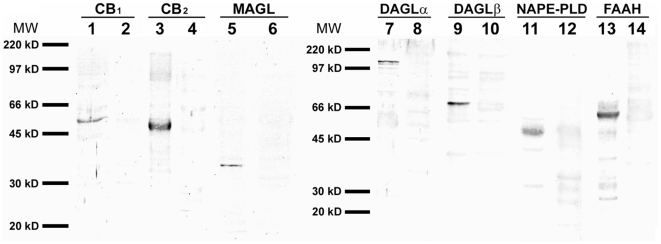
Principal findings: Western blot and immunocytochemistry indicated that the endocannabinoid system is present in the colonic tissue, but it shows a differential distribution in epithelium, lamina propria, smooth muscle and enteric plexi. Quantification of epithelial immunoreactivity showed an increase of CB(2) receptor, DAGLalpha and MAGL expression, mainly in mild and moderate pancolitis patients. In contrast, NAPE-PLD expression decreased in moderate and severe pancolitis patients. During quiescent pancolitis, CB(1), CB(2) and DAGLalpha expression dropped, while NAPE-PLD expression rose, mainly in patients treated with 5-ASA or 5-ASA+corticosteroids. The number of immune cells containing MAGL and FAAH in the lamina propria increased in acute pancolitis patients, but dropped after treatment.
Conclusions: Endocannabinoids signaling pathway, through CB(2) receptor, may reduce colitis-associated inflammation suggesting a potential drugable target for the treatment of inflammatory bowel diseases.
Conflict of interest statement
Figures


References
-
- Massa F, Storr M, Lutz B. The endocannabinoid system in the physiology and pathophysiology of the gastrointestinal tract. J Mol Med. 2005;83:944–954. - PubMed
-
- Pinto L, Capasso R, Di Carlo G, Izzo AA. Endocannabinoids and the gut. Prostag Leukotr Ess. 2002;66:333–341. - PubMed
-
- Izzo AA, Mascolo N, Capasso F. The gastrointestinal pharmacology of cannabinoids. Curr Opin Pharmacol. 2001;1:597–603. - PubMed
-
- Fowler CJ, Holt S, Nilsson O, Jonsson KO, Tiger G, et al. The endocannabinoid signaling system: pharmacological and therapeutic aspects. Pharmacol Biochem Behav. 2005;81:248–262. - PubMed
Publication types
MeSH terms
Substances
LinkOut - more resources
Full Text Sources
Other Literature Sources
Medical
