. 2009 Sep;85(3):377-93.
doi: 10.1016/j.ajhg.2009.08.007.

Allele-specific chromatin remodeling in the ZPBP2/GSDMB/ORMDL3 locus associated with the risk of asthma and autoimmune disease

Affiliations

Allele-specific chromatin remodeling in the ZPBP2/GSDMB/ORMDL3 locus associated with the risk of asthma and autoimmune disease

Dominique J Verlaan et al. Am J Hum Genet. 2009 Sep.

Abstract

Common SNPs in the chromosome 17q12-q21 region alter the risk for asthma, type 1 diabetes, primary biliary cirrhosis, and Crohn disease. Previous reports by us and others have linked the disease-associated genetic variants with changes in expression of GSDMB and ORMDL3 transcripts in human lymphoblastoid cell lines (LCLs). The variants also alter regulation of other transcripts, and this domain-wide cis-regulatory effect suggests a mechanism involving long-range chromatin interactions. Here, we further dissect the disease-linked haplotype and identify putative causal DNA variants via a combination of genetic and functional analyses. First, high-throughput resequencing of the region and genotyping of potential candidate variants were performed. Next, additional mapping of allelic expression differences in Yoruba HapMap LCLs allowed us to fine-map the basis of the cis-regulatory differences to a handful of candidate functional variants. Functional assays identified allele-specific differences in nucleosome distribution, an allele-specific association with the insulator protein CTCF, as well as a weak promoter activity for rs12936231. Overall, this study shows a common disease allele linked to changes in CTCF binding and nucleosome occupancy leading to altered domain-wide cis-regulation. Finally, a strong association between asthma and cis-regulatory haplotypes was observed in three independent family-based cohorts (p = 1.78 x 10(-8)). This study demonstrates the requirement of multiple parallel allele-specific tools for the investigation of noncoding disease variants and functional fine-mapping of human disease-associated haplotypes.


Figures
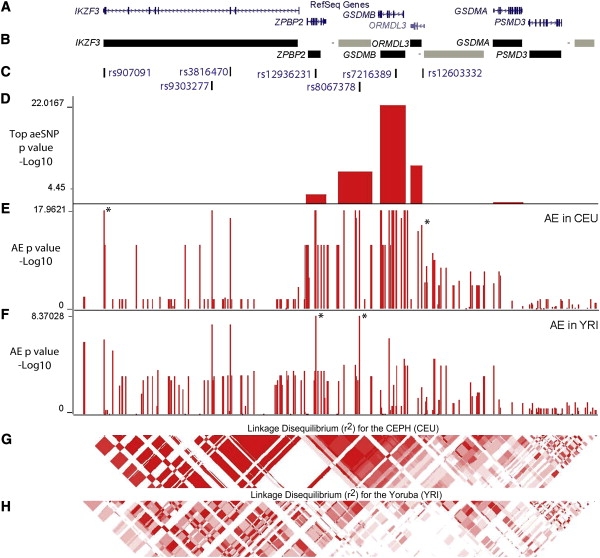
Figure 1
Figure 1
Allelic Expression Analysis of the Genes Found in the Vicinity of rs7216389 (A) RefSeq genes found within the 17q12-q21 region. (B) Informative windows tested for AE via the Illumina 1M duo (three intergenic [−] regions with expressed SNPs were also tested [in gray]). (C) Location of pertinent SNPs. (D) Blocks showing the top association for each transcript (−log10(p value)) via high-throughput AE mapping data generated from 34 informative CEU HapMap LCLs by the Illumina 1M BeadChips (B.G., D.K. Pokholok, T.K., E.G., L. Morcos, D.J.V., J. Le, V.K., K.C.L.L., V. Gagné, J.D., R.H., A. Montpetit, M.-M. Joly, E.J. Harvey, D.S., P. Beaulieu, R. Hamon, A. Graziani, K.D., E.H., J. Majewski, H.H.H. Göring, A.K.N., M. Blanchette, K.L. Gunderson, and T.P., unpublished data). (E and F) GSDMB AE mapping results for 32 informative CEU LCLs (E) (stars delimit the 160 kb CEU rHAP) and for 21 informative YRI LCLs (F) (stars delimit the 22 kb YRI rHAP). Vertical red lines correspond to −log10(p value) of the AE assay for each SNP tested and generated by a two-sided Fisher's exact test. (G and H) Linkage disequilibrium (r2) for CEU phased genotype data (G) and for YRI phased genotype data (H).
Figure 2
Figure 2
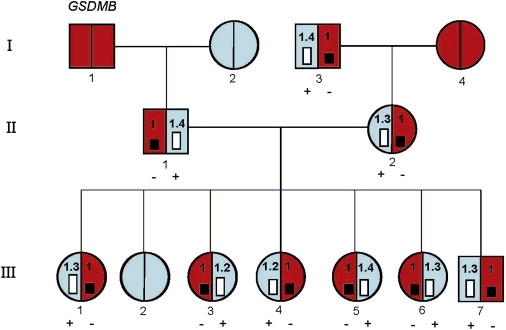
Transmission of AE Observed for GSDMB in the LCLs from CEPH Family 1420 Relative underexpression (−) or overexpression (+) is shown below the family member when data were available. The estimated fold differences between alleles, measured with the Illumina 1M BeadChip AE analysis (B.G., D.K. Pokholok, T.K., E.G., L. Morcos, D.J.V., J. Le, V.K., K.C.L.L., V. Gagné, J.D., R.H., A. Montpetit, M.-M. Joly, E.J. Harvey, D.S., P. Beaulieu, R. Hamon, A. Graziani, K.D., E.H., J. Majewski, H.H.H. Göring, A.K.N., M. Blanchette, K.L. Gunderson, and T.P., unpublished data), is shown in the bar graph for each family member. The red color represents the haplotype associated with underexpression of GSDMB (rs12936231>G) while the blue color represents the overexpressed-associated haplotype (rs12936231>C). The expression differences between the alleles are subtle, but are reproducible and correlate perfectly with what is expected based on population AE mapping.
Figure 3
Figure 3
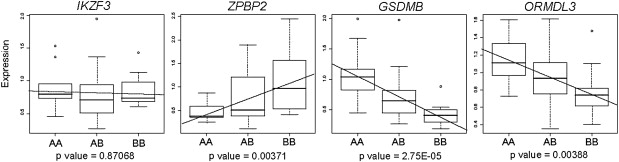
Quantitative Real-Time PCR Results for IKZF3, ZPBP2, GSDMB, and ORMDL3 Performed in 53 CEU LCLs, All Normalized for 18S and Correlated with the Common CEU Overexpressed-Associated Haplotype “A” represents the CEU haplotype associated with the overexpression of GSDMB and “B” is any other haplotype (AA = 9, AB = 32, BB = 12). Error bars were calculated by the mean ± SD for each genotype.
Figure 4
Figure 4
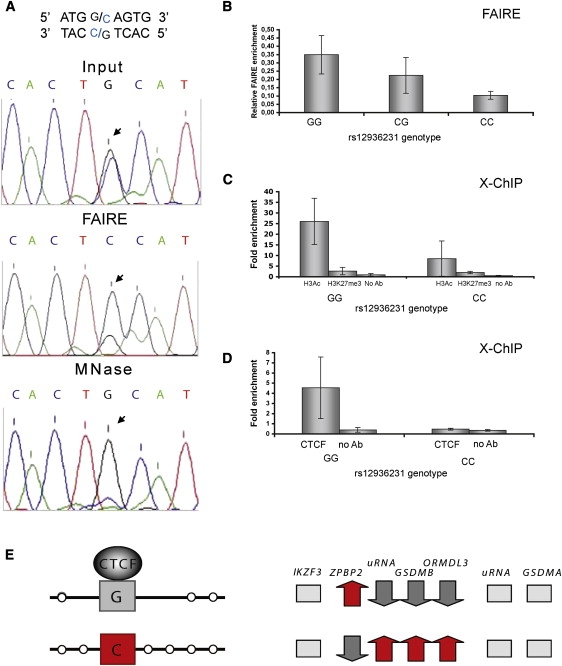
Allele-Specific Chromatin Effects in the rs12936231 Region (A) Sequencing assay to detect allele-specific FAIRE enrichment and micrococcal nuclease (MNase) sensitivity. The negative strand of the rs12936231 region is shown and the position of the SNP is indicated by an arrow. (B) Genotype effect on FAIRE enrichment for rs12936231, qPCR results on FAIRE-treated LCLs (GG = 4, CG = 7, CC = 3). (C) Association of the rs12936231 alleles with active and inactive chromatin marks as determined by X-ChIP qPCR assays (GG = 4 and CC = 4). (D) Allele-specific CTCF binding detected by X-ChIP qPCR assay in homozygous GG (n = 4) and CC (n = 4) LCLs. For (B), (C), and (D), the error bars were calculated with the mean ± SD for each genotype. (E) Summary diagram for the allele-specific chromatin conformation in the rs12936231 region (left) and gene expression (right) in the ZPBP2-ORMDL3 region.
Figure 5
Figure 5
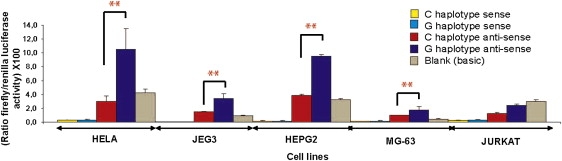
Gene Reporter Assays for Promoter Haplotypes Carrying the rs12936231 Region Relative luciferase activity of the promoter haplotypes was measured after transient transfection in five different cell lines. Each haplotype was transfected in both sense and antisense and performed in quadruplicates (mean ± SD). The empty promoterless pGL3-Basic vector was used as a negative control. ∗∗p < 0.01.
Figure 6
Figure 6
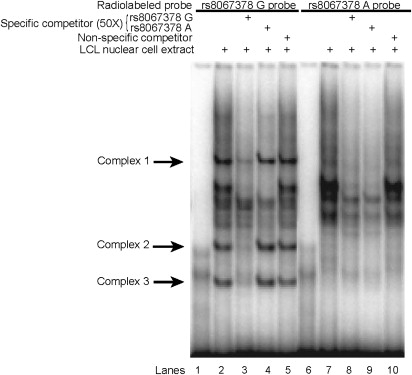
Positive EMSA Analyses Showing Allelic DNA-Protein Interactions for SNP rs8067378G>A in LCLs The unlabeled probes used to complete DNA-protein interactions are indicated (+) at the top of each lane. Specific competitors corresponding to the unlabeled allele-specific probes were used in lanes 3, 4, 8, and 9 and a nonspecific competitor was used in lanes 5 and 10. The three predominant allele-specific DNA-protein complexes are indicated by arrows. All other cell types tested showed similarly strong allele-specific effects for this SNP, whereas none of the other SNPs yielded consistently strong EMSA signals (Figure S6).

References

    1. American Lung Association. (2008). Asthma. In Lung Disease Data: 2008. (http://www.lungusa.org/site/c.dvLUK9O0E/b.4136273/k.16D5/Lung_Disease_Da...).
    1. Ober C., Hoffjan S. Asthma genetics 2006: The long and winding road to gene discovery. Genes Immun. 2006;7:95–100. - PubMed
    1. Vercelli D. Discovering susceptibility genes for asthma and allergy. Nat. Rev. Immunol. 2008;8:169–182. - PubMed
    1. Moffatt M.F., Kabesch M., Liang L., Dixon A.L., Strachan D., Heath S., Depner M., von Berg A., Bufe A., Rietschel E. Genetic variants regulating ORMDL3 expression contribute to the risk of childhood asthma. Nature. 2007;448:470–473. - PubMed
    1. Sleiman P.M., Annaiah K., Imielinski M., Bradfield J.P., Kim C.E., Frackelton E.C., Glessner J.T., Eckert A.W., Otieno F.G., Santa E. ORMDL3 variants associated with asthma susceptibility in North Americans of European ancestry. J. Allergy Clin. Immunol. 2008;122:1225–1227. - PubMed

Publication types

MeSH terms