


Comment
doi: 10.1128/JB.01151-09.
Epub 2009 Sep 4.
Opening a new path to lipoic acid
Affiliations
- PMID: 19734307
- PMCID: PMC2772479
- DOI: 10.1128/JB.01151-09
Item in Clipboard
Comment
Opening a new path to lipoic acid
J Bacteriol.
2009 Nov.
No abstract available
Figures
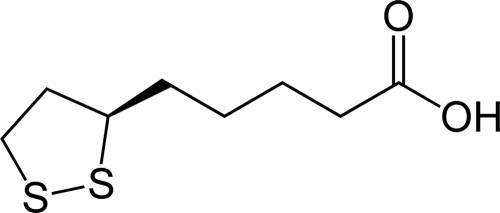
Structure of lipoic acid. Lipoic acid [R-5-(1,2-dithiolan- 3-yl)pentanoic acid] is sometimes known as thioctic acid.
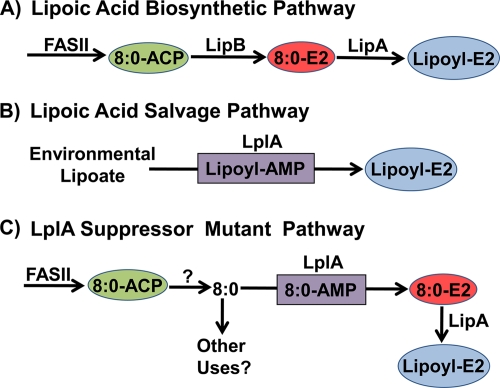
Lipoic acid biosynthesis in E. coli. (A) The de novo lipoate biosynthetic pathway begins by the utilization of octanoyl-ACP (8:0-ACP) produced by type II fatty acid synthase (FASII) by LipB to acylate the E2 domain of PDH. Octanoate bound to the E2 domain is converted to lipoic acid by the S-adenylmethionine-dependent LipA protein to form lipoyl-E2. (B) The scavenging pathway utilizes LplA to transfer lipoic acid from the environment to the E2 domain via an acyl-adenylate intermediate. (C) The LplA suppressor pathway is possible due to an intracellular pool of octanoate (8:0) released from the FASII pathway by an unknown thioesterase-like mechanism. Mutant LplA proteins with increased affinity for free octanoate activate and transfer the fatty acid to 8:0-E2. Lipoyl-E2 is then formed by LipA. It is not known whether there are other potential uses for the medium-chain free fatty acid pool in E. coli.
Comment on
-
Scavenging of cytosolic octanoic acid by mutant LplA lipoate ligases allows growth of Escherichia coli strains lacking the LipB octanoyltransferase of lipoic acid synthesis.J Bacteriol. 2009 Nov;191(22):6796-803. doi: 10.1128/JB.00798-09. Epub 2009 Aug 14. J Bacteriol. 2009. PMID: 19684135 Free PMC article.
References
-
- Cronan, J. E., X. Zhao, and Y. Jiang. 2005. Function, attachment and synthesis of lipoic acid in Escherichia coli. Adv. Microb. Physiol. 50:103-146. - PubMed
-
- Fujiwara, K., S. Toma, K. Okamura-Ikeda, Y. Motokawa, A. Nakagawa, and H. Taniguchi. 2005. Crystal structure of lipoate-protein ligase A from Escherichia coli. Determination of the lipoic acid-binding site. J. Biol. Chem. 280:33645-33651. - PubMed
-
- Herbert, A. A., and J. R. Guest. 1968. Biochemical and genetic studies with lysine+methionine mutants of Escherichia coli: lipoic acid and α-ketoglutarate dehydrogenase-less mutants. J. Gen. Microbiol. 53:363-381. - PubMed
Publication types
MeSH terms
Substances
Grants and funding
LinkOut - more resources
Full Text Sources
Molecular Biology Databases
