Is mobilized peripheral blood comparable with bone marrow as a source of hematopoietic stem cells for allogeneic transplantation from HLA-identical sibling donors? A case-control study
- PMID: 19734420
- PMCID: PMC2738721
- DOI: 10.3324/haematol.2009.006924
Is mobilized peripheral blood comparable with bone marrow as a source of hematopoietic stem cells for allogeneic transplantation from HLA-identical sibling donors? A case-control study
Abstract
Background: Granulocyte colony-stimulating factor mobilized peripheral blood stem cells are increasingly used instead of bone marrow as a stem cell source for transplantation. Whereas this change is almost complete for autologous transplantation, there are some concerns when considering allogeneic transplants.
Design and methods: We performed a retrospective case-control study including 820 adult patients who had received an allogeneic stem cell transplant from an HLA-identical sibling donor. Quality of life (QoL) was assessed in 150 patients using the EORTC Quality of Life Questionnaire C30 (QLQ-C30).
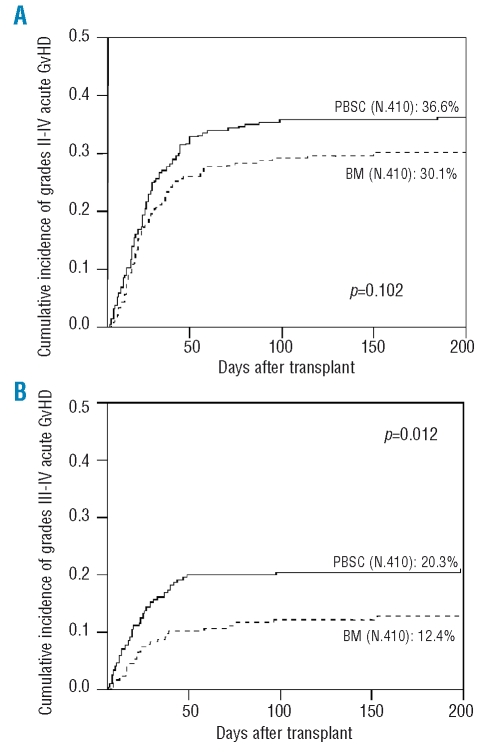
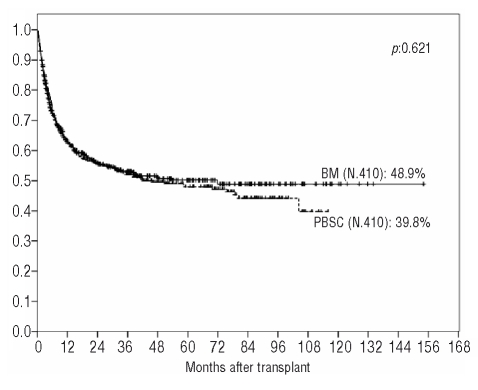
Results: There were no statistically significant differences in overall survival at ten years (bone marrow: 48.9% vs. peripheral blood stem cells: 39.8%; p=0.621), transplant-related mortality (bone marrow: 28.9% vs. peripheral blood stem cells: 34.4%; p=0.682) or relapse incidence at 9 years (29.4% vs. 35.2%, respectively; p=0.688). Similar outcomes were maintained independently of the phase of the disease. However, multivariate analysis identified a higher incidence of acute graft-versus-host disease grades II-IV (p: 0.023; Hazard ratio [HR]: 1.41; 95% confidence interval [CI]: 1.05-1.89) and grades III-IV (p: 0.006; HR: 1.89; 95% CI: 1.20-2.98), in the peripheral blood stem cells-stem cell transplant group. As previously described, extensive chronic graft-versus-host disease was also more frequent in the peripheral blood stem cells group (28% vs. 15.6%; p<0.001). Patients transplanted with peripheral blood stem cells had significant impairment of role and social functioning.
Conclusions: Although overall survival was not affected by the stem cell source, peripheral blood stem cell transplants were associated with a higher risk of both acute and chronic GvHD. Global quality of life was similar in both groups, but patients transplanted with peripheral blood stem cells showed worse role and social functioning scores, probably related to the increased incidence of chronic graft-versus-host disease.
Figures
References
-
- Gratwohl A, Baldomero H, Frauendorfer K, Rocha V, Apperley J, Niederwieser D. The EBMT activity survey 2006 on hematopoietic stem cell transplantation: focus on the use of cord blood products. Bone Marrow Transplant. 2008;41:687–705. - PubMed
-
- Cavallaro AM, Lilleby K, Majolino I, Storb R, Appelbaum FR, Rowley SD, et al. Three to six year follow-up of normal donors who received recombinant human granulocyte colony-stimulating factor. Bone Marrow Transplant. 2000;25:85–9. - PubMed
-
- Schmitz N, Dreger P, Suttorp M, Rohwedder EB, Haferlach T, Loffler H, et al. Primary transplantation of allogeneic peripheral blood progenitor cells mobilized by filgrastim (granulocyte colony-stimulating factor) Blood. 1995;85:1666–72. - PubMed
-
- Bensinger WI, Clift R, Martin P, Appelbaum FR, Demirer T, Gooley T, et al. Allogeneic peripheral blood stem cell transplantation in patients with advanced hematologic malignancies: a retrospective comparison with marrow transplantation. Blood. 1996;88:2794–800. - PubMed
-
- Przepiorka D, Anderlini P, Ippoliti C, Khouri I, Fietz T, Thall P, et al. Allogeneic blood stem cell transplantation in advanced hematologic cancers. Bone Marrow Transplant. 1997;19:455–60. - PubMed
Publication types
MeSH terms
Substances
LinkOut - more resources
Full Text Sources
Other Literature Sources
Medical
Research Materials