


Chlamydial infection and spatial ascension of the female genital tract: a novel hybrid cellular automata and continuum mathematical model
- PMID: 19735471
- PMCID: PMC2777520
- DOI: 10.1111/j.1574-695X.2009.00596.x
Chlamydial infection and spatial ascension of the female genital tract: a novel hybrid cellular automata and continuum mathematical model
Abstract
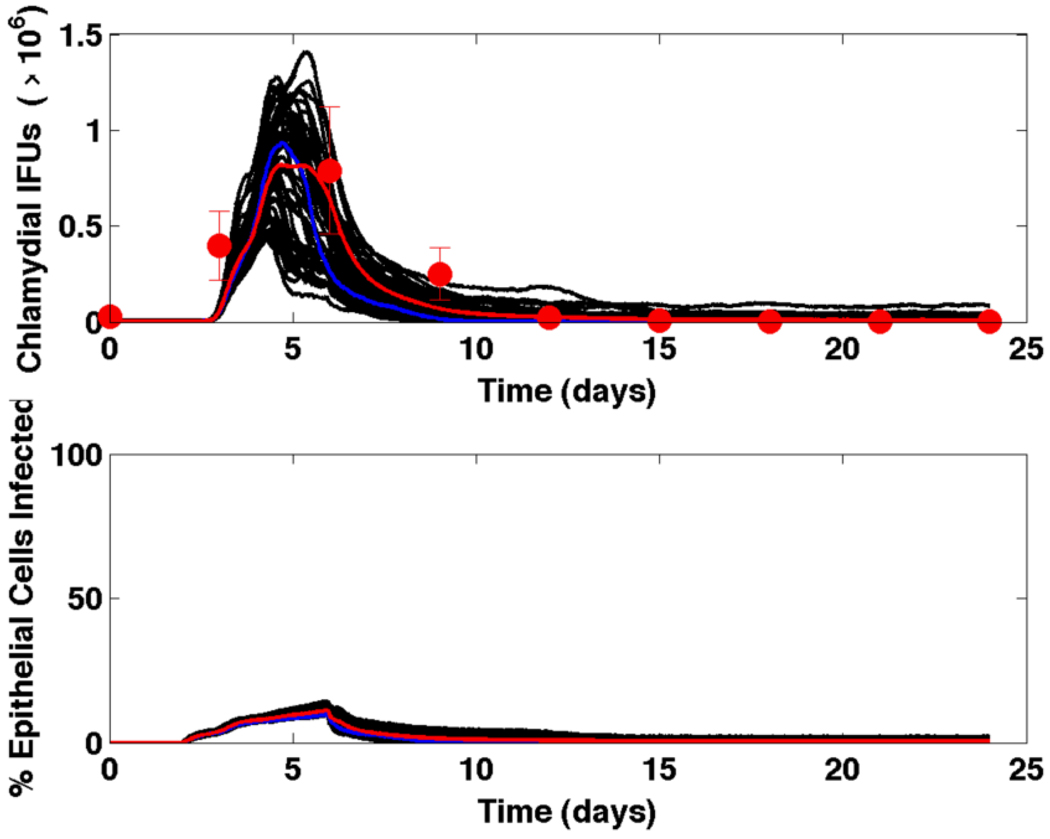
Sexually transmitted chlamydial infection initially establishes in the endocervix in females, but if the infection ascends the genital tract, significant disease, including infertility, can result. Many of the mechanisms associated with chlamydial infection kinetics and disease ascension are unknown. We attempt to elucidate some of these processes by developing a novel mathematical model, using a cellular automata-partial differential equation model. We matched our model outputs to experimental data of chlamydial infection of the guinea-pig cervix and carried out sensitivity analyses to determine the relative influence of model parameters. We found that the rate of recruitment and action of innate immune cells to clear extracellular chlamydial particles and the rate of passive movement of chlamydial particles are the dominant factors in determining the early course of infection, magnitude of the peak chlamydial time course and the time of the peak. The rate of passive movement was found to be the most important factor in determining whether infection would ascend to the upper genital tract. This study highlights the importance of early innate immunity in the control of chlamydial infection and the significance of motility-diffusive properties and the adaptive immune response in the magnitude of infection and in its ascension.
Figures



References
-
- Cohen CR, et al. Association between Mycoplasma genitalium and acute endometritis. Lancet. 2002;359(9308):765–766. - PubMed
-
- Westrom L. Clinical manifestations and diagnosis of pelvic inflammatory disease. J Reprod Med. 1983;28(10 Suppl):703–708. - PubMed
-
- Westrom L, Mardh PA. Chlamydial salpingitis. Br Med Bull. 1983;39(2):145–150. - PubMed
-
- Barron AL, et al. A new animal model for the study of Chlamydia trachomatis genital infections: infection of mice with the agent of mouse pneumonitis. J Infect Dis. 1981;143(1):63–66. - PubMed
-
- Rank RG. Animal models for urogenital infections. Methods Enzymol. 1994;235:83–93. - PubMed
Publication types
MeSH terms
Grants and funding
LinkOut - more resources
Full Text Sources
Medical