


Hemostatic risk factors in patients with coronary artery disease and type 2 diabetes - a two year follow-up of 243 patients
- PMID: 19735543
- PMCID: PMC2743654
- DOI: 10.1186/1475-2840-8-48
Hemostatic risk factors in patients with coronary artery disease and type 2 diabetes - a two year follow-up of 243 patients
Abstract
Background: Thrombosis is regarded to be a key factor in the development of acute coronary syndromes in patients with coronary artery disease (CAD). We hypothesize, that hemostatic and rheological risk factors may be of major relevance for the incidence and the risk stratification of these patients.
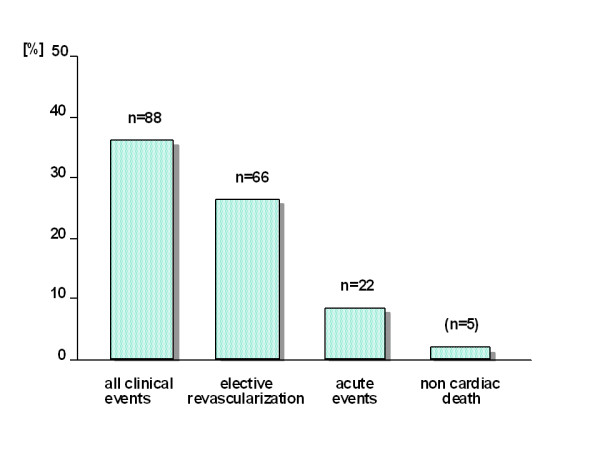
Methods: In 243 patients with coronary artery disease and stable angina pectoris parameters of metabolism, hemostasis, blood rheology and endogenous fibrinolysis were assessed. Patients were prospectively followed for 2 years in respect to elective revascularizations and acute coronary syndromes.
Results: During follow-up 88 patients presented with cardiac events, 22 of those were admitted to the hospital because of acute events, 5 Patients were excluded due to non- cardiac death. Patients with clinical events were found to be more frequently diabetic and presented with a more progressed coronary atherosclerosis. Even though patients with diabetes mellitus demonstrated a comparable level of multivessel disease (71% vs. 70%) the rate of elective revascularization was higher (41% vs. 28%, p < 0.05). The results were also unfavorable for the incidence of acute cardiovascular events (18% vs. 8%, p < 0.01). In comparison to non-diabetic patients diabetics demonstrated significantly elevated levels of fibrinogen (352 +/- 76 vs. 312 +/- 64 mg/dl, p < 0.01), plasma viscosity (1.38 +/- 0.23 vs. 1.31 +/- 0.16 mPas, p < 0.01), red blood cell aggregation (13.2 +/- 2.5 vs. 12.1 +/- 3.1 E, p < 0.05) and plasmin-activator-inhibitor (6.11 +/- 3.4 vs. 4.7 +/- 2.7 U/l, p < 0.05).
Conclusion: Pathological alterations of fibrinogen, blood rheology and plasminogen-activator-inhibitor as indicators of a procoagulant state are of major relevance for the short-term incidence of cardiac events, especially in patients with diabetes mellitus type 2, and may be used to stratify patients to specific therapies.
Figures


References
-
- Auwerx J, Bouillon R, Collen D, Geboers J. Tissue-type plasminogen activator antigen and plasminogen activator inhibitor in diabetes mellitus. Artherosclerosis. 1988;8:68–72. - PubMed
-
- Fisher BM, Quin JD, Rumley A, Lennie SE, Small M, MacCuish AC, Lowe GD. Effects of acute insulin-induced hypoglycaemia on haemostasis, fibrinolysis and haemorheology in insulin-dependent diabetic patients and control subjects. Clin Sci Colch. 1991;8:525–531. - PubMed
-
- Juhan Vague I, Alessi MC. activator inhibitor 1 and atherothrombosis. Thromb Haemost. 1993;8:138–143. - PubMed
MeSH terms
Substances
LinkOut - more resources
Full Text Sources
Medical
Miscellaneous
