


A gene expression model of intrinsic tumor radiosensitivity: prediction of response and prognosis after chemoradiation
- PMID: 19735873
- PMCID: PMC3038688
- DOI: 10.1016/j.ijrobp.2009.06.014
A gene expression model of intrinsic tumor radiosensitivity: prediction of response and prognosis after chemoradiation
Abstract
Purpose: Development of a radiosensitivity predictive assay is a central goal of radiation oncology. We reasoned a gene expression model could be developed to predict intrinsic radiosensitivity and treatment response in patients.
Methods and materials: Radiosensitivity (determined by survival fraction at 2 Gy) was modeled as a function of gene expression, tissue of origin, ras status (mut/wt), and p53 status (mut/wt) in 48 human cancer cell lines. Ten genes were identified and used to build a rank-based linear regression algorithm to predict an intrinsic radiosensitivity index (RSI, high index = radioresistance). This model was applied to three independent cohorts treated with concurrent chemoradiation: head-and-neck cancer (HNC, n = 92); rectal cancer (n = 14); and esophageal cancer (n = 12).
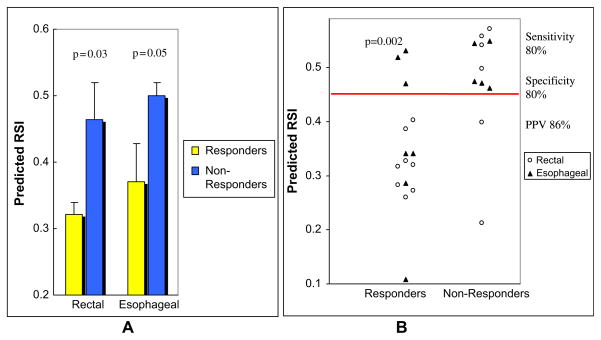
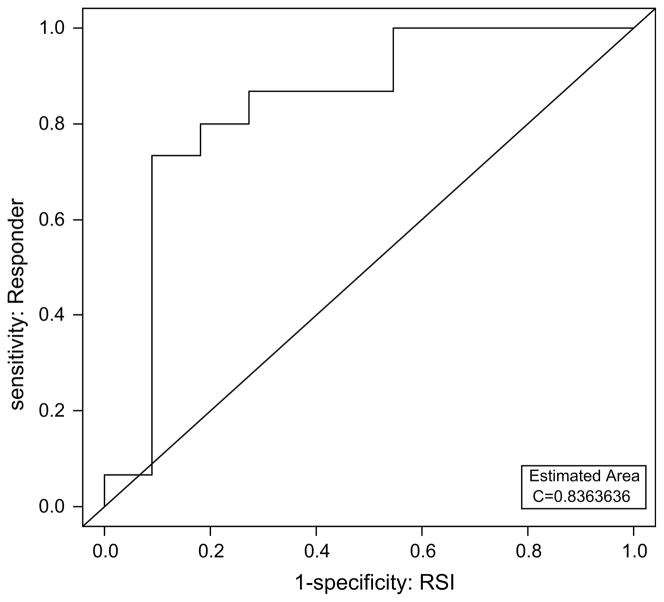
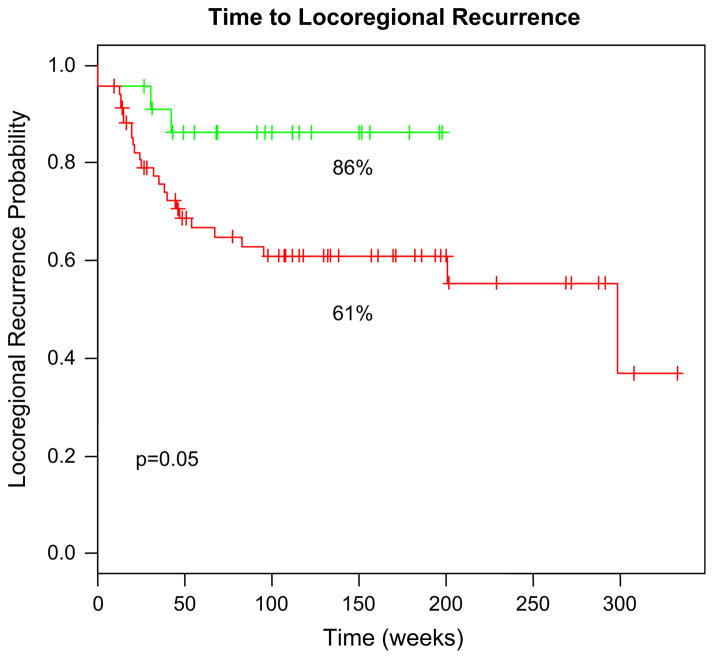
Results: Predicted RSI was significantly different in responders (R) vs. nonresponders (NR) in the rectal (RSI R vs. NR 0.32 vs. 0.46, p = 0.03), esophageal (RSI R vs. NR 0.37 vs. 0.50, p = 0.05) and combined rectal/esophageal (RSI R vs. NR 0.34 vs. 0.48, p = 0.001511) cohorts. Using a threshold RSI of 0.46, the model has a sensitivity of 80%, specificity of 82%, and positive predictive value of 86%. Finally, we evaluated the model as a prognostic marker in HNC. There was an improved 2-year locoregional control (LRC) in the predicted radiosensitive group (2-year LRC 86% vs. 61%, p = 0.05).
Conclusions: We validate a robust multigene expression model of intrinsic tumor radiosensitivity in three independent cohorts totaling 118 patients. To our knowledge, this is the first time that a systems biology-based radiosensitivity model is validated in multiple independent clinical datasets.
Conflict of interest statement
Conflict of interest: S.E. and J.T.R. are named as inventors in a patent application of the technology described.
Figures
References
-
- Dalton WS, Friend SH. Cancer biomarkers—an invitation to the table. Science. 2006;312:1165–1168. - PubMed
-
- Bucci MK, Bevan A, Roach M., III Advances in radiation therapy: Conventional to 3D, to IMRT, to 4D, and beyond. CA Cancer J Clin. 2005;55:117–134. - PubMed
-
- Zelefsky MJ, Fuks ZVI, Hunt M, et al. High dose radiation delivered by intensity modulated conformal radiotherapy improves the outcome of localized prostate cancer. J Urol. 2001;166:876–881. - PubMed
-
- Bjork-Eriksson T, West C, Karlsson E, et al. Tumor radiosensitivity (SF2) is a prognostic factor for local control in head and neck cancers. Int J Radiat Oncol Biol Phys. 2000;46:13–19. - PubMed
-
- Buffa FM, Davidson SE, Hunter RD, et al. Incorporating biologic measurements (SF(2), CFE) into a tumor control probability model increases their prognostic significance: A study in cervical carcinoma treated with radiation therapy. Int J Radiat Oncol Biol Phys. 2001;50:1113–1122. - PubMed
Publication types
MeSH terms
Substances
Grants and funding
LinkOut - more resources
Full Text Sources
Other Literature Sources
Medical
Research Materials
Miscellaneous
