Review
. 2009 Sep;12(5):693-704.

Acid-sensing ion channels: A new target for pain and CNS diseases

Affiliations
Review

Acid-sensing ion channels: A new target for pain and CNS diseases

Kathleen A Sluka et al. Curr Opin Drug Discov Devel. 2009 Sep.

Abstract

Low pH in tissue can evoke pain in animals and humans, and is an important factor in hyperalgesia. Research has also implicated acidosis in psychiatric and neurological diseases. One emerging class of pH-detecting receptors is that of the acid-sensing ion channels (ASICs). Advances in ASIC research have improved the understanding of the role played by pH dynamics in physiological and pathophysiological processes. Increasing evidence suggests that targeting ASICs with pharmacological agents may offer an effective and novel approach for treating pain and diseases of the CNS. However, the development of pharmaceuticals that target ASICs and are suitable for clinical use remains an obstacle. This review provides an update on ASICs and their potential for therapeutic modification in pain and CNS diseases.


Figures
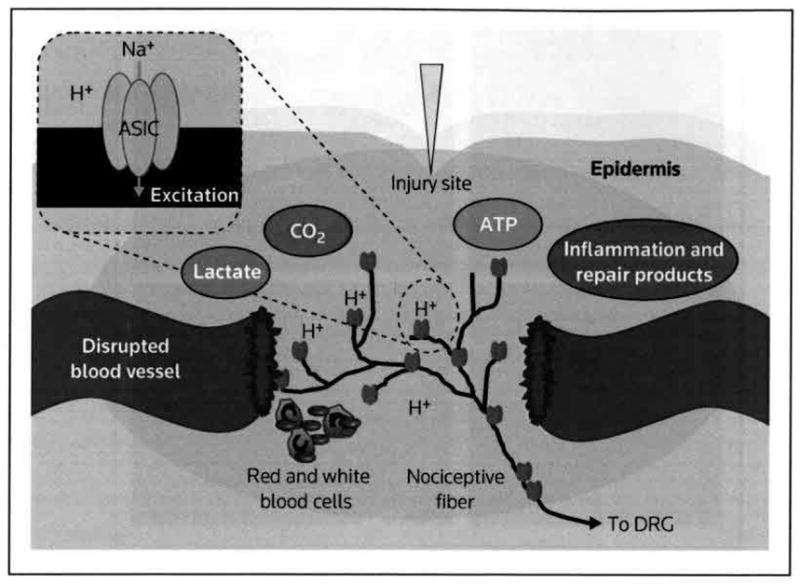
Figure 1
Figure 1. A model of tissue injury causing acidosis and activating ASICs on nociceptive fibers
The disruption of blood vessels decreases tissue oxygenation and increases anaerobic metabolism, which increase levels of carbon dioxide and lactate, and thus lowers pH. Inflammation and tissue repair further increase metabolic activity and acidic products. ATP and lactate potentiate pH effects on ASIC-expressing peripheral sensory neurons [67]. The resulting Na+ influx and depolarization activate DRG fibers, leading to pain and hyperalgesia. ASIC acid-sensing ion channel, DRG dorsal root ganglion
Figure 2
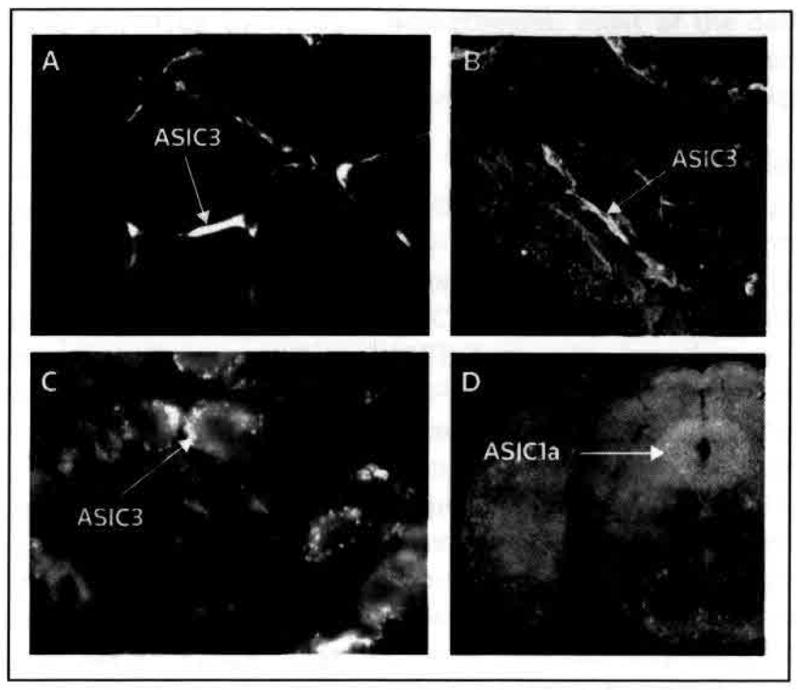
Figure 2. Immunofluorescent localization of mouse ASIC3 and ASIC1a protein at pain-related sites
(A) ASIC3 in primary afferent fibers innervating muscle (cross-section); (B) ASIC3 in primary afferent fibers innervating the knee joint synyovium; and (C) ASIC3 in dorsal root ganglion neurons. (D) ASIC1a is abundantly expressed in brainstem periaqueductal gray matter (coronal section). (B adapted with permission from The International Association for the Study of Pain and Ikeuchi M, Kolker SJ, Burnes LA, Walder RY, Sluka KA: Role of ASIC3 in the primary and secondary hyperalgesia produced by joint Inflammation in mice. Pain (2008) 137(3):662–669 © 2008 The International Association for the Study of Pain; C adapted with permission from The International Association for the Study of Pain and Sluka KA, Price MP, Breese NM, Stucky CL, Wemmie JA, Welsh MJ: Chronic hyperalgesia induced by repeated acid injections in muscle is abolished by the loss of ASIC3, but not ASIC1. Pain (2003) 106(3):229–239 © 2003 The International Association for the Study of Pain; and D adapted with permission from Elsevier Ltd and Coryell M, Ziemann AE, Westmoreland PJ, Haenfler JM, Kurjakovic Z, Zha XM, Price M, Schnizler MK, Wemmie JA: Targeting ASIC1a reduces innate fear and alters neuronal activity in the fear circuit. Biol Psychiatry (2007) 62(10):1140–1148 © 2007 Elsevier Ltd) ASIC acid-sensing ion channel
Figure 3
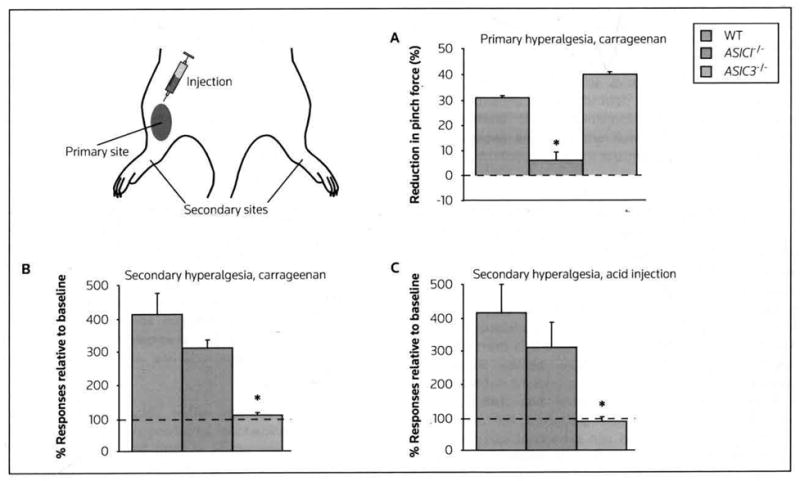
Figure 3. ASIC1a- and ASIC3-mediated hyperalgesia
Hyperalgesia was tested 24 h after the administration of carrageenan (A and B) or acid (C) into the leg muscle of mice. (A) Primary hyperalgesia was assessed by pinching the previously injected muscle and measuring the force required to induce leg withdrawal (reduced force relative to baseline indicates hyperalgesia). ASIC1a−/− mice exhibited a significant reduction in primary hyperalgesia. (B and C) Secondary hyperalgesia was measured at the paw; a 0.4-mN von Frey filament-increased paw withdrawal response relative to baseline indicated hyperalgesia. ASIC3−/− mice demonstrated a significant deficit in secondary hyperalgesia following both carageenan and acid injection. *p < 0.05 compared with the other two groups. ASIC acid-sensing ion channel, WT wild-type
Figure 4
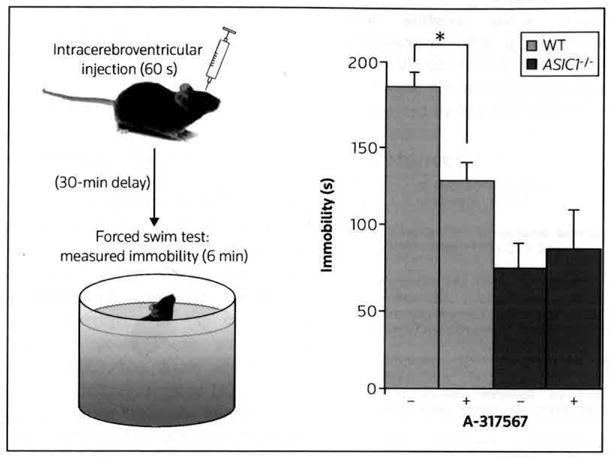
Figure 4. Attenuated depression-related behavior with the ASIC1a inhibitor A-317567
In the forced swim test, mice were placed in a beaker of tepid water, and the time spent immobile was quantified; antidepressants are known to reduce immobility in this test. Wild-type mice injected with A-317567 exhibited significantly less immobility than those injected with vehicle. ASIC1a−/− mice were less immobile than wild-type mice, and the administration of A-317567 produced no effect in the knockout mice. *p < 0.01 (Adapted with permission from The Society for Neuroscience and Coryell MW, Wunsch AM, Haenfler JM, Allen JE, Schnizler M, Ziemann AE, Cook MN, Dunning JP, Price MP, Rainier JD, Liu Z et al: Acid-sensing ion channel-1a in the amygdala, a novel therapeutic target in depression-related behavior. J Neurosci (2009) 29(17):5381–5388 © 2009 The Society for Neuroscience) ASIC acid-sensing ion channel, WT wild-type

References

    1. Canessa CM. Structural biology: Unexpected opening. Nature. 2007;449(7160):293–294. - PubMed
    1. Wemmie JA, Price MP, Welsh MJ. Acid-sensing ion channels: Advances, questions and therapeutic opportunities. Trends Neurosci. 2006;29(10):578–586. Review of the structure, function and physiological roles of ASICs. - PubMed
    1. Stockand JD, Staruschenko A, Pochynyuk O, Booth RE, Silverthorn DU. Insight toward epithelial Na+ channel mechanism revealed by the acid-sensing ion channel 1 structure. IUBMB Life. 2008;60(9):620–628. - PubMed
    1. Jasti J, Furukawa H, Gonzales EB, Gouaux E. Structure of acid-sensing ion channel 1 at 1.9 Å resolution and low pH. Nature. 2007;449(7160):316–323. Discloses the first crystal structures of ASICs and DEG/ENaCs. - PubMed
    1. Qadri YJ, Berdiev BK, Song Y, Lippton HL, Fuller CM, Benos DJ. Psalmotoxin-1 docking to human acid sensing ion channel-1. J Biol Chem. 2009;284(26):17625–17633. - PMC - PubMed

Publication types

MeSH terms

LinkOut - more resources