Crohn's disease adherent-invasive Escherichia coli colonize and induce strong gut inflammation in transgenic mice expressing human CEACAM
- PMID: 19737864
- PMCID: PMC2757893
- DOI: 10.1084/jem.20090741
Crohn's disease adherent-invasive Escherichia coli colonize and induce strong gut inflammation in transgenic mice expressing human CEACAM
Abstract
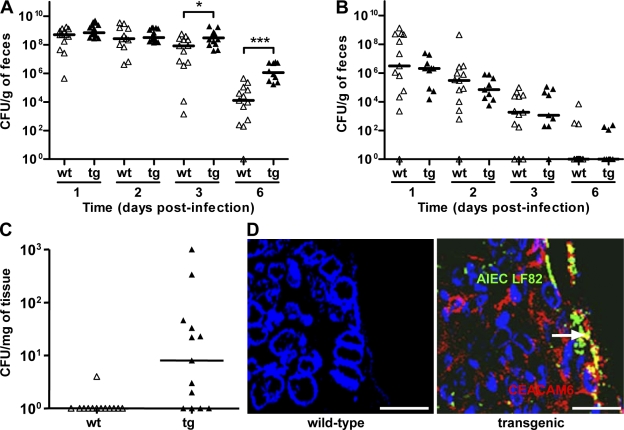
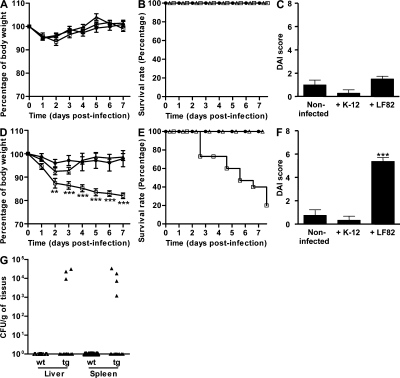
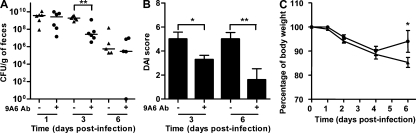
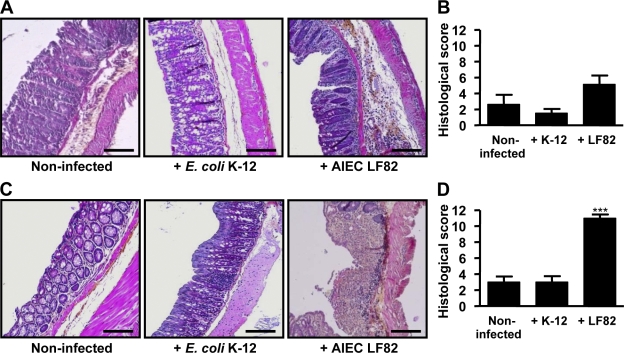
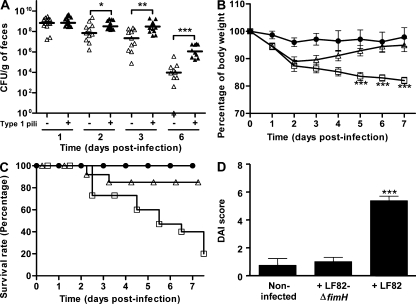
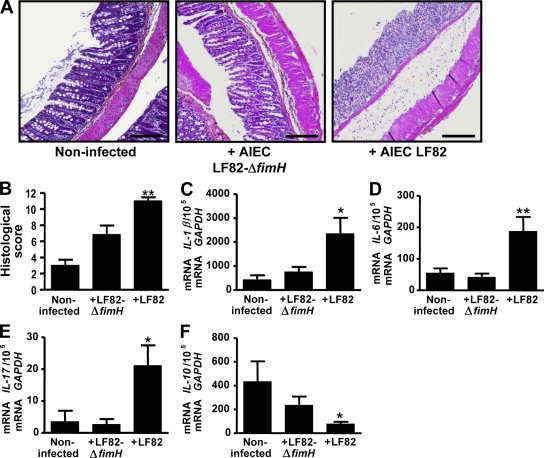
Abnormal expression of CEACAM6 is observed at the apical surface of the ileal epithelium in Crohn's disease (CD) patients, and CD ileal lesions are colonized by pathogenic adherent-invasive Escherichia coli (AIEC). We investigated the ability of AIEC reference strain LF82 to colonize the intestinal mucosa and to induce inflammation in CEABAC10 transgenic mice expressing human CEACAMs. AIEC LF82 virulent bacteria, but not nonpathogenic E. coli K-12, were able to persist in the gut of CEABAC10 transgenic mice and to induce severe colitis with reduced survival rate, marked weight loss, increased rectal bleeding, presence of erosive lesions, mucosal inflammation, and increased proinflammatory cytokine expression. The colitis depended on type 1 pili expression by AIEC bacteria and on intestinal CEACAM expression because no sign of colitis was observed in transgenic mice infected with type 1 pili-negative LF82-Delta fimH isogenic mutant or in wild-type mice infected with AIEC LF82 bacteria. These findings strongly support the hypothesis that in CD patients having an abnormal intestinal expression of CEACAM6, AIEC bacteria via type 1 pili expression can colonize the intestinal mucosa and induce gut inflammation. Thus, targeting AIEC adhesion to gut mucosa represents a new strategy for clinicians to prevent and/or to treat ileal CD.
Figures
References
-
- Barnich N., Boudeau J., Claret L., Darfeuille-Michaud A. 2003. Regulatory and functional co-operation of flagella and type 1 pili in adhesive and invasive abilities of AIEC strain LF82 isolated from a patient with Crohn's disease.Mol. Microbiol. 48:781–794 doi:10.1046/j.1365-2958.2003.03468.x - DOI - PubMed
-
- Barnich N., Carvalho F.A., Glasser A.L., Darcha C., Jantscheff P., Allez M., Peeters H., Bommelaer G., Desreumaux P., Colombel J.F., Darfeuille-Michaud A. 2007. CEACAM6 acts as a receptor for adherent-invasive E. coli, supporting ileal mucosa colonization in Crohn disease.J. Clin. Invest. 117:1566–1574 doi:10.1172/JCI30504 - DOI - PMC - PubMed
-
- Baumgart M., Dogan B., Rishniw M., Weitzman G., Bosworth B., Yantiss R., Orsi R.H., Wiedmann M., McDonough P., Kim S.G., et al. 2007. Culture independent analysis of ileal mucosa reveals a selective increase in invasive Escherichia coli of novel phylogeny relative to depletion of Clostridiales in Crohn's disease involving the ileum.ISME J. 1:403–418 doi:10.1038/ismej.2007.52 - DOI - PubMed
-
- Boudeau J., Glasser A.L., Julien S., Colombel J.F., Darfeuille-Michaud A. 2003. Inhibitory effect of probiotic Escherichia coli strain Nissle 1917 on adhesion to and invasion of intestinal epithelial cells by adherent-invasive E. coli strains isolated from patients with Crohn's disease.Aliment. Pharmacol. Ther. 18:45–56 doi:10.1046/j.1365-2036.2003.01638.x - DOI - PubMed
Publication types
MeSH terms
Substances
LinkOut - more resources
Full Text Sources
Other Literature Sources
Medical
Molecular Biology Databases