. 2009 Sep 15;69(18):7165-9.
doi: 10.1158/0008-5472.CAN-09-1448. Epub 2009 Sep 8.

miR-21: an androgen receptor-regulated microRNA that promotes hormone-dependent and hormone-independent prostate cancer growth

Affiliations

miR-21: an androgen receptor-regulated microRNA that promotes hormone-dependent and hormone-independent prostate cancer growth

Judit Ribas et al. Cancer Res. .

Abstract

Androgen receptor (AR)-mediated oncogenic pathways have not been fully elucidated. In this study, we used high-throughput microarray analysis on two AR-positive prostate cancer (CaP) cell lines to identify 16 AR-responsive microRNAs (miRNA). We focused on miR-21 because of its previously reported oncogenic activity in other cancers. We show androgen-induced AR binding to the defined miR-21 promoter, miPPR-21, suggesting direct transcriptional regulation. Inhibition of miR-21 diminished androgen-induced CaP cell proliferation, providing new evidence that miRNAs can contribute to androgen-driven cell growth. Elevated expression of miR-21 enhanced CaP tumor growth in vivo and, surprisingly, was sufficient for androgen-dependent tumors to overcome castration-mediated growth arrest. Thus, elevated miR-21 expression alone is sufficient to impart castration resistance. Moreover, quantitative reverse transcription-PCR analysis revealed elevated miR-21 expression in CaP when compared with adjacent normal tissue. These results suggest that miR-21 may contribute to CaP pathogenesis.


Figures
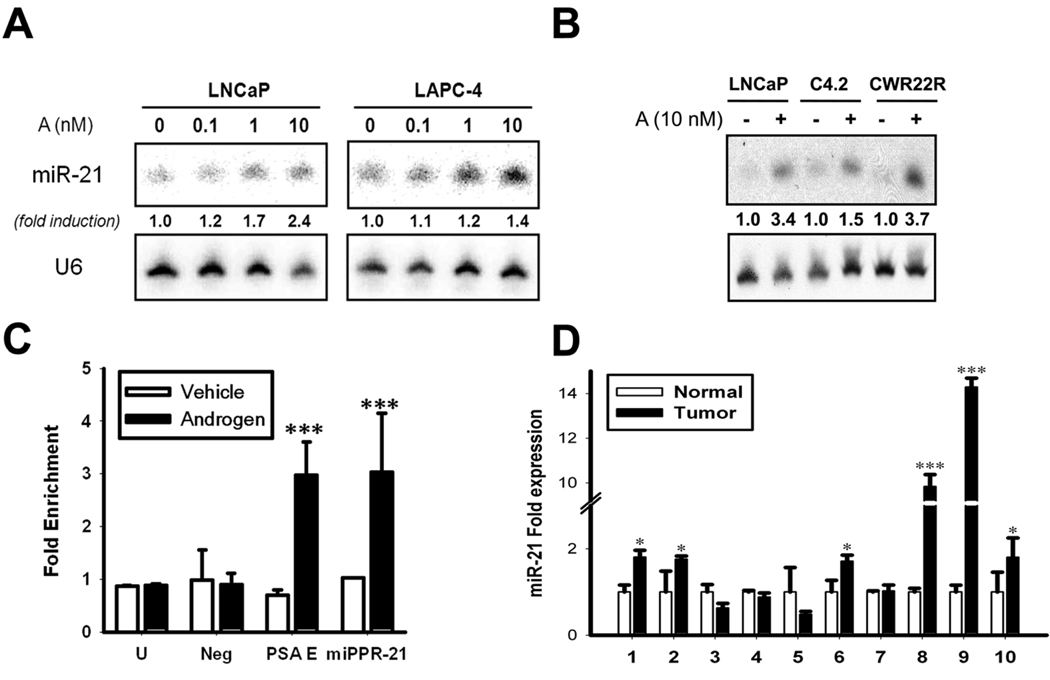
Fig. 1
Fig. 1. miR-21 expression and regulation in CaP
A, Androgen-stimulated miR-21 expression. Northern blots of miR-21 dose-response (A, R1881). U6 used as a loading control. ’Fold-induction’ represents miR-21 relative to the non-stimulated state. B, miR-21 induction in additional AR-positive CaP cell lines. C, miPPR-21 Chromatin Immunoprecipitation. White = non-treated, Black = androgen-stimulated. Fold-enrichment represents AR immunoprecipitation relative to control antibody. ‘PSA E’: PSA Enhancer; ‘U’ control amplicon; ‘Neg’: non-conserved ARE. Mean ± SE from three independent measurements, *P<0.05, ***P<0.001 (t-student test). D, miR-21 in human CaP tumors. Fold-expression normalized to U6 by qRT-PCR. Mean ± SE, *P<0.05, ***P<0.001 (Two way ANOVA).
Fig. 2
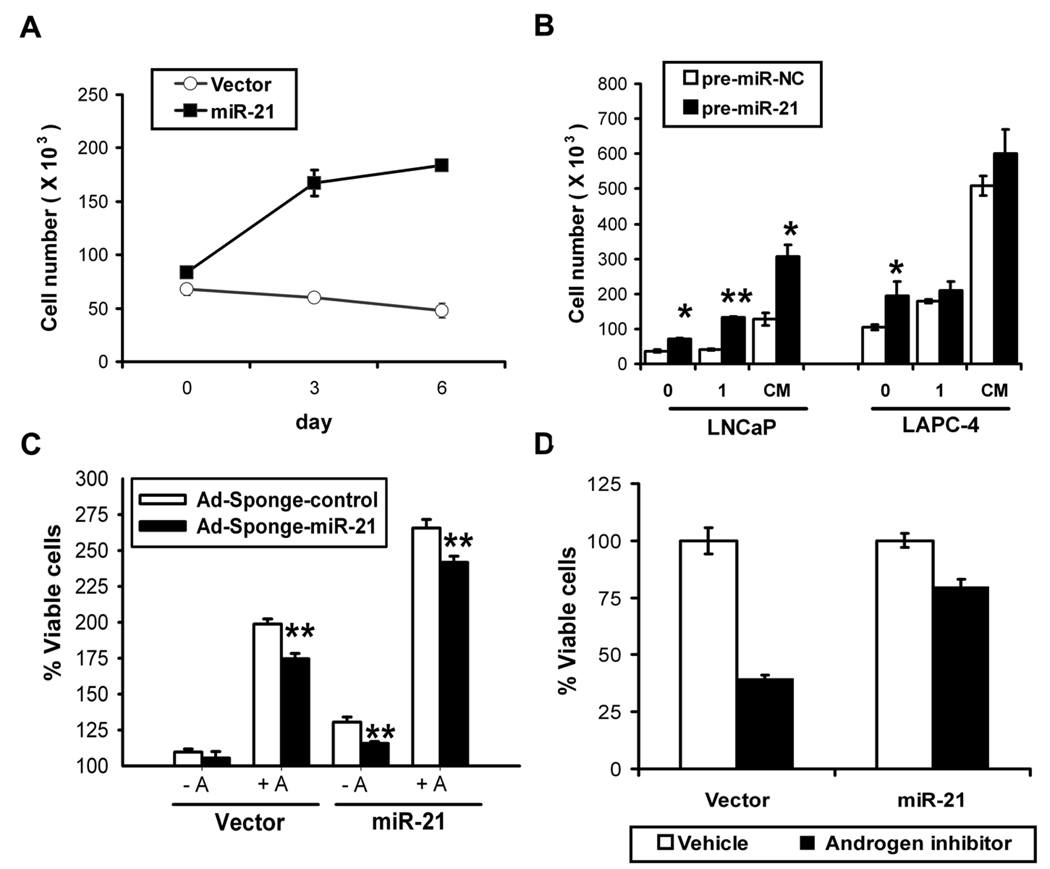
Fig. 2. miR-21-induced proliferation
A, miR-21 mediated androgen-independent growth. LNCaP retrovirally transduced to stably express miR-21 (black square) or empty vector (white circle) grown in androgen-depleted media. Mean ± S.E. B, Effects of synthetic miR-21 on growth. Transient transfectantions with synthetic pre-miR-21 (black) or pre-miR-Negative Control (white) after 6 days in androgen-depleted (0), 1 nM R1881 (1) or complete media (CM). Viable cells quantified by trypan blue (Mean ± S.E. from 3 different wells), *P<0.05, **P<0.01 (t-student test). C, Effects of miR-21 inhibition. LNCaP miR-21 or vector control cells infected with 10 MOI of Ad-Sponge-control (white) or anti-miR-21 Ad-Sponge-miR-21 (black) after 6 days in charcoal-stripped (−A) or R1881 supplemented (+A) media. Percent growth calculated by MTS. Mean ± S.E of 12 independent measurements, **P<0.01 (t-student test). D, Elevated miR-21 partially overcomes AR blockade. LNCaP miR-21 or control vector in complete media treated with vehicle (white) or 10 µM Casodex (black). Cell proliferation calculated by MTS (relative to vehicle, 6 days). Mean ± S.E of 6 independent measurements.
Fig. 3
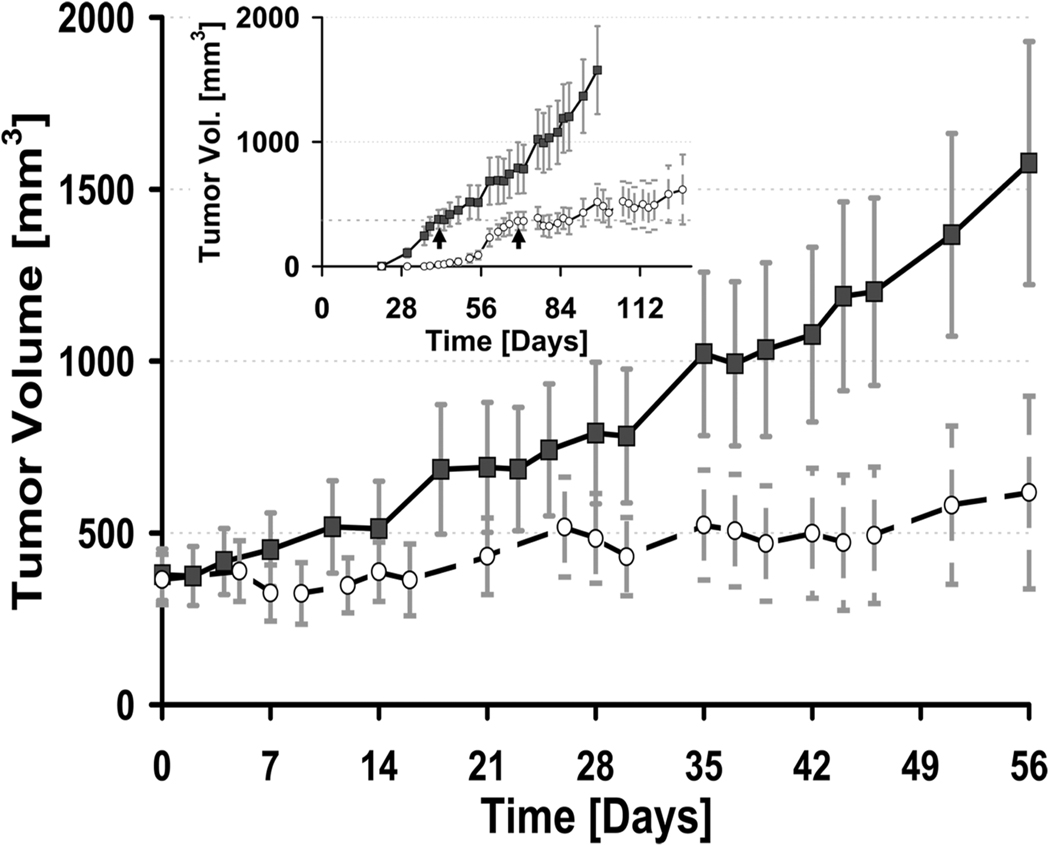
Fig. 3. Elevated expression of miR-21 promotes enhanced tumor growth and castration-resistance in vivo
LNCaP miR-21 (black square) or a control vector (white circle) subcutaneous xenograft growth before and after castration. Castration was performed at ~ 375 mm3 tumor volume for each group. Tumor growth is normalized to the time of castration (day 0). Inset: Time course of tumor growth from the time of injection. Castration indicated by arrows. Mean ± S.E of at least 10 independent values. *P<0.05 (t-student test).

References

    1. Mangelsdorf DJ, Thummel C, Beato M, et al. The nuclear receptor superfamily: the second decade. Cell. 1995;83:835–839. - PMC - PubMed
    1. Dehm SM, Tindall DJ. Androgen receptor structural and functional elements: role and regulation in prostate cancer. Mol Endocrinol. 2007;21:2855–2863. - PubMed
    1. Yuan X, Balk SP. Mechanisms mediating androgen receptor reactivation after castration. Urol Oncol. 2009;27:36–41. - PMC - PubMed
    1. Ambs S, Prueitt RL, Yi M, et al. Genomic profiling of microRNA and messenger RNA reveals deregulated microRNA expression in prostate cancer. Cancer Res. 2008;68:6162–6170. - PMC - PubMed
    1. Lin SL, Chiang A, Chang D, Ying SY. Loss of mir-146a function in hormone-refractory prostate cancer. Rna. 2008;14:417–424. - PMC - PubMed

Publication types

MeSH terms