


Role of tissue factor in cancer
- PMID: 19738116
- PMCID: PMC2764391
- DOI: 10.1200/JCO.2009.22.6324
Role of tissue factor in cancer
Abstract
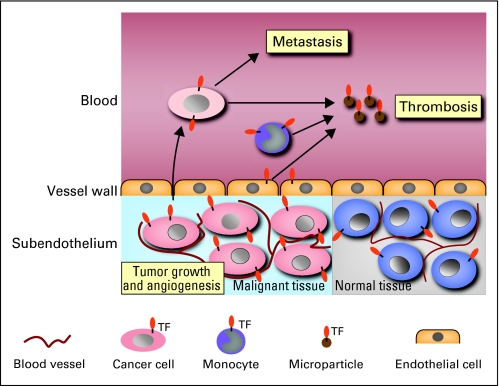
Tissue factor (TF) is a transmembrane glycoprotein that localizes the coagulation serine protease factor VII/VIIa (FVII/VIIa) to the cell surface. The primary function of TF is to activate the clotting cascade. The TF:FVIIa complex also activates cells by cleavage of a G-protein coupled receptor called protease-activated receptor 2 (PAR2). TF is expressed by tumor cells and contributes to a variety of pathologic processes, such as thrombosis, metastasis, tumor growth, and tumor angiogenesis. For instance, tumor cells release TF-positive procoagulant microparticles into the circulation and these may trigger venous thromboembolism in patients with cancer. TF on circulating tumor cells also leads to the coating of the cells with fibrin that traps them within the microvasculature and facilitates hematogenous metastasis. In addition, TF:FVIIa-dependent activation of PAR2 on tumor cells increases tumor growth via an undefined mechanism. One possibility is that PAR2-dependent signaling increases the expression of proangiogenic proteins. Other studies have reported that endothelial cells in the tumor vasculature express TF and this may enhance angiogenesis. These results suggest that inhibition of TF should reduce several pathologic pathways that increase tumor growth and metastasis. This would represent a novel approach to anticancer therapy. Initial studies using inhibitors of the TF:FVIIa complex in mouse tumor models have produced encouraging results. Nevertheless, additional studies are needed to determine if this strategy can be successfully translated to the treatment of cancer patients.
Conflict of interest statement
Authors' disclosures of potential conflicts of interest and author contributions are found at the end of this article.
Figures
References
-
- Mackman N. Role of tissue factor in hemostasis, thrombosis, and vascular development. Arterioscler Thromb Vasc Biol. 2004;24:1015–1022. - PubMed
-
- Coughlin SR. Thrombin signaling and protease-activated receptors. Nature. 2000;407:258–264. - PubMed
-
- Mackman N. Regulation of the tissue factor gene. FASEB J. 1995;9:883–889. - PubMed
-
- Osterud B, Bjorklid E. Sources of tissue factor. Semin Thromb Hemost. 2006;32:11–23. - PubMed
Publication types
MeSH terms
Substances
LinkOut - more resources
Full Text Sources
Other Literature Sources
Medical
Miscellaneous
