


Toward a theory of motivational interviewing
- PMID: 19739882
- PMCID: PMC2759607
- DOI: 10.1037/a0016830
Toward a theory of motivational interviewing
Abstract
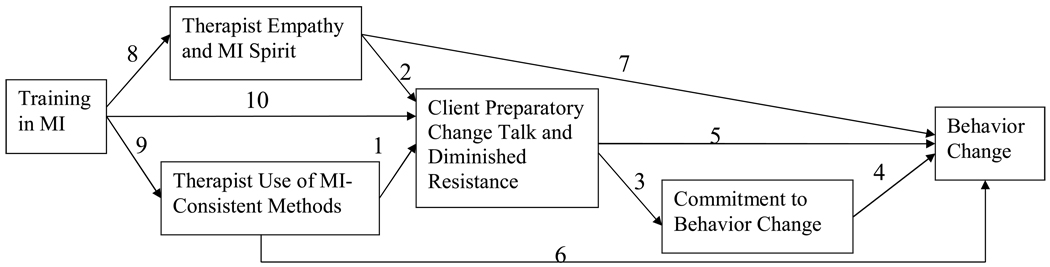
The widely disseminated clinical method of motivational interviewing (MI) arose through a convergence of science and practice. Beyond a large base of clinical trials, advances have been made toward "looking under the hood" of MI to understand the underlying mechanisms by which it affects behavior change. Such specification of outcome-relevant aspects of practice is vital to theory development and can inform both treatment delivery and clinical training. An emergent theory of MI is proposed that emphasizes two specific active components: a relational component focused on empathy and the interpersonal spirit of MI, and a technical component involving the differential evocation and reinforcement of client change talk. A resulting causal chain model links therapist training, therapist and client responses during treatment sessions, and posttreatment outcomes.
Figures
Comment in
-
Motivational interviewing and the social context.Am Psychol. 2010 May-Jun;65(4):297-8; discussion 298-9. doi: 10.1037/a0019276. Am Psychol. 2010. PMID: 20455630 No abstract available.
References
-
- Amrhein PC. The comprehension of quasi-performance verbs in verbal commitments: New evidence for componential theories of lexical meaning. Journal of Memory and Language. 1992;31:756–784.
-
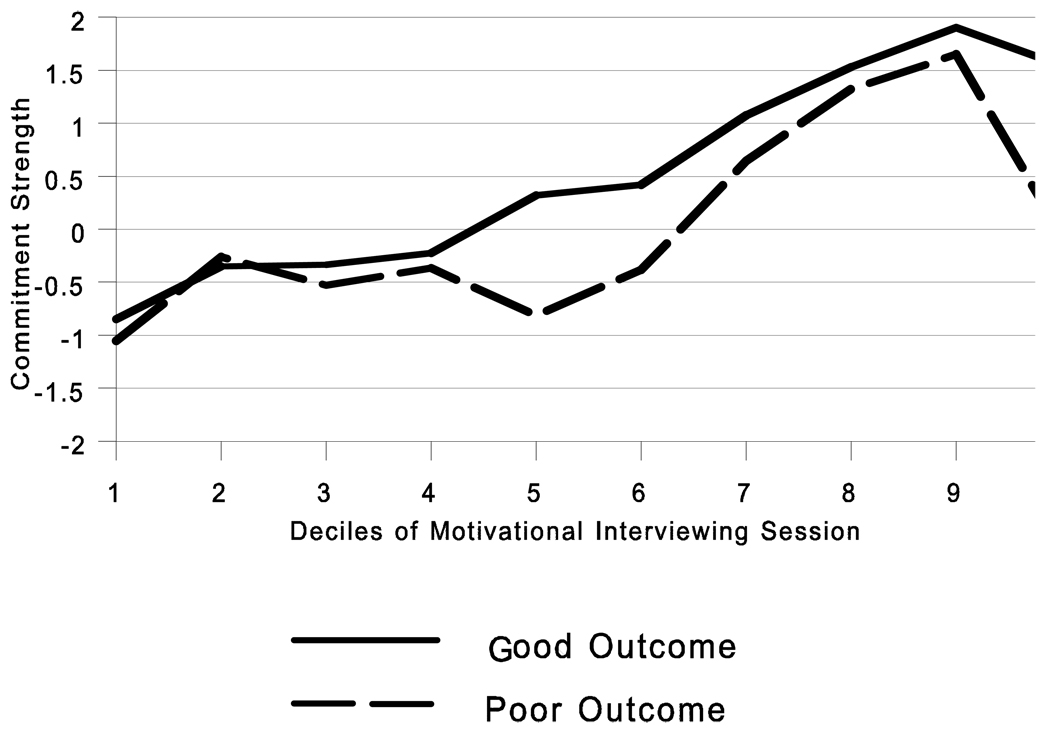
- Amrhein PC, Miller WR, Yahne C, Knupsky A, Hochstein D. Strength of client commitment language improves with therapist training in motivational interviewing. Alcoholism-Clinical and Experimental Research. 2004;28(5):74A.
-
- Amrhein PC, Miller WR, Yahne CE, Palmer M, Fulcher L. Client commitment language during motivational interviewing predicts drug use outcomes. Journal of Consulting and Clinical Psychology. 2003;71:862–878. - PubMed
Publication types
MeSH terms
Grants and funding
LinkOut - more resources
Full Text Sources
Medical