


Now you see it, now you don't: age differences in affective reactivity to social tensions
- PMID: 19739920
- PMCID: PMC2742971
- DOI: 10.1037/a0016673
Now you see it, now you don't: age differences in affective reactivity to social tensions
Abstract
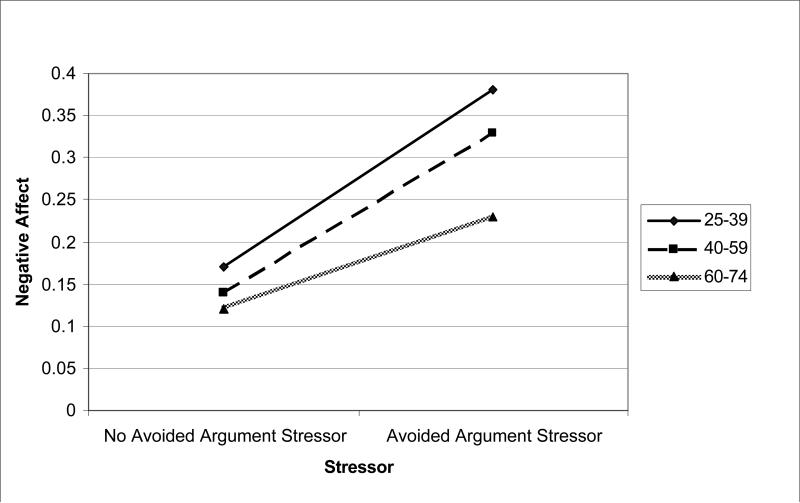
When faced with interpersonal conflict, older adults report using passive strategies more often than do young adults. They also report less affective reactivity in response to these tensions. We examined whether the use of passive strategies may explain age-related reductions in affective reactivity to interpersonal tensions. Over 8 consecutive evenings, participants (N = 1,031; 25-74 years-old) reported daily negative affect and the occurrence of tense situations resulting in an argument or avoidance of an argument. Older age was related to less affective reactivity when people decided to avoid an argument but was unrelated to affective reactivity when people engaged in arguments. Findings suggest that avoidance of negative situations may largely underlie age-related benefits in affective well-being.
(c) 2009 APA, all rights reserved.
Figures
References
-
- Almeida DM. Resilience and vulnerability to daily stressors assessed via diary methods. Current Directions in Psychological Science. 2005;14:64–68.
-
- Almeida DM, Wethington E, Kessler RC. The daily inventory of stressful events: An interview-based approach for measuring daily stressors. Assessment. 2002;9:41–55. - PubMed
-
- Almeida DM, Horn MC. Is daily life more stressful during middle adulthood? In: Brim OG, Ryff CD, Kessler RC, editors. How healthy are we? A national study of well-being at midlife. University of Chicago Press; Chicago: 2004. pp. 425–451.
-
- Antonucci TC, Langfahl ES, Akiyama H. Relationships as outcomes and contexts. In: Lang FR, Fingerman KL, editors. Growing together: Personal relationships across the life span. Cambridge University Press; New York: 2004. pp. 24–44.
-
- Baumeister RF, Leary MR. The need to belong: Desire for interpersonal attachments as a fundamental human motivation. Psychological Bulletin. 1995;117:497–529. - PubMed
