Review
. 2009 Oct;20(8):402-8.
doi: 10.1016/j.tem.2009.05.002. Epub 2009 Sep 7.

The hypothalamic GnRH pulse generator: multiple regulatory mechanisms

Affiliations
Review

The hypothalamic GnRH pulse generator: multiple regulatory mechanisms

Lazar Z Krsmanovic et al. Trends Endocrinol Metab. 2009 Oct.

Abstract

Pulsatile secretion of gonadotropin-releasing hormone (GnRH) release is an intrinsic property of hypothalamic GnRH neurons. Pulse generation has been attributed to multiple specific mechanisms, including spontaneous electrical activity of GnRH neurons, calcium and cAMP signaling, a GnRH receptor autocrine regulatory component, a GnRH concentration-dependent switch in GnRH receptor (GnRH-R) coupling to specific G proteins, the expression of G protein-coupled receptors (GPCRs) and steroid receptors, and homologous and heterologous interactions between cell membrane receptors expressed in GnRH neurons. The coexistence of multiple regulatory mechanisms for pulsatile GnRH secretion provides a high degree of redundancy in maintaining this crucial component of the mammalian reproductive process. These studies provide insights into the basic cellular and molecular mechanisms involved in GnRH neuronal function.


Figures
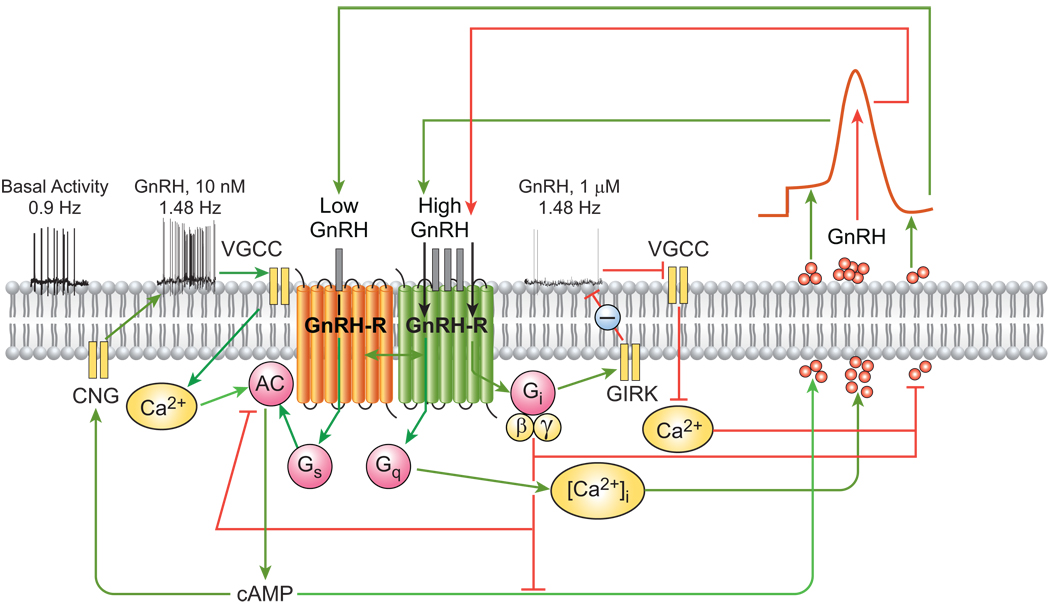
Figure 1
Figure 1
Proposed mechanism of autocrine control of pulsatile GnRH secretion. (i) Firing of Ca2+-dependent action potentials in GnRH neurons promotes Ca2+ influx, activation of Ca2+-dependent adenylyl cyclase (AC), increased cAMP production, and elevated GnRH secretion. (ii) GnRH-induced stimulation of the endogenous GnRH-R expressed in GnRH neurons activates three G proteins, as indicated by the time- and dose-dependent release of their specific α-subunits from the plasma membrane. This is associated with increased inositol phosphate production and [Ca2+]i mobilization, as well as prominent increases in GnRH peak amplitude. Agonist activation of GnRH-Rs in GnRH neurons regulates AC activity in a biphasic manner, such that cAMP production is stimulated at nanomolar agonist levels and decreased by micromolar concentrations. (iii) Neuronal GnRH-Rs also interact with Gi proteins. The autocrine switch from Gs to Gi at high local GnRH concentrations interrupts the rise in neurosecretion and is followed by a fall to baseline and subsequent reactivation of secretion via the resurgent Ca2+/cAMP signaling pathways. VSCC, voltage-sensitive calcium channels; AC, adenylyl cyclase; CNG, cyclic nucleotide gated channels; GIRK, G protein-activated inwardly rectifying potassium channels. Green and red lines indicate stimulatory and inhibitory actions, respectively.
Figure 2
Figure 2
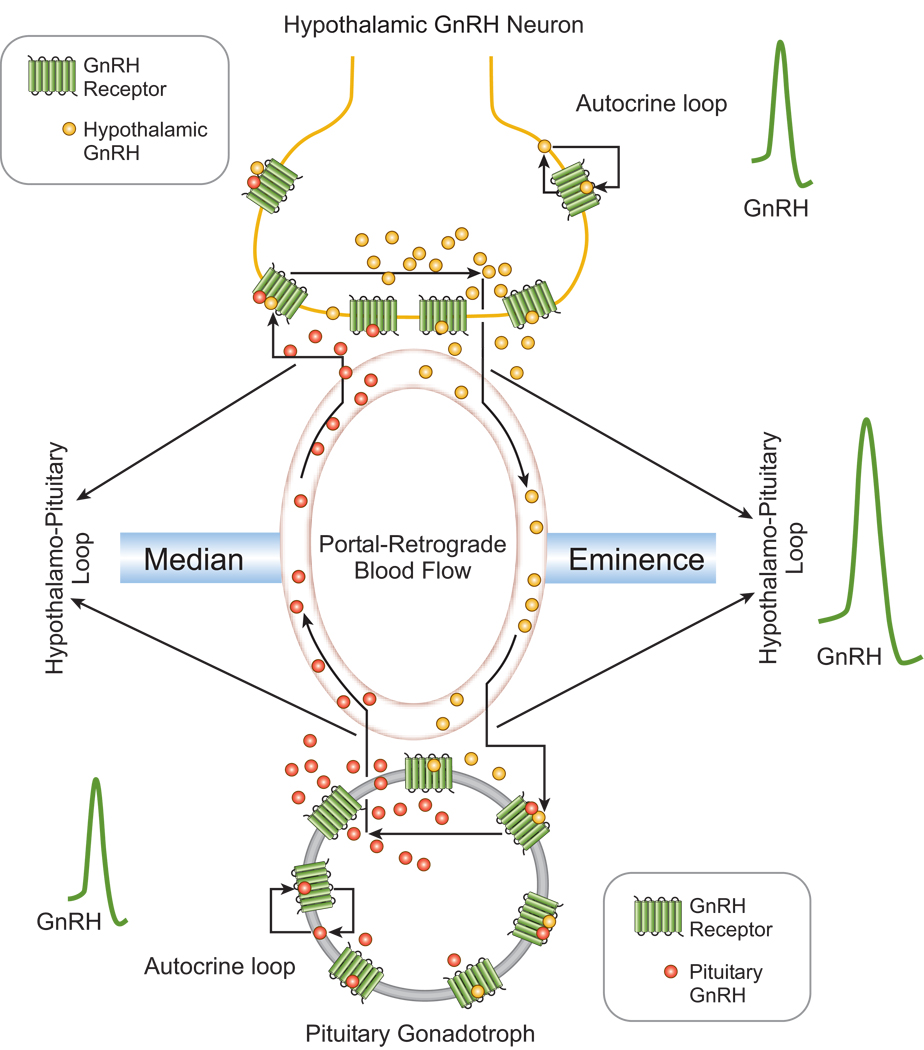
The hypothalamo-pituitary GnRH system. Rat hypothalamic GnRH neurons and anterior pituitary cells express both GnRH and specific GnRH receptors that mediate the actions of GnRH agonist and antagonist analogs on intracellular signaling, GnRH secretion, and gonadotropin secretion. Identified pituitary gonadotrophs also exhibited positive immunostaining for GnRH and GnRH receptors, and mRNA transcripts for GnRH were found in pituitary cells as well as hypothalamic neurons. Temporal analysis of the pulsatile production of GnRH and LH in perifused pituitary cells revealed that release of GnRH preceded the episodes of LH secretion. Furthermore, perifused pituitary cells exposed to pulsatile GnRH agonist treatment exhibited increased release of both LH and GnRH. In contrast, treatment with a GnRH antagonist abolished spontaneous [Ca2+]i oscillations in pituitary gonadotrophs, decreased both basal and agonist-stimulated LH release, and converted the pulsatile pattern of endogenous GnRH release to a monotonic non-pulsatile profile. In vivo, the two GnRH systems are connected by the hypothalamo-pituitary portal vessels and potentially by retrograde neurohypophysial blood flow, leading to synchronous pulsatile or episodic discharges of GnRH with consequent increases in LH release.
Figure 3
Figure 3
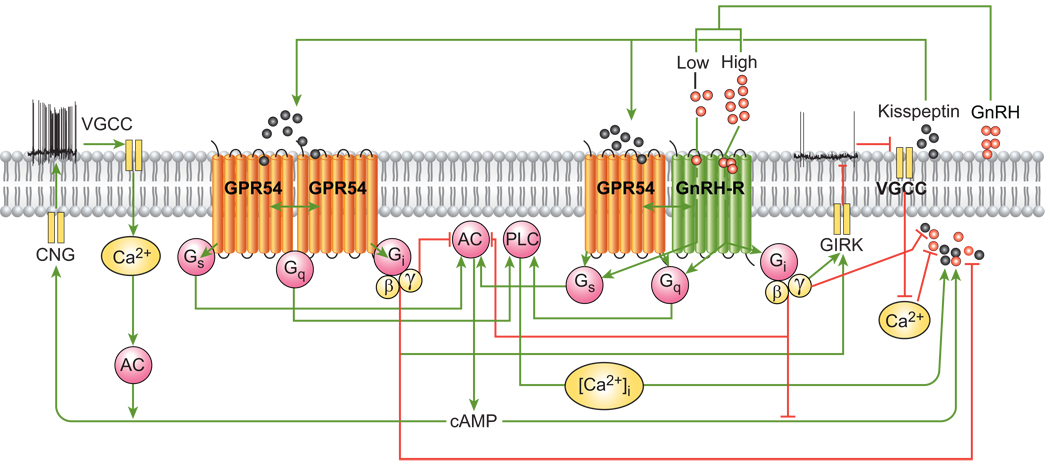
Homo- and hetero-oligomerization of G protein-coupled receptors expressed in GnRH neurons. The expression of kisspeptin and GPR54 mRNAs in identified hypothalamic GnRH neurons and the constitutive and agonist-induced hetero-oligomerization of GnRH-R and GPR54 indicate that both receptors are involved in the regulating GnRH neuronal function. Green and red lines indicate stimulatory and inhibitory actions, respectively.
Figure 4
Figure 4
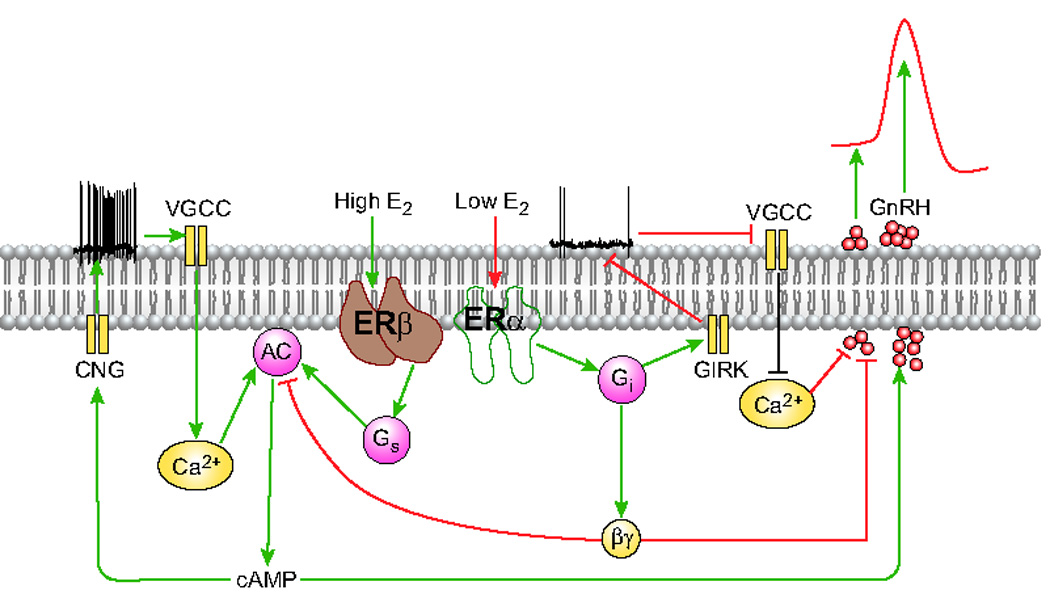
Expression of ERs in hypothalamic GnRH neurons. Estrogen receptor alpha (ERα) and beta (ERβ) are expressed in cultured hypothalamic GnRH neurons. (i) In cultured hypothalamic cells and immortalized GT1–7 neurons, low (picomolar) E2 concentrations and an ERα agonist suppressed spontaneous action potential (AP) firing, decreased cAMP production, and inhibited pulsatile GnRH release. The marked inhibitory effects of Gi-coupled ERα on spontaneous AP firing, cAMP production, and pulsatile GnRH secretion, indicate its capacity for negative regulation of GnRH neuronal function. (ii) In contrast, higher (nanomolar) E2 concentrations and an ERβ agonist increased the rate of AP firing, cAMP production, and GnRH secretion, consistent with positive regulation of GnRH secretion. In accord with the coupling of ER to PTX-sensitive Gi/o proteins, E2 also activates G protein-activated inwardly rectifying potassium (GIRK) channels, decreasing membrane excitability and slowing the firing of spontaneous APs in hypothalamic GnRH neurons. Green and red lines indicate stimulatory and inhibitory actions, respectively.

References

    1. Catt KJ, et al. GnRH receptors and actions in the control of reproductive function. J Steroid Biochem. 1985;23:677–689. - PubMed
    1. Rasmussen DD. Episodic gonadotropin-releasing hormone release from the rat isolated median eminence in vitro. Neuroendocrinology. 1993;58:511–518. - PubMed
    1. Krsmanovic LZ, et al. Pulsatile gonadotropin-releasing hormone release and its regulation. Trends Endocrinol Metab. 1996;7:56–59. - PubMed
    1. Terasawa E. Cellular mechanism of pulsatile LHRH release. Gen Comp Endocrinol. 1998;112:283–295. - PubMed
    1. Moenter SM, et al. Mechanisms underlying episodic gonadotropin-releasing hormone secretion. Front Neuroendocrinol. 2003;24:79–93. - PubMed

MeSH terms

Substances