. 2009 Nov;37(20):6905-15.
doi: 10.1093/nar/gkp729. Epub 2009 Sep 8.

Evidence for large diversity in the human transcriptome created by Alu RNA editing

Affiliations

Evidence for large diversity in the human transcriptome created by Alu RNA editing

Michal Barak et al. Nucleic Acids Res. 2009 Nov.

Abstract

Adenosine-to-inosine (A-to-I) RNA editing alters the original genomic content of the human transcriptome and is essential for maintenance of normal life in mammals. A-to-I editing in Alu repeats is abundant in the human genome, with many thousands of expressed Alu sequences undergoing editing. Little is known so far about the contribution of Alu editing to transcriptome complexity. Transcripts derived from a single edited Alu sequence can be edited in multiple sites, and thus could theoretically generate a large number of different transcripts. Here we explored whether the combinatorial potential nature of edited Alu sequences is actually fulfilled in the human transcriptome. We analyzed datasets of editing sites and performed an analysis of a detailed transcript set of one edited Alu sequence. We found that editing appears at many more sites than detected by earlier genomic screens. To a large extent, editing of different sites within the same transcript is only weakly correlated. Thus, rather than finding a few versions of each transcript, a large number of edited variants arise, resulting in immense transcript diversity that eclipses alternative splicing as mechanism of transcriptome diversity, although with less impact on the proteome.


Figures
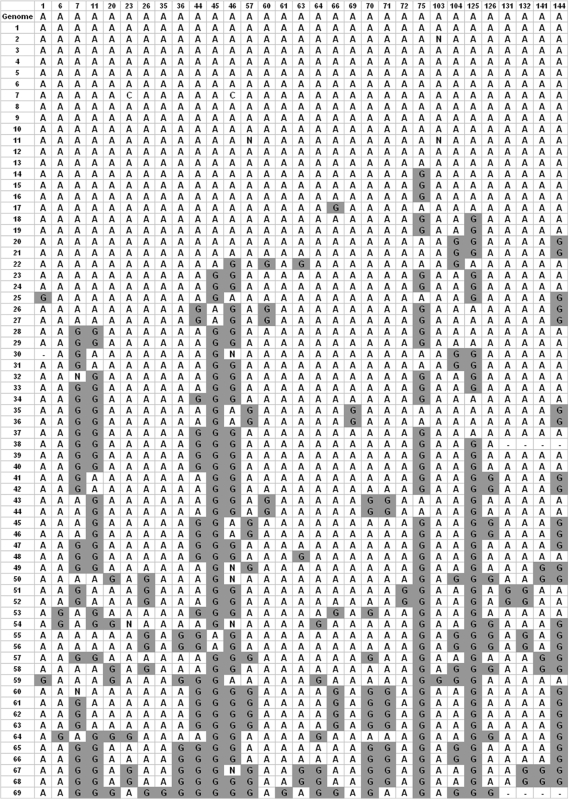
Figure 1.
Figure 1.
Multiple alignment of editing locations. Graphical representation of the alignment with the edited clones. The first row represents the DNA root sequence and the following rows represent clones of RNA. Only locations that have at least one editing event are shown. The filled rectangles with ‘G’ represent editing events. Column numbering gives the location in the complete alignment.
Figure 2.
Figure 2.
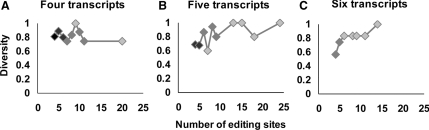
Transcriptome complexity is increased by A-to-I editing. Using a genome-wide dataset, we found groups with equal numbers of transcripts. The number of different transcripts due to editing, for an Alu with four (A), five (B), or six (C) available transcripts in total, shows that editing increases the diversity in the transcriptome. The figures show the diversity—the ratio between the number of different transcripts and maximum possible number of different transcripts—as a function of the number of editing sites. The colors represent the number of sequences found: full black represents more than 15 sequences and light gray represents one sequence—the other shades are values between 1 and 15. Error bars appear in the figure, but are usually too small relative to the data points to be visible.
Figure 3.
Figure 3.
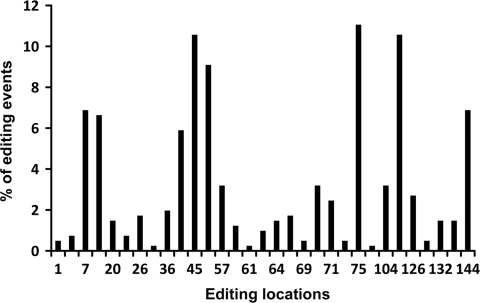
Editing locations and level. Thirty-one editing sites were found in the clones derived from normal brain. The distribution of the editing is not even and eight locations are ‘hot spots’ for editing, with more than 20 editing events in each. About two-thirds of all editing events are found within these hot spots.
Figure 4.
Figure 4.
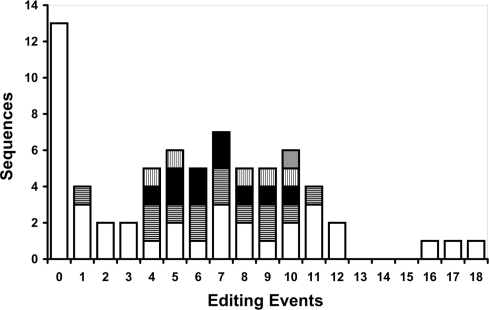
Different populations of clones have the same number of editing sites. The columns in the graph represent the number of RNA sequences, shown for each number of editing events. There is a large number of unedited sequences—13 clones—that are identical to the DNA root (zero editing events). The different color patterns in some of the other columns represent different clone groups (each clone is identical to the others in the group). It can be seen that, for a given number of editing events, there is usually more than one edited transcript.
Figure 5.
Figure 5.
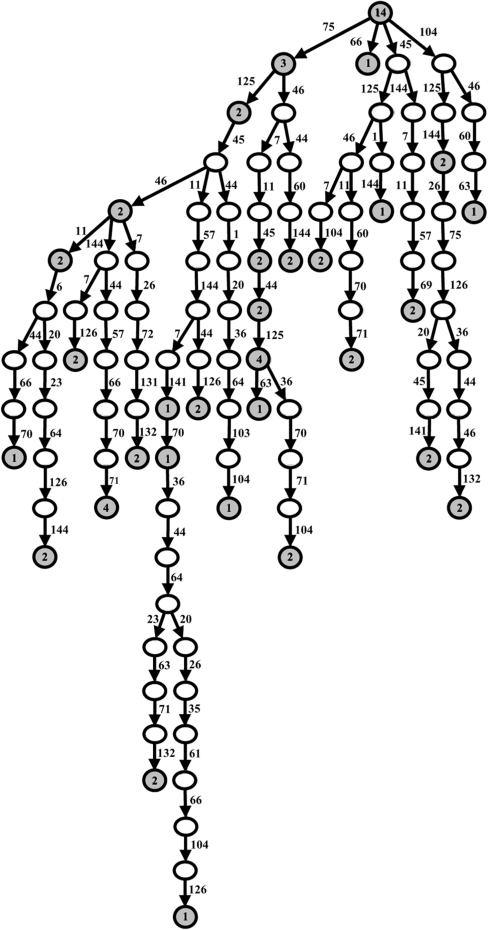
A-to-I editing tree of a normal control sequence. The editing tree was created from the alignment of the cDNA sequences with the DNA sequence. The root of the tree is the DNA sequence and the gray nodes are the edited RNA sequences. The empty nodes are intermediate stages between the DNA and RNA, that were not detected in the library, but were deduced by the program. The numbers in the grey nodes are the numbers of copies found in the alignment where the root of the tree also includes the number of exact copies of the DNA sequence. The numbers beside the edges represent the location of the editing event separating each node from its parents. Every editing event represented by a node is found in all its direct and indirect descendents.

References

    1. Bass BL. RNA editing by adenosine deaminases that act on RNA. Annu. Rev. Biochem. 2002;71:817–846. - PMC - PubMed
    1. Athanasiadis A, Rich A, Maas S. Widespread A-to-I RNA editing of Alu-containing mRNAs in the human transcriptome. PLoS Biol. 2004;2:e391. - PMC - PubMed
    1. Blow M, Futreal PA, Wooster R, Stratton MR. A survey of RNA editing in human brain. Genome Res. 2004;14:2379–2387. - PMC - PubMed
    1. Kim DD, Kim TT, Walsh T, Kobayashi Y, Matise TC, Buyske S, Gabriel A. Widespread RNA editing of embedded alu elements in the human transcriptome. Genome Res. 2004;14:1719–1725. - PMC - PubMed
    1. Levanon EY, Eisenberg E, Yelin R, Nemzer S, Hallegger M, Shemesh R, Fligelman ZY, Shoshan A, Pollock SR, Sztybel D, et al. Systematic identification of abundant A-to-I editing sites in the human transcriptome. Nat. Biotechnol. 2004;22:1001–1005. - PubMed

Publication types