


Anthropoid versus strepsirhine status of the African Eocene primates Algeripithecus and Azibius: craniodental evidence
- PMID: 19740889
- PMCID: PMC2821352
- DOI: 10.1098/rspb.2009.1339
Anthropoid versus strepsirhine status of the African Eocene primates Algeripithecus and Azibius: craniodental evidence
Abstract
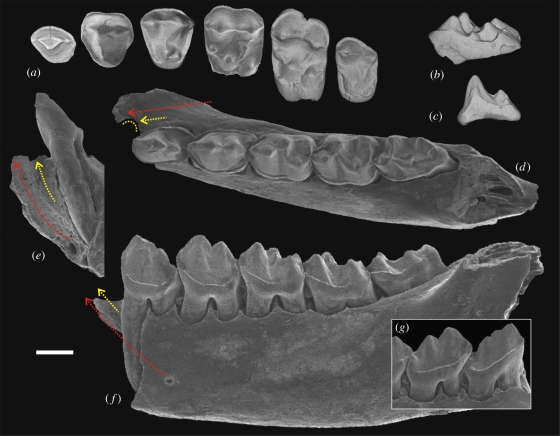
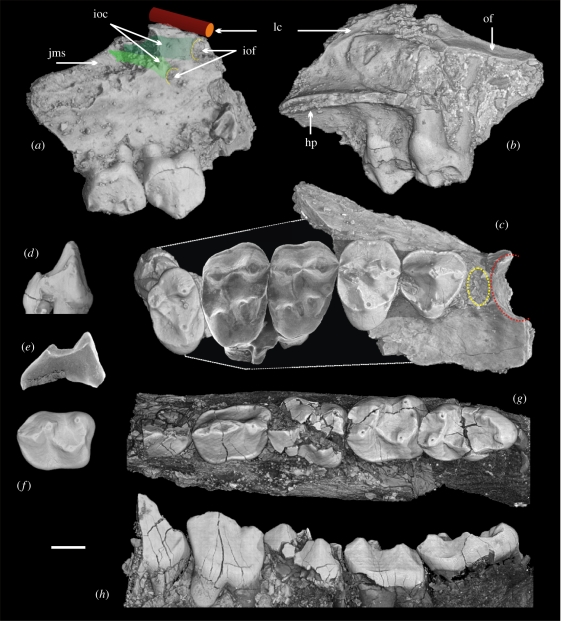
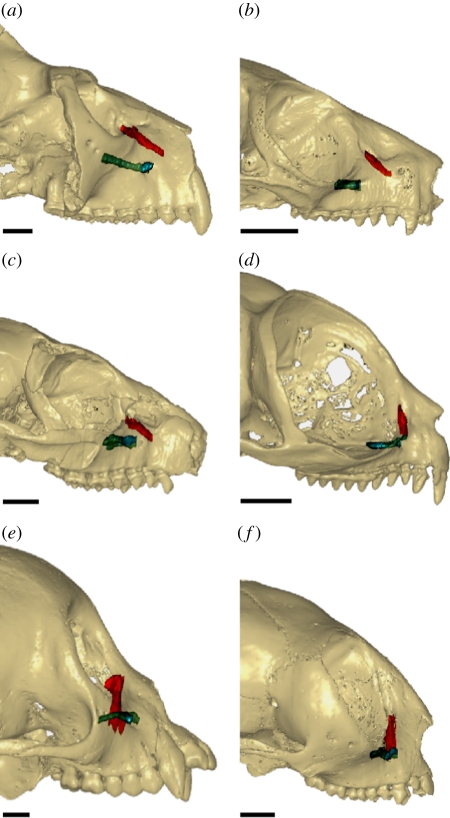
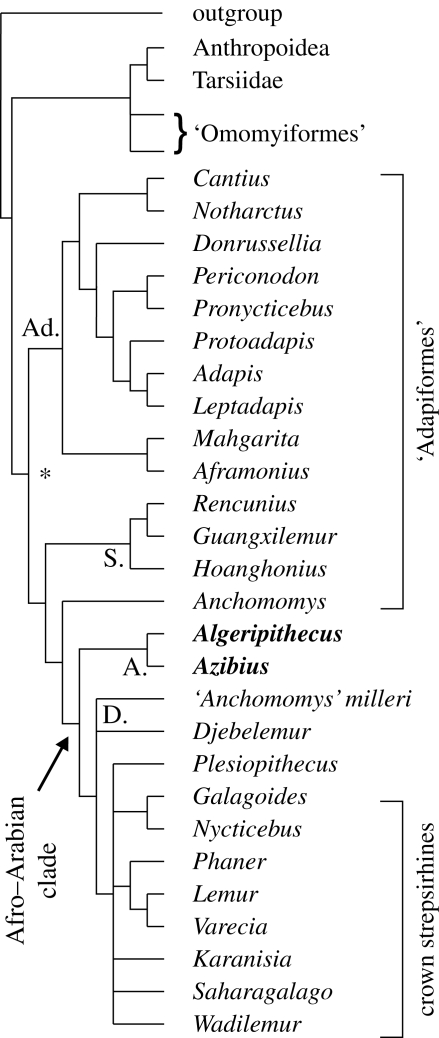
Recent fossil discoveries have demonstrated that Africa and Asia were epicentres for the origin and/or early diversification of the major living primate lineages, including both anthropoids (monkeys, apes and humans) and crown strepsirhine primates (lemurs, lorises and galagos). Competing hypotheses favouring either an African or Asian origin for anthropoids rank among the most hotly contested issues in paleoprimatology. The Afrocentric model for anthropoid origins rests heavily on the >45 Myr old fossil Algeripithecus minutus from Algeria, which is widely acknowledged to be one of the oldest known anthropoids. However, the phylogenetic position of Algeripithecus with respect to other primates has been tenuous because of the highly fragmentary fossils that have documented this primate until now. Recently recovered and more nearly complete fossils of Algeripithecus and contemporaneous relatives reveal that they are not anthropoids. New data support the idea that Algeripithecus and its sister genus Azibius are the earliest offshoots of an Afro-Arabian strepsirhine clade that embraces extant toothcombed primates and their fossil relatives. Azibius exhibits anatomical evidence for nocturnality. Algeripithecus has a long, thin and forwardly inclined lower canine alveolus, a feature that is entirely compatible with the long and procumbent lower canine included in the toothcomb of crown strepsirhines. These results strengthen an ancient African origin for crown strepsirhines and, in turn, strongly challenge the role of Africa as the ancestral homeland for anthropoids.
Figures
References
-
- Adaci M., et al. 2007Nouveaux sites à vertébrés paléogènes dans la région des Gour Lazib (Sahara Nord-occidental, Algérie). C. R. Palevol. 6, 535–544 (doi:10.1016/j.crpv.2007.09.001) - DOI
-
- Ankel-Simons F., Rasmussen D. T.2008Diurnality, nocturnality and the evolution of primate visual systems. Yearbook Phys. Anthro. 137, 100–117 (doi:10.1002/ajpa.20957) - DOI - PubMed
-
- Bajpai S., Kay R. F., Williams B. A., Das D. P., Kapur V. V., Tiwari B. N.2008The oldest Asian record of Anthropoidea. Proc. Natl Acad. Sci. USA 105, 11093–11098 (doi:10.1073/pnas.0804159105) - DOI - PMC - PubMed
-
- Beard K. C.2004The hunt for the dawn monkey: unearthing the origins of monkeys, apes and humans Berkeley, CA: University of California Press
-
- Beard K. C.2006Mammalian biogeography and anthropoid origin. In Primate biogeography (eds Lehman S. M., Fleagle J. G.), pp. 439–467 New York, NY: Springer
Publication types
MeSH terms
LinkOut - more resources
Full Text Sources
