


Total exposure and exposure rate effects for alcohol and smoking and risk of head and neck cancer: a pooled analysis of case-control studies
- PMID: 19745021
- PMCID: PMC2800266
- DOI: 10.1093/aje/kwp222
Total exposure and exposure rate effects for alcohol and smoking and risk of head and neck cancer: a pooled analysis of case-control studies
Abstract
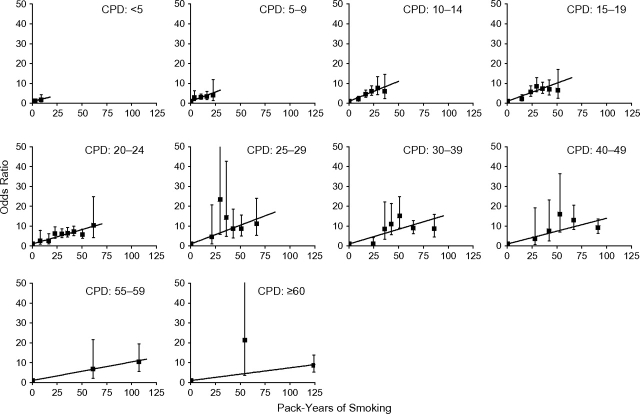
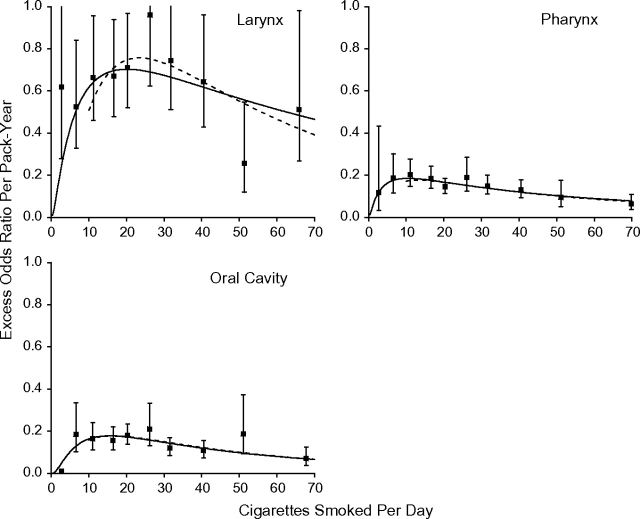
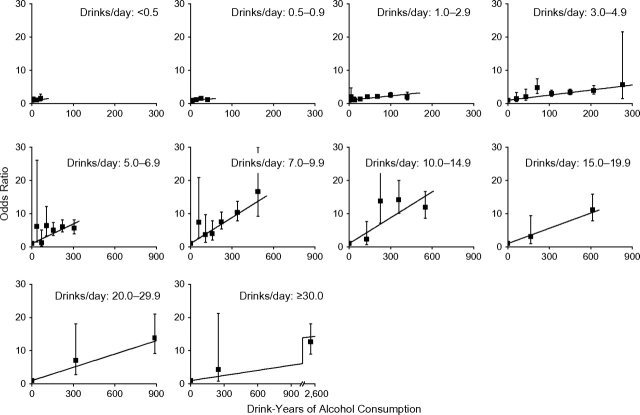
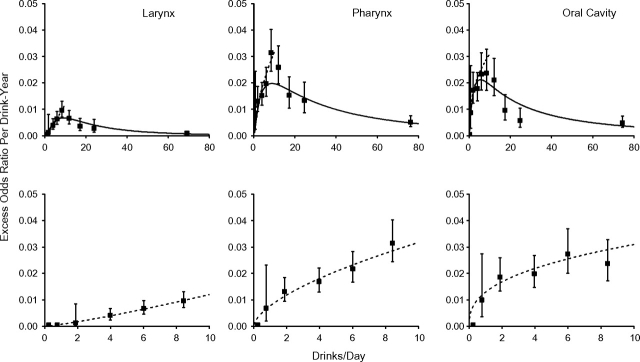
Although cigarette smoking and alcohol consumption increase risk for head and neck cancers, there have been few attempts to model risks quantitatively and to formally evaluate cancer site-specific risks. The authors pooled data from 15 case-control studies and modeled the excess odds ratio (EOR) to assess risk by total exposure (pack-years and drink-years) and its modification by exposure rate (cigarettes/day and drinks/day). The smoking analysis included 1,761 laryngeal, 2,453 pharyngeal, and 1,990 oral cavity cancers, and the alcohol analysis included 2,551 laryngeal, 3,693 pharyngeal, and 3,116 oval cavity cancers, with over 8,000 controls. Above 15 cigarettes/day, the EOR/pack-year decreased with increasing cigarettes/day, suggesting that greater cigarettes/day for a shorter duration was less deleterious than fewer cigarettes/day for a longer duration. Estimates of EOR/pack-year were homogeneous across sites, while the effects of cigarettes/day varied, indicating that the greater laryngeal cancer risk derived from differential cigarettes/day effects and not pack-years. EOR/drink-year estimates increased through 10 drinks/day, suggesting that greater drinks/day for a shorter duration was more deleterious than fewer drinks/day for a longer duration. Above 10 drinks/day, data were limited. EOR/drink-year estimates varied by site, while drinks/day effects were homogeneous, indicating that the greater pharyngeal/oral cavity cancer risk with alcohol consumption derived from the differential effects of drink-years and not drinks/day.
Figures
Comment in
-
" Everything in moderation...? ".Evid Based Dent. 2010;11(3):89-90. doi: 10.1038/sj.ebd.6400744. Evid Based Dent. 2010. PMID: 20938480
References
-
- Mayne AT, Morse DE, Winn DM. Cancers of the oral cavity and pharynx. In: Schottenfeld D, Fraumeni JF Jr, editors. Cancer Epidemiology and Prevention. 3rd ed. New York, NY: Oxford University Press, Inc; 2006. pp. 674–696.
-
- Olshan AF. Cancer of the larynx. In: Schottenfeld D, Fraumeni JF Jr, editors. Cancer Epidemiology and Prevention. 3rd ed. New York, NY: Oxford University Press, Inc; 2006. pp. 627–637.
-
- Lubin JH, Caporaso NE. Cigarette smoking and lung cancer: modeling total exposure and intensity. Cancer Epidemiol Biomarkers Prev. 2006;15(3):517–523. - PubMed
-
- Lubin JH, Alavanja MC, Caporaso N, et al. Cigarette smoking and cancer: modeling total exposure and intensity. Am J Epidemiol. 2007;166(4):479–489. - PubMed
Publication types
MeSH terms
Grants and funding
LinkOut - more resources
Full Text Sources
Medical
