Identification of virulence determinants of Mycobacterium avium that impact on the ability to resist host killing mechanisms
- PMID: 19745033
- PMCID: PMC2887559
- DOI: 10.1099/jmm.0.012864-0
Identification of virulence determinants of Mycobacterium avium that impact on the ability to resist host killing mechanisms
Abstract
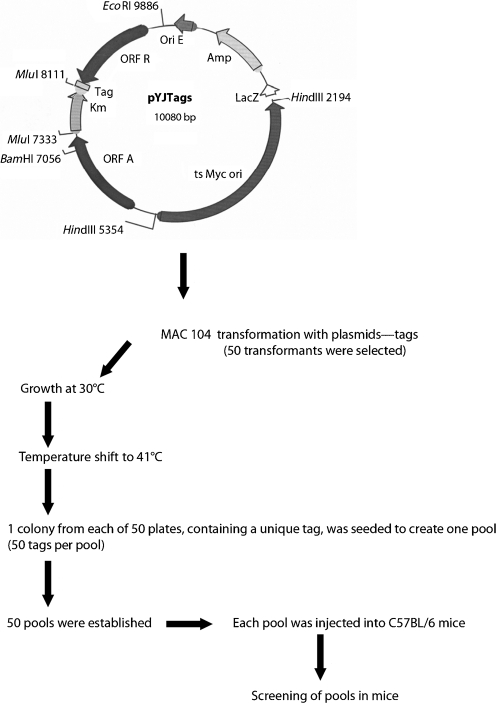
Mycobacterium avium is an opportunistic pathogen associated with pulmonary disease in non-AIDS patients and disseminated infection in patients with AIDS. The chief route of infection is by colonization and invasion of the mucosa of the gastrointestinal tract, but infection through the respiratory route also occurs. After crossing the mucosa, M. avium infects and replicates within tissue macrophages. To identify M. avium genes required for survival in vivo, a library of signature-tagged transposon mutants was constructed and screened for clones attenuated in mice. Thirty-two clones were found to be attenuated for their virulence, from which eleven were sequenced and tested further. All the mutants studied grew similarly in vitro to the wild-type MAC104. Ten mutants were tested individually in mice, confirming the attenuated phenotype. MAV_2450, a polyketide synthase homologue to Mycobacterium tuberculosis pks12, was identified. STM5 and STM10 genes (encoding two hypothetical proteins MAV_4292 and MAV_4012) were associated with susceptibility to oxidative products. Mutants MAV_2450, MAV_4292, MAV_0385 and MAV_4264 live in macrophage vacuoles with acidic pH (below 6.9). Mutants MAV_4292, MAV_0385 and MAV_4264 were susceptible to nitric oxide in vitro. The study of individual mutants can potentially lead to new knowledge about M. avium pathogenic mechanisms.
Figures
References
-
- Bermudez, L. E. & Young, L. S. (1989). Oxidative and non-oxidative intracellular killing of Mycobacterium avium complex. Microb Pathog 7, 289–298. - PubMed
-
- Bermudez, L. E., Petrofsky, M., Kolonoski, P. & Young, L. S. (1992). An animal model of Mycobacterium avium complex disseminated infection after colonization of the intestinal tract. J Infect Dis 165, 75–79. - PubMed
Publication types
MeSH terms
Substances
Grants and funding
LinkOut - more resources
Full Text Sources
Medical