


doi: 10.1093/nar/gkp687.
Epub 2009 Sep 10.
Synthesis of DNA fragments in yeast by one-step assembly of overlapping oligonucleotides
Affiliations
- PMID: 19745056
- PMCID: PMC2777417
- DOI: 10.1093/nar/gkp687
Item in Clipboard
Synthesis of DNA fragments in yeast by one-step assembly of overlapping oligonucleotides
Nucleic Acids Res.
2009 Nov.
Abstract
Here it is demonstrated that the yeast Saccharomyces cerevisiae can take up and assemble at least 38 overlapping single-stranded oligonucleotides and a linear double-stranded vector in one transformation event. These oligonucleotides can overlap by as few as 20 bp, and can be as long as 200 nucleotides in length. This straightforward scheme for assembling chemically-synthesized oligonucleotides could be a useful tool for building synthetic DNA molecules.
Figures
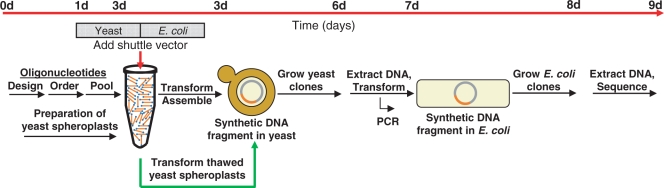
Schematic overview and timeline for the assembly of overlapping ssDNA oligonucleotides (orange lines with blue circles) into a linear dsDNA yeast/E. coli shuttle vector (pRS313; grey) within the nucleus of a yeast cell. Following a single transformation event, a synthetic dsDNA fragment (orange) is produced. These fragments are recovered from yeast and then transferred to E. coli for more efficient amplification.

Assembly of 38 overlapping 60-mer oligonucleotides in yeast. (a) The 38 oligonucleotides, named 1–38 u, have 30 bp overlaps and produce a 1170 bp synthetic DNA fragment following assembly. The terminal oligonucleotides overlap the vector (grey) by 20 bp (red x). Ten nucleotide gaps (green) are repaired inside the yeast cell. (b) PCR analysis of 12 randomly selected yeast clones following transformation and assembly of the oligonucleotides and vector depicted in (a). The primers used for this PCR analysis and for DNA sequencing are M13F and M13R and are shown in (a). The predicted amplicon size for a complete assembly is 1393 bp and is indicated by an asterisk. The presence (+) or absence (−) of the expected product is noted for each clone screened. L indicates the 1 kb DNA ladder (NEB).

Twenty base-pair overlaps are sufficient for oligonucleotide assembly in yeast. (a and b) Schematic demonstrating the assembly of eight 60-mers, named A–H, or their reverse complements, named Arc–Hrc. The oligonucleotides each contain 20 bp overlaps and were assembled into a vector to produce a 340 bp synthetic DNA fragment. The terminal oligonucleotides overlap the vector (grey) by 20 bp (red x). Twenty nucleotide gaps (green) were repaired inside the yeast cell. (c and d) PCR analysis of four randomly selected yeast clones following transformation and assembly of oligonucleotides A–H (c) as depicted in (a) or oligonucleotides A–rc–H–rc (d) as depicted in (b). The predicted amplicon size for a complete assembly is 563 bp and is indicated by an asterisk. M indicates the 100 bp DNA ladder (NEB). (e) Assembly of 28 60-mers, named 1–28 g, containing 20 bp overlaps, to produce a 1140 bp synthetic DNA fragment. (f) PCR analysis of 12 randomly selected yeast clones following transformation and assembly of the oligonucleotides and vector shown in (e). The predicted amplicon size for a complete assembly is 1363 bp and is indicated by an asterisk.

High-fidelity oligonucleotide assembly in yeast. (a) Schematic demonstrating the assembly of six 200-mers, named HF1–HF6. The oligonucleotides each contain 20 bp overlaps and were assembled into a vector to produce a 1100 bp synthetic DNA fragment. The terminal oligonucleotides overlap the vector (grey) by 20 bp (red x). One hundred sixty nucleotide gaps (green) were repaired inside the yeast cell. (b) NotI restriction analysis of 10 E. coli clones containing synthetic DNA fragments that were assembled in yeast. Products were separated by gel-electrophoresis on a 2% E-gel. The predicted size for a complete assembly (C) is 1052 bp and is indicated by an asterisk. This analysis also revealed no assembly (N), multiple assembly (M) and partial assembly (P) of oligonucleotides.
References
-
- Agarwal KL, Buchi H, Caruthers MH, Gupta N, Khorana HG, Kleppe K, Kumar A, Ohtsuka E, Rajbhandary UL, Van de Sande JH, et al. Total synthesis of the gene for an alanine transfer ribonucleic acid from yeast. Nature. 1970;227:27–34. - PubMed
-
- Reese CB. Oligo- and poly-nucleotides: 50 years of chemical synthesis. Org. Biomol. Chem. 2005;3:3851–3868. - PubMed
-
- Xiong AS, Peng RH, Zhuang J, Gao F, Li Y, Cheng ZM, Yao QH. Chemical gene synthesis: strategies, softwares, error corrections, and applications. FEMS Microbiol. Rev. 2008;32:522–540. - PubMed
-
- Xiong AS, Peng RH, Zhuang J, Liu JG, Gao F, Chen JM, Cheng ZM, Yao QH. Non-polymerase-cycling-assembly-based chemical gene synthesis: strategies, methods, and progress. Biotechnol. Adv. 2008;26:121–134. - PubMed
-
- Czar MJ, Anderson JC, Bader JS, Peccoud J. Gene synthesis demystified. Trends Biotechnol. 2008;27:63–72. - PubMed
Publication types
MeSH terms
Substances
LinkOut - more resources
Full Text Sources
Other Literature Sources
Molecular Biology Databases
