


Comparative proteomic analysis of the PhoP regulon in Salmonella enterica serovar Typhi versus Typhimurium
- PMID: 19746165
- PMCID: PMC2736619
- DOI: 10.1371/journal.pone.0006994
Comparative proteomic analysis of the PhoP regulon in Salmonella enterica serovar Typhi versus Typhimurium
Abstract
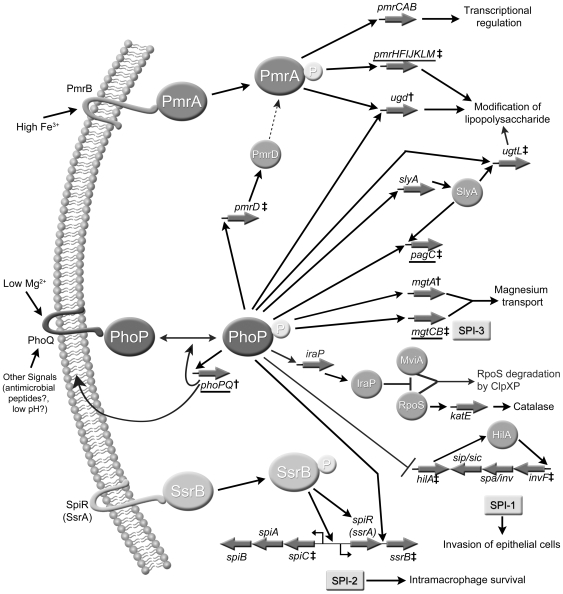
Background: S. Typhi, a human-restricted Salmonella enterica serovar, causes a systemic intracellular infection in humans (typhoid fever). In comparison, S. Typhimurium causes gastroenteritis in humans, but causes a systemic typhoidal illness in mice. The PhoP regulon is a well studied two component (PhoP/Q) coordinately regulated network of genes whose expression is required for intracellular survival of S. enterica.
Methodology/principal findings: Using high performance liquid chromatography mass spectrometry (HPLC-MS/MS), we examined the protein expression profiles of three sequenced S. enterica strains: S. Typhimurium LT2, S. Typhi CT18, and S. Typhi Ty2 in PhoP-inducing and non-inducing conditions in vitro and compared these results to profiles of phoP(-)/Q(-) mutants derived from S. Typhimurium LT2 and S. Typhi Ty2. Our analysis identified 53 proteins in S. Typhimurium LT2 and 56 proteins in S. Typhi that were regulated in a PhoP-dependent manner. As expected, many proteins identified in S. Typhi demonstrated concordant differential expression with a homologous protein in S. Typhimurium. However, three proteins (HlyE, STY1499, and CdtB) had no homolog in S. Typhimurium. HlyE is a pore-forming toxin. STY1499 encodes a stably expressed protein of unknown function transcribed in the same operon as HlyE. CdtB is a cytolethal distending toxin associated with DNA damage, cell cycle arrest, and cellular distension. Gene expression studies confirmed up-regulation of mRNA of HlyE, STY1499, and CdtB in S. Typhi in PhoP-inducing conditions.
Conclusions/significance: This study is the first protein expression study of the PhoP virulence associated regulon using strains of Salmonella mutant in PhoP, has identified three Typhi-unique proteins (CdtB, HlyE and STY1499) that are not present in the genome of the wide host-range Typhimurium, and includes the first protein expression profiling of a live attenuated bacterial vaccine studied in humans (Ty800).
Conflict of interest statement
Figures
References
-
- Parry CM, Hien TT, Dougan G, White NJ, Farrar JJ. Typhoid fever. N Engl J Med. 2002;347:1770–1782. - PubMed
-
- Parkhill J, Dougan G, James KD, Thomson NR, Pickard D, et al. Complete genome sequence of a multiple drug resistant Salmonella enterica serovar Typhi CT18. Nature. 2001;413:848–852. - PubMed
-
- Miller SI, Loomis WP, Alpuche-Aranda C, Behlau I, Hohmann E. The PhoP virulence regulon and live oral Salmonella vaccines. Vaccine. 1993;11:122–125. - PubMed
Publication types
MeSH terms
Substances
Grants and funding
- AI058935/AI/NIAID NIH HHS/United States
- R01 AI067103/AI/NIAID NIH HHS/United States
- K08 AI089721/AI/NIAID NIH HHS/United States
- TW05572/TW/FIC NIH HHS/United States
- AI67103/AI/NIAID NIH HHS/United States
- K01 TW007144/TW/FIC NIH HHS/United States
- R21 NS059429/NS/NINDS NIH HHS/United States
- K01 TW007409/TW/FIC NIH HHS/United States
- K01 TW07144/TW/FIC NIH HHS/United States
- U54 AI057159/AI/NIAID NIH HHS/United States
- NS059429/NS/NINDS NIH HHS/United States
- U01 AI058935/AI/NIAID NIH HHS/United States
- D43 TW005572/TW/FIC NIH HHS/United States
- AI072599/AI/NIAID NIH HHS/United States
- R21 AI072599/AI/NIAID NIH HHS/United States
LinkOut - more resources
Full Text Sources
Molecular Biology Databases
Research Materials
