


Infectious agents detected in the feces of diarrheic foals: a retrospective study of 233 cases (2003-2008)
- PMID: 19747192
- PMCID: PMC7166729
- DOI: 10.1111/j.1939-1676.2009.0383.x
Infectious agents detected in the feces of diarrheic foals: a retrospective study of 233 cases (2003-2008)
Abstract
Background: Diarrhea is common in foals but there are no studies investigating the relative prevalence of common infectious agents in a population of hospitalized diarrheic foals.
Objectives: To determine the frequency of detection of infectious agents in a population of hospitalized foals with diarrhea and to determine if detection of specific pathogens is associated with age, outcome, or clinicopathologic data.
Animals: Two hundred and thirty-three foals < or = 10 months of age with diarrhea examined at a referral institution.
Methods: Retrospective case series. Each foal was examined for Salmonella spp., viruses, Clostridium difficile toxins, Clostridium perfringens culture, C. perfringens enterotoxin, Cryptosporidium spp., and metazoan parasites in feces collected at admission or at the onset of diarrhea.
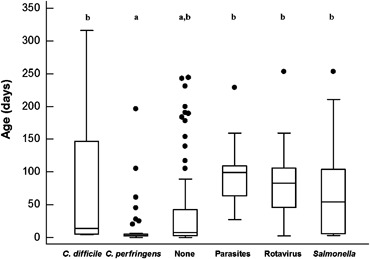
Results: At least 1 infectious agent was detected in 122 foals (55%). Rotavirus was most frequently detected (20%) followed by C. perfringens (18%), Salmonella spp. (12%), and C. difficile (5%). Foals < 1 month of age were significantly more likely to be positive for C. perfringens (odds ratio [OR] = 15, 95% confidence interval [CI] = 3.5-66) or to have negative fecal diagnostic results (OR = 3.0, 95% CI = 1.7-5.2) than older foals. Foals > 1 month of age were significantly more likely to have Salmonella spp. (OR = 2.6, 95% CI = 1.2-6.0), rotavirus (OR = 13.3, 95% CI = 5.3-33), and parasites (OR = 23, 95% CI = 3.1-185) detected compared with younger foals. Overall 191 of the 223 foals (87%) survived. The type of infectious agent identified in the feces or bacteremia was not significantly associated with survival.
Conclusions and clinical importance: In the population studied, foals with diarrhea had a good prognosis regardless of which infectious agent was identified in the feces.
Figures
References
-
- Urquhart K. Diarrhoea in foals. In Pract 1981;3:22–23, 25, 27, 29. - PubMed
-
- Lester GD, Madigan JE. Diarrhea in neonatal foals In: Smith BP, ed. Large Animal Internal Medicine, 4th ed St Louis, MO: Mosby‐Elsevier; 2009:315–319.
-
- Magdesian KG, Hirsh DC, Jang SS, et al Characterization of Clostridium difficile isolates from foals with diarrhea: 28 cases (1993–1997). J Am Vet Med Assoc 2002;220:67–73. - PubMed
MeSH terms
LinkOut - more resources
Full Text Sources
Medical
Miscellaneous
