Review
. 2010 Jan;42(1):1-4.
doi: 10.1016/j.biocel.2009.09.002. Epub 2009 Sep 9.

Clara cell: progenitor for the bronchiolar epithelium

Affiliations
Review

Clara cell: progenitor for the bronchiolar epithelium

Susan D Reynolds et al. Int J Biochem Cell Biol. 2010 Jan.

Abstract

Clara cells were first described as a morphologically distinct cell type by Kolliker in 1881, but they take their name from the seminal study of human and rabbit bronchioles by Max Clara in 1937. Since their discovery, Clara cells have been identified as central players in protecting the airway from environmental exposures. The diverse functions of Clara cells in lung homeostasis include roles in xenobiotic metabolism, immune system regulation, and progenitor cell activity. Recent identification of a sub-population of Clara cells as a bronchiolar tissue-specific stem cell and a potential tumor initiating cell has focused the attention of cell and molecular biologists on the Clara cell and its behavior under normal and disease conditions.


Figures
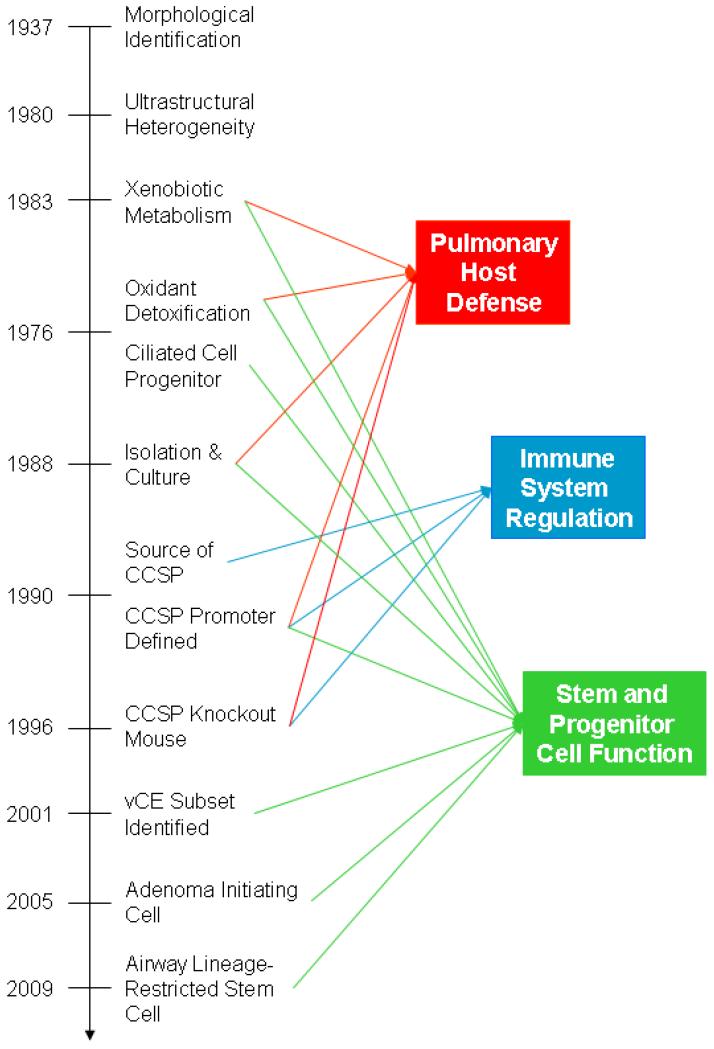
Figure 1
Figure 1
Clara cells were discovered in the early twentieth century. Structural and functional analyses revealed roles in pulmonary host defense, immune system regulation, and epithelial repair.
Figure 2
Figure 2
A. Scanning electron micrograph of the lining of the proximal bronchiole of a rat showing Clara cells, some of which are undergoing apocrine secretion (arrows), surrounded by ciliated cells. (Bar = 10um). B. Transmission electron micrograph of a terminal bronchiolar Clara cell. Numerous mitochondria (M), secretory granules (S), rough endoplasmic reticulum (RER), and the basal nucleus (N) are indicated.
Figure 3
Figure 3
Clara cell diversity: Clara cell structure and function varies as the lung milieu changes. In the normal adult lung, Clara cells are non-mitotic and perform essential homeostatic functions. Epithelial injury activates quiescent stem cells (vCE) resulting in self-renewal (elliptical line) and generation of facultative progenitor cells (Clara). Injury can also initiate dedifferentiation of Clara cells (dashed arrow) to a Type A intermediate. Type A cells divide (double-headed arrow) and generate two daughter cell types, ciliated cells and maturing (slightly differentiated) cells (Type B). Type B cells can differentiate (dashed arrow) into Clara cells. Some injuries stimulate mucus secretion by Clara cells (Mucus cell).
Figure 4
Figure 4
Biomarker expression in a spontaneous lung adenocarcinoma. A. Triple color image in which CCSP (red), proSPC (green), and nuclei (blue) are detected by dual immunofluorescence. CCSP-proSPC dual positive cells are indicated by yellow arrows. Airway CCSP+ cells are intentionally overstained to allow detection of CCSP+ tumor cells. B. Analysis of label-retaining cells. Cells “born” 120 days prior to analysis are indicated by autoradiographic grains (black dots). Cells of similar age in unaffected airway (blue arrow) and in tumor tissue (black arrows) are shown at higher magnification in insets C and D.

References

    1. Evans CM, Williams OW, Tuvim MJ, Nigam R, Mixides GP, Blackburn MR, DeMayo FJ, Burns AR, Smith C, Reynolds SD, et al. Mucin is produced by clara cells in the proximal airways of antigen-challenged mice. Am J Respir Cell Mol Biol. 2004;31:382–394. - PMC - PubMed
    1. Giangreco A, Arwert EN, Rosewell IR, Snyder J, Watt FM, Stripp BR. Stem cells are dispensable for lung homeostasis but restore airways after injury. Proc Natl Acad Sci U S A. 2009;106:9286–9291. - PMC - PubMed
    1. Hoyt RF, Jr., McNelly NA, McDowell EM, Sorokin SP. Neuroepithelial bodies stimulate proliferation of airway epithelium in fetal hamster lung. Am J Physiol. 1991;260:L234–240. - PubMed
    1. Ito T, Udaka N, Yazawa T, Okudela K, Hayashi H, Sudo T, Guillemot F, Kageyama R, Kitamura H. Basic helix-loop-helix transcription factors regulate the neuroendocrine differentiation of fetal mouse pulmonary epithelium. Development. 2000;127:3913–3921. - PubMed
    1. Khoor A, Gray ME, Singh G, Stahlman MT. Ontogeny of Clara cell-specific protein and its mRNA: their association with neuroepithelial bodies in human fetal lung and in bronchopulmonary dysplasia. J Histochem Cytochem. 1996;44:1429–1438. - PubMed

Publication types
