


Salvage allogeneic hematopoietic cell transplantation with fludarabine and low-dose total body irradiation after rejection of first allografts
- PMID: 19747640
- PMCID: PMC2757150
- DOI: 10.1016/j.bbmt.2009.06.011
Salvage allogeneic hematopoietic cell transplantation with fludarabine and low-dose total body irradiation after rejection of first allografts
Abstract
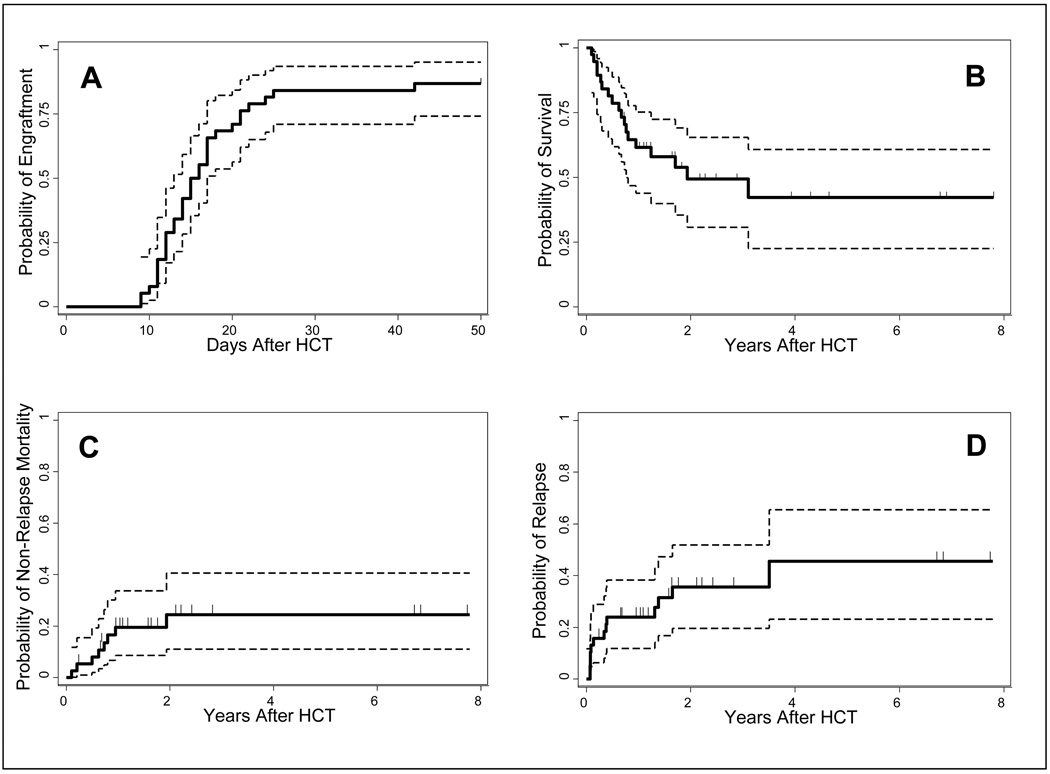
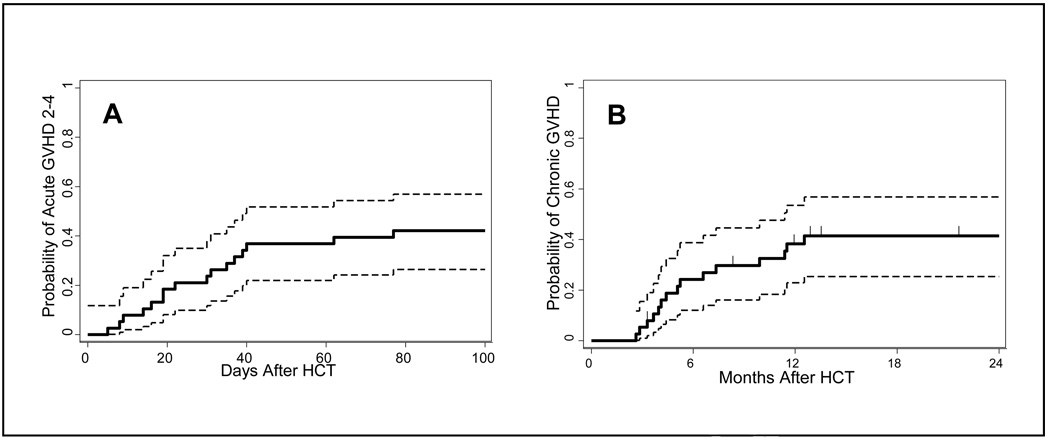
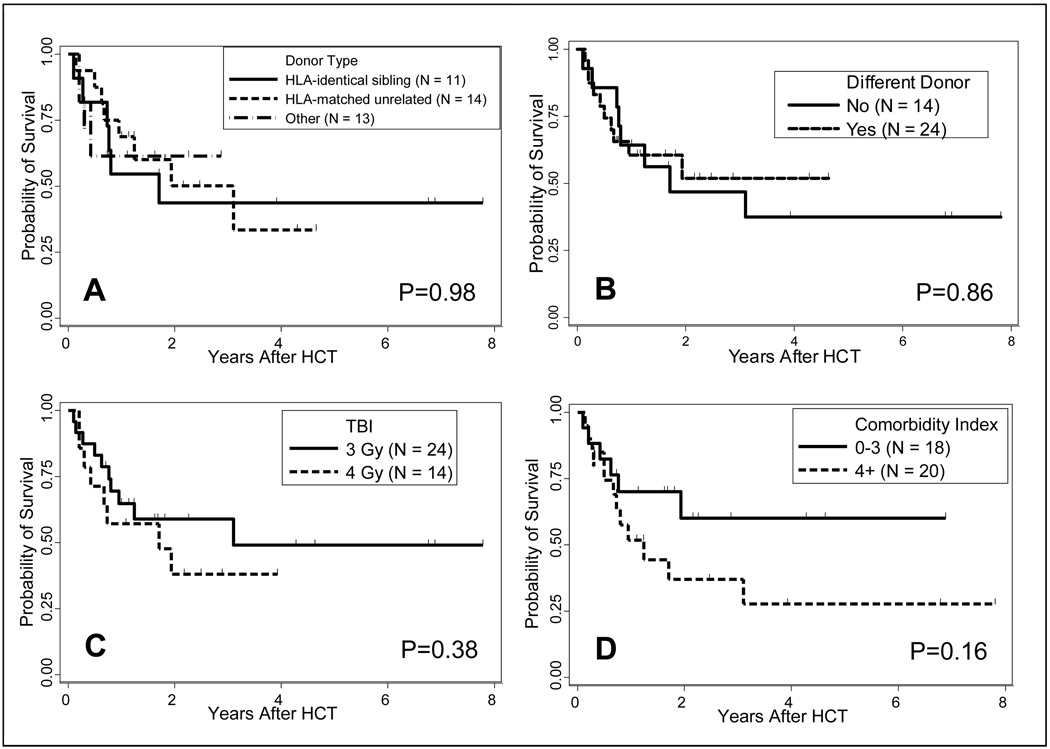
We summarized results in 38 consecutive patients (median age=56 years) with hematologic malignancies (n=35), aplastic anemia (n=2), or renal cell carcinoma (n=1), who underwent salvage hematopoietic cell transplantation (HCT) for allograft rejection. In 14 patients, the original donors were used for salvage HCT, and, in 24 cases, different donors were used. Conditioning for salvage HCT consisted of fludarabine (Flu) and either 3 or 4 Gy total body irradiation (TBI). Sustained engraftment was achieved in 33 patients (87%). Grafts were rejected in 5 patients (13%), 4 of whom had myelofibrosis. With a median follow-up of 2 years (range: 0.3 to 7.8 years), the 2- and 4-year estimated survivals were 49% and 42%, respectively. The 2-year relapse rate and nonrelapse mortality (NRM) were 36% and 24%, respectively. The 2-year cumulative incidences of grades II-IV acute and moderate-severe chronic graft-versus-host disease (aGVHD, cGVHD) were 42% and 41%, respectively. In this cohort, TBI dose, grafts from original versus different donors, related versus unrelated donors, and HCT comorbidity scores did not have an impact on outcomes. We concluded that graft rejection after allogeneic HCT could be overcome by salvage transplantation using conditioning with Flu and low-dose TBI.
Figures
References
-
- Thomas ED, Storb R, Clift RA, et al. Bone-marrow transplantation. N Engl J Med. 1975;292:832–843. 895–902. - PubMed
-
- Kernan NA, Bartsch G, Ash RC, et al. Analysis of 462 transplantations from unrelated donors facilitated by The National Marrow Donor Program. N Engl J Med. 1993;328:593–602. - PubMed
-
- Niederwieser D, Maris M, Shizuru JA, et al. Low-dose total body irradiation (TBI) and fludarabine followed by hematopoietic cell transplantation (HCT) from HLA-matched or mismatched unrelated donors and postgrafting immunosuppression with cyclosporine and mycophenolate mofetil (MMF) can induce durable complete chimerism and sustained remissions in patients with hematological diseases. Blood. 2003;101:1620–1629. - PubMed
-
- Maris MB, Niederwieser D, Sandmaier BM, et al. HLA-matched unrelated donor hematopoietic cell transplantation after nonmyeloablative conditioning for patients with hematologic malignancies. Blood. 2003;102:2021–2030. - PubMed
Publication types
MeSH terms
Substances
Grants and funding
- CA18029/CA/NCI NIH HHS/United States
- HL36444/HL/NHLBI NIH HHS/United States
- CA49605/CA/NCI NIH HHS/United States
- R00 HL088021/HL/NHLBI NIH HHS/United States
- CA15704/CA/NCI NIH HHS/United States
- P01 HL036444/HL/NHLBI NIH HHS/United States
- P01 CA078902/CA/NCI NIH HHS/United States
- HL088021/HL/NHLBI NIH HHS/United States
- P01 CA018029/CA/NCI NIH HHS/United States
- P30 CA015704/CA/NCI NIH HHS/United States
- CA78902/CA/NCI NIH HHS/United States
- K99 HL088021/HL/NHLBI NIH HHS/United States
- P01 CA049605/CA/NCI NIH HHS/United States
LinkOut - more resources
Full Text Sources
Medical
