


Cryptosporidium propidium monoazide-PCR, a molecular biology-based technique for genotyping of viable Cryptosporidium oocysts
- PMID: 19749067
- PMCID: PMC2772443
- DOI: 10.1128/AEM.00540-09
Cryptosporidium propidium monoazide-PCR, a molecular biology-based technique for genotyping of viable Cryptosporidium oocysts
Abstract
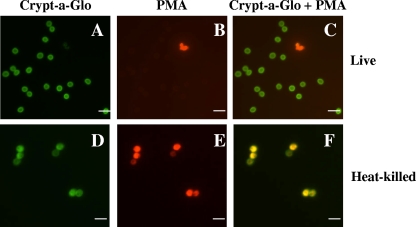
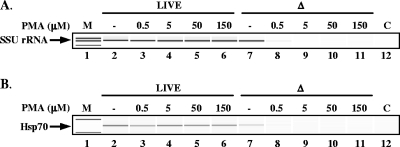
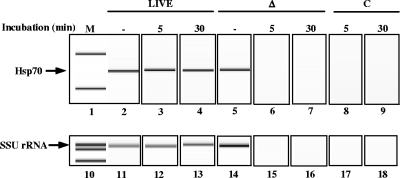
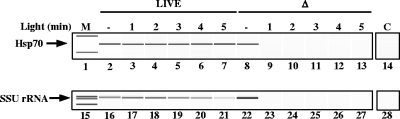
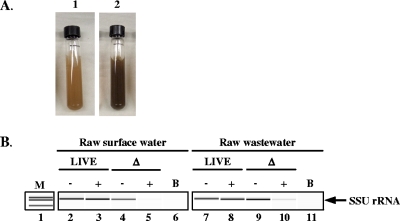
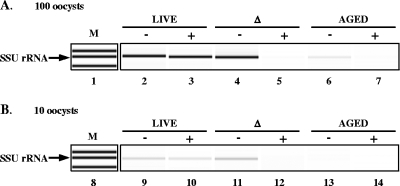
Cryptosporidium is an important waterborne protozoan parasite that can cause severe diarrhea and death in the immunocompromised. The current methods used to monitor for Cryptosporidium oocysts in water are the microscopy-based USEPA methods 1622 and 1623. These methods assess total levels of oocysts in source waters, but do not determine oocyst viability or genotype. Recently, propidium monoazide (PMA) has been used in conjunction with molecular diagnostic tools to identify species and assess the viability of bacteria. The goal of this study was the development of a Cryptosporidium PMA-PCR (CryptoPMA-PCR) assay that includes PMA treatment prior to PCR analysis in order to prevent the amplification of DNA from dead oocysts. The results demonstrated that PMA penetrates only dead oocysts and blocks amplification of their DNA. The CryptoPMA-PCR assay can also specifically detect live oocysts within a mixed population of live and dead oocysts. More importantly, live oocysts, not dead oocysts, were detected in raw waste or surface water samples spiked with Cryptosporidium oocysts. This proof-of-concept study is the first to demonstrate the use of PMA for pre-PCR treatment of Cryptosporidium oocysts. The CryptoPMA-PCR assay is an attractive approach to specifically detect and genotype viable Cryptosporidium oocysts in the water, which is critical for human health risk assessment.
Figures
References
-
- Arrowood, M. J. 2008. In vitro cultivation, p. 499-526. In R. Fayer and L. Xiao (ed.), Cryptosporidium and cryptosporidiosis, 2nd ed. CRC Press and IWA Publishing, Boca Raton, FL.
-
- Arrowood, M. J., L. T. Xie, K. Rieger, and J. Dunn. 1996. Disinfection of Cryptosporidium parvum oocysts by pulsed light treatment evaluated in an in vitro cultivation model. J. Eukaryot. Microbiol. 43:88S. - PubMed
-
- Baeumner, A. J., M. C. Humiston, R. A. Montagna, and R. A. Durst. 2001. Detection of viable oocysts of Cryptosporidium parvum following nucleic acid sequence based amplification. Anal. Chem. 73:1176-1180. - PubMed
-
- Bednarska, M., A. Bajer, E. Sinski, A. S. Girouard, L. Tamang, and T. K. Graczyk. 2007. Fluorescent in situ hybridization as a tool to retrospectively identify Cryptosporidium parvum and Giardia lamblia in samples from terrestrial mammalian wildlife. Parasitol. Res. 100:455-460. - PubMed
Publication types
MeSH terms
Substances
LinkOut - more resources
Full Text Sources
Other Literature Sources
