


Metacognitive Judgments and Control of Study
- PMID: 19750138
- PMCID: PMC2742428
- DOI: 10.1111/j.1467-8721.2009.01628.x
Metacognitive Judgments and Control of Study
Abstract
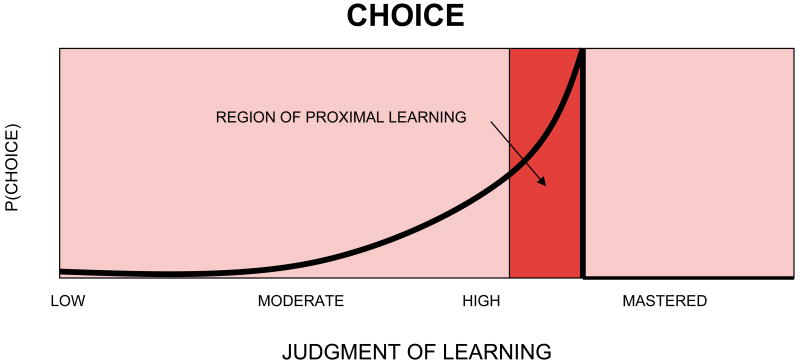
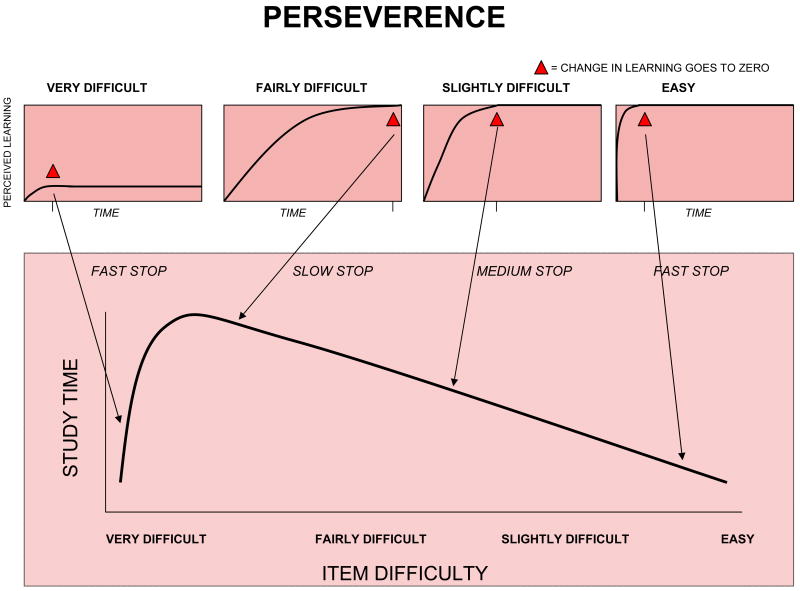
Recent evidence indicates that people's judgments of their own learning are causally related to their study behavior and not epiphenomenal. I argue here that people use these metacognitions in an effort to selectively study material in their own region of proximal learning. First they attempt to eliminate materials that are already well learned. Then they progress successively from studying easier to more difficult materials. Successful implementation of this metacognitively guided strategy enhances learning. The necessary components are, first, that the metacognitions be accurate, and second, that the appropriate choices are implemented for study. With these parts in place, the individual is in position to effectively take control of his or her own learning.
Figures
References
-
- Bjork RA. Memory and metamemory considerations in the training of human beings. In: Metcalfe J, Shimamura AP, editors. Metacognition: Knowing about knowing. Cambridge, MA: MIT Press; 1994. pp. 185–206.
-
- Dunlosky J, Hertzog C. Training programs to improve learning in later adulthood: Helping older adults educate themselves. In: Hacker DJ, Dunlosky J, Graesser AC, editors. Metacognition in educational theory and practice. Mahwah, NJ: Erlbaum; 1998. pp. 249–275.
-
- Dunlosky J, Lipko AR. Metacomprehension: A brief history and how to improve its accuracy. Current Directions in Psychological Science. 2007;16:228–232.
-
- Dunlosky J, Nelson TO. Importance of kind of cue for judgments of learning (JOL) and the delayed-JOL effect. Memory & Cognition. 1992;20:374–380. - PubMed
Recommended Reading
-
- Nelson TO, Narens L. Metamemory: A theoretical framework and new findings. In: Bower GH, editor. The psychology of learning and motivation. Vol. 26. New York: Academic Press; 1990. pp. 125–141.
-
A classic paper that influenced all subsequent research on metacognition and on the connections between metacognition, control, and learning; discusses metatheoretical and philosophical implications of metacognition.
-
- Kuhn D, Dean D., Jr Metacognition: A bridge between cognitive psychology and educational practice. Theory Into Practice. 2004;43:268–273.
-
A fascinating study on how the mechanisms of metacognition may be applied in education and provide a bridge between educational practitioners and academic researchers, resulting in a cross fertilization that may greatly foster the educational goal of critical thinking so valued in our society.
-
- Dunlosky J, Metcalfe J. Metacognition. San Francisco: Sage; 2008.
-
A comprehensive textbook providing a thorough grounding in all aspects of human metacognition, both theoretical and applied.
Grants and funding
LinkOut - more resources
Full Text Sources