


Monocyte transplantation for neural and cardiovascular ischemia repair
- PMID: 19754667
- PMCID: PMC3823455
- DOI: 10.1111/j.1582-4934.2009.00903.x
Monocyte transplantation for neural and cardiovascular ischemia repair
Abstract
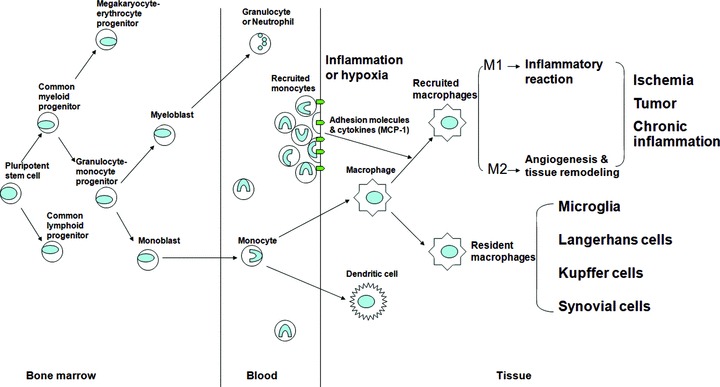
Neovascularization is an integral process of inflammatory reactions and subsequent repair cascades in tissue injury. Monocytes/macrophages play a key role in the inflammatory process including angiogenesis as well as the defence mechanisms by exerting microbicidal and immunomodulatory activity. Current studies have demonstrated that recruited monocytes/macrophages aid in regulating angiogenesis in ischemic tissue, tumours and chronic inflammation. In terms of neovascularization followed by tissue regeneration, monocytes/macrophages should be highly attractive for cell-based therapy compared to any other stem cells due to their considerable advantages: non-oncogenic, non-teratogenic, multiple secretary functions including pro-angiogenic and growth factors, straightforward cell harvesting procedure and non-existent ethical controversy. In addition to adult origins such as bone marrow or peripheral blood, umbilical cord blood (UCB) can be a potential source for autologous or allogeneic monocytes/macrophages. Especially, UCB monocytes should be considered as the first candidate owing to their feasibility, low immune rejection and multiple characteristic advantages such as their anti-inflammatory properties by virtue of their unique immune and inflammatory immaturity, and their pro-angiogenic ability. In this review, we present general characteristics and potential of monocytes/macrophages for cell-based therapy, especially focusing on neovascularization and UCB-derived monocytes.
Figures
References
-
- Bosco MC, Puppo M, Blengio F, et al. Monocytes and dendritic cells in a hypoxic environment: spotlights on chemotaxis and migration. Immunobiology. 2008;213:733–49. - PubMed
-
- Imhof BA, Aurrand-Lions M. Adhesion mechanisms regulating the migration of monocytes. Nat Rev Immunol. 2004;4:432–44. - PubMed
-
- Murdoch C, Giannoudis A, Lewis CE. Mechanisms regulating the recruitment of macrophages into hypoxic areas of tumors and other ischemic tissues. Blood. 2004;104:2224–34. - PubMed
-
- Sunderkotter C, Steinbrink K, Goebeler M, et al. Macrophages and angiogenesis. J Leukoc Biol. 1994;55:410–22. - PubMed
-
- Gordon S. Alternative activation of macrophages. Nat Rev Immunol. 2003;3:23–35. - PubMed
Publication types
MeSH terms
Substances
LinkOut - more resources
Full Text Sources
Other Literature Sources
