. 2009 Nov;37(20):6655-64.
doi: 10.1093/nar/gkp676. Epub 2009 Sep 16.

Transcription from bacteriophage lambda pR promoter is regulated independently and antagonistically by DksA and ppGpp

Affiliations

Transcription from bacteriophage lambda pR promoter is regulated independently and antagonistically by DksA and ppGpp

Robert Łyzen et al. Nucleic Acids Res. 2009 Nov.

Abstract

The stringent response effector, guanosine tetraphosphate (ppGpp), adjust gene expression and physiology in bacteria, by affecting the activity of various promoters. RNA polymerase-interacting protein, DksA, was proposed to be the co-factor of ppGpp effects; however, there are reports suggesting independent roles of these regulators. Bacteriophage lambda major lytic promoter, pR, is down-regulated by the stringent response and ppGpp. Here, we present evidence that DksA significantly stimulates pR-initiated transcription in vitro in the reconstituted system. DksA is also indispensable for pR activity in vivo. DksA-mediated activation of pR-initiated transcription is predominant over ppGpp effects in the presence of both regulators in vitro. The possible role of the opposite regulation by ppGpp and DksA in lambda phage development is discussed. The major mechanism of DksA-mediated activation of transcription from pR involves facilitating of RNA polymerase binding to the promoter region, which results in more productive transcription initiation. Thus, our results provide evidence for the first promoter inhibited by ppGpp that can be stimulated by the DksA protein both in vivo and in vitro. Therefore, DksA role could be not only independent but antagonistic to ppGpp in transcription regulation.


Figures
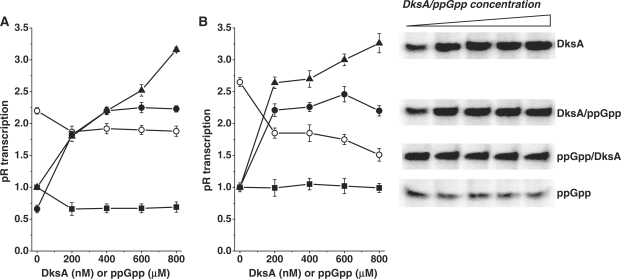
Figure 1.
Figure 1.
In vitro transcription from pR promoter in the presence and absence of ppGpp and DksA. (A) Transcription in the presence of increasing concentrations of ppGpp (squares), DksA (triangles), DksA with addition of 200 μM ppGpp (closed circles) or ppGpp with addition of 400 nM DksA (open circles). RNAP and ppGpp/DksA were incubated 7 min at room temperature, then KCl was added (final concentration 140 mM) and temperature increased to 37°C prior to DNA addition. Transcription was initiated by adding of NTPs (see details in ‘Materials and Methods’ section). (B) Transcription in the presence of increasing concentrations of ppGpp (squares), DksA (triangles), DksA with addition of 200 μM ppGpp (closed circles) or ppGpp with addition of 400 nM DksA (open circles). RNAP, DNA, ppGpp/DksA were incubated in the buffer with KCl (150 mM) in 37°C then reaction was initiated by adding of NTPs. Transcription in the absence of ppGpp and DksA was set as 1. Data are from three independent experiments with error bars indicated. Inset: Autoradiogram of transcription illustrating the example experiment performed as described in (B), corresponding to the plots.
Figure 2.
Figure 2.
In vivo activity of pR promoter (β-galactosidase activity) in wild-type, relA spoT (ppGpp-null), dksA and relA spoT dksA strains. Activity in the wild-type (wt) strain was set as 1 (actual value was 12318 ± 1003 Miller units). The data are from six independent measurements with SD indicated.
Figure 3.
Figure 3.
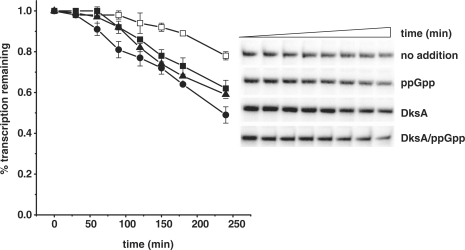
The effects of ppGpp and DksA on pR promoter half-life. (A) The time course of competitor-resistant open complexes was monitored by in vitro transcription challenged by heparin in the presence of none addition (DksA storage buffer, open squares), ppGpp at 200 μM (closed squares), DksA at 400 nM (triangles) or DksA at 400 nM with addition of 200 μM ppGpp (circles). The values found at 20 s after competitor addition were set as 1. Data are the average from three independent experiments with standard errors. (B) The autoradiogram from the experiment performed as shown in the (A).
Figure 4.
Figure 4.
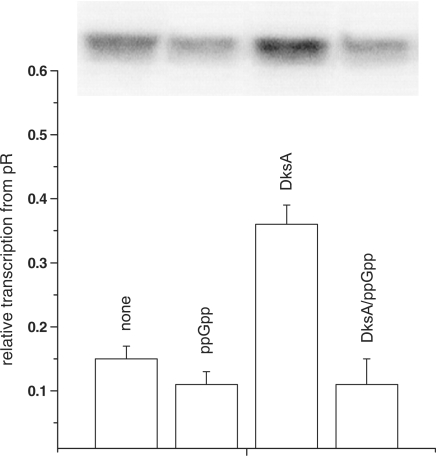
The effect of ppGpp and DksA on the in vitro transcription initiation. Relative transcription levels at 3 min after the reaction start (in the time-course experiment) Autoradiogram of transcription products is inserted above the columns representing transcription from pR. DNA was incubated with ppGpp/DksA in buffer containing 150 mM KCl with no addition, ppGpp at 200 μM, DksA at 400 nM or DksA at 400 nM with addition of 200 μM ppGpp. The reaction was initiated by simultaneous addition of RNAP and NTP with heparin, and samples were withdrawn at indicated times. Values were normalized to the level of transcription for 30 min with no addition (set as 1). The results are from three independent experiments with standard errors.
Figure 5.
Figure 5.
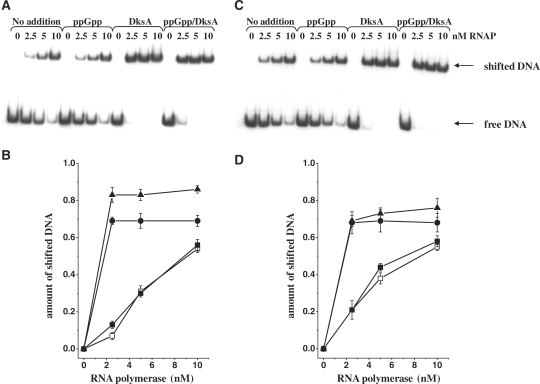
Binding of RNAP to pR DNA fragment. (A and C) Gel-shift assay using 15 ng of DNA and indicated amounts of the RNAP. (B and D) Quantification of the percentage of shifted (bound) DNA fragment. Symbols: none addition (DksA storage buffer, open squares), ppGpp at 200 μM (closed squares), DksA at 400 nM (triangles) or DksA at 400 nM with addition of 200 μM ppGpp (circles). In (C and D), ATP and UTP were present at 1 mM. The results are mean values from three measurements with error bars.
Figure 6.
Figure 6.
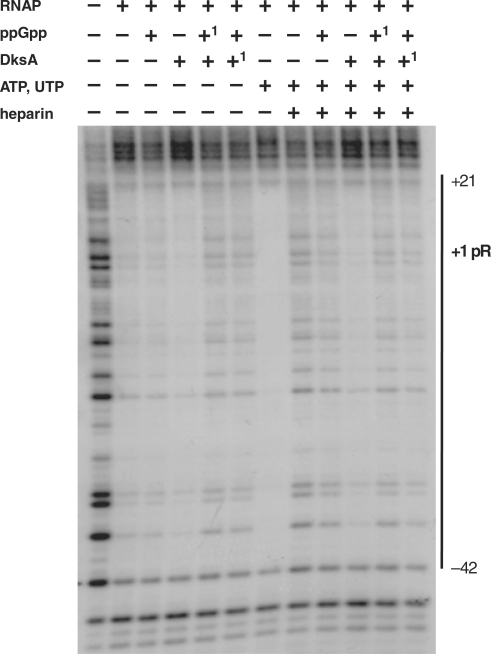
Footprinting analysis of RNAP protection at pR promoter in the presence of ppGpp and/or DksA. Reactions contained double-stranded template with the 5′-end (P32)-labeled, 40 nM RNAP, 400 μM ppGpp, 500 nM DksA, ATP and UTP at 1 mM, heparin at 100 µg/ml where indicated. In the lanes containing both DksA and ppGpp ‘1’ indicates the regulator added as first.

References

    1. Cashel M, Gentry D, Hernandez VJ, Vinella D. Escherichia coli and Salmonella: Cellular and Molecular Biology. I. Washington DC: American Society for Microbiology; 1996. The stringent response; pp. 1458–1496.
    1. Magnusson LU, Farewell A, Nystrom T. ppGpp: a global regulator in Escherichia coli. Trends Microbiol. 2005;13:236–242. - PubMed
    1. Potrykus K, Cashel M. (p)ppGpp: still magical? Annu. Rev. Microbiol. 2008;62:35–51. - PubMed
    1. Artsimovitch I, Patlan V, Sekine S, Vassylyeva MN, Hosaka T, Ochi K, Yokoyama S, Vassylyev DG. Structural basis for transcription regulation by alarmone ppGpp. Cell. 2004;117:299–310. - PubMed
    1. Vrentas CE, Gaal T, Berkmen MB, Rutherford ST, Haugen SP, Vassylyev DG, Ross W, Gourse RL. Still looking for the magic spot: the crystallographically defined binding site for ppGpp on RNA polymerase is unlikely to be responsible for rRNA transcription regulation. J. Mol. Biol. 2008;377:551–564. - PMC - PubMed

Publication types

MeSH terms