. 2009 Nov;151(3):1596-608.
doi: 10.1104/pp.109.144824. Epub 2009 Sep 16.

A systems-level analysis of the effects of light quality on the metabolism of a cyanobacterium

Affiliations

A systems-level analysis of the effects of light quality on the metabolism of a cyanobacterium

Abhay K Singh et al. Plant Physiol. 2009 Nov.

Abstract

Photosynthetic organisms experience changes in light quantity and light quality in their natural habitat. In response to changes in light quality, these organisms redistribute excitation energy and adjust photosystem stoichiometry to maximize the utilization of available light energy. However, the response of other cellular processes to changes in light quality is mostly unknown. Here, we report a systematic investigation into the adaptation of cellular processes in Synechocystis species PCC 6803 to light that preferentially excites either photosystem II or photosystem I. We find that preferential excitation of photosystem II and photosystem I induces massive reprogramming of the Synechocystis transcriptome. The rewiring of cellular processes begins as soon as Synechocystis senses the imbalance in the excitation of reaction centers. We find that Synechocystis utilizes the cyclic photosynthetic electron transport chain for ATP generation and a major part of the respiratory pathway to generate reducing equivalents and carbon skeletons during preferential excitation of photosystem I. In contrast, cytochrome c oxidase and photosystem I act as terminal components of the photosynthetic electron transport chain to produce sufficient ATP and limited amounts of NADPH and reduced ferredoxin during preferential excitation of photosystem II. To overcome the shortage of NADPH and reduced ferredoxin, Synechocystis preferentially activates transporters and acquisition pathways to assimilate ammonia, urea, and arginine over nitrate as a nitrogen source. This study provides a systematic analysis of cellular processes in cyanobacteria in response to preferential excitation and shows that the cyanobacterial cell undergoes significant adjustment of cellular processes, many of which were previously unknown.


Figures
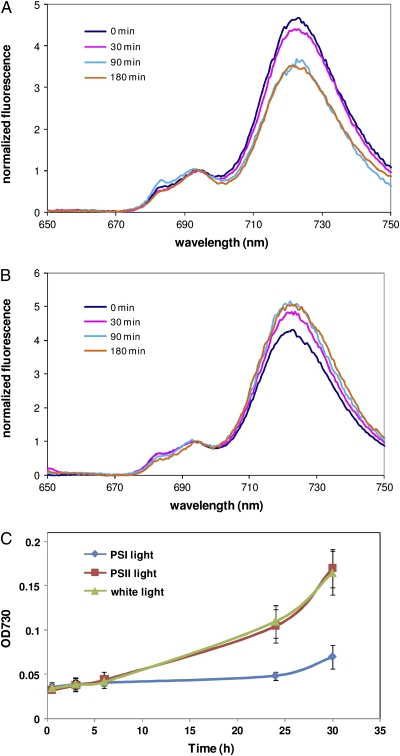
Figure 1.
Figure 1.
Physiological responses of Synechocystis to PSI and PSII light. A and B, Chl fluorescence emission spectra of cells illuminated with PSI light (A) and PSII light (B) were measured following excitation of Chl at 435 nm. Curves were normalized to the fluorescence intensity at 695 nm. C, Cell growth was monitored by measuring absorption (OD [optical density]) at 730 nm under PSI light or PSII light. Error bars represent sd based on mean values of three independent growth experiments.
Figure 2.
Figure 2.
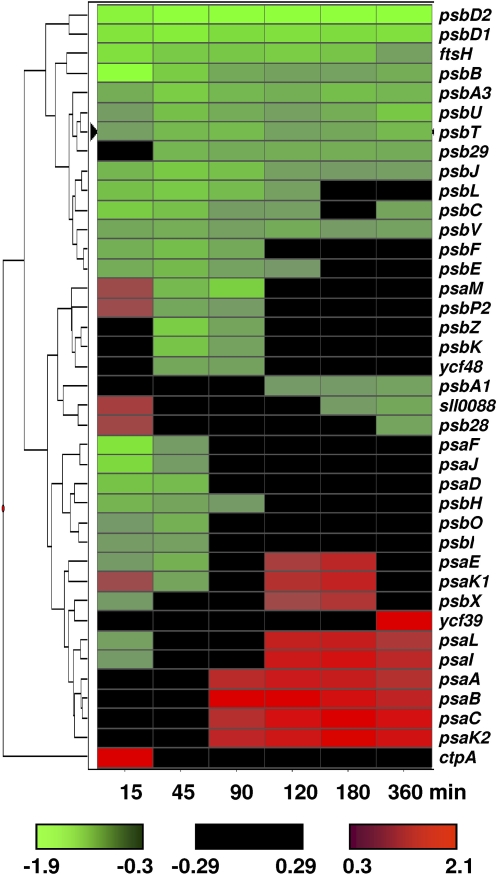
A hierarchical cluster display of photosystem genes regulated by PSI and PSII light. Expression ratios [log2(PSII light/PSI light)] of all PSI and PSII genes were used to generate the cluster using Spotfire Decisionsite version 8.0. Euclidean distance was used as a measure of similarity between various time points, and genes were clustered using the weighted pair gene method with arithmetic means. The color scale used to define the regulation pattern of a gene is provided at the bottom. The fold changes of genes are provided in Supplemental Table S2.
Figure 3.
Figure 3.
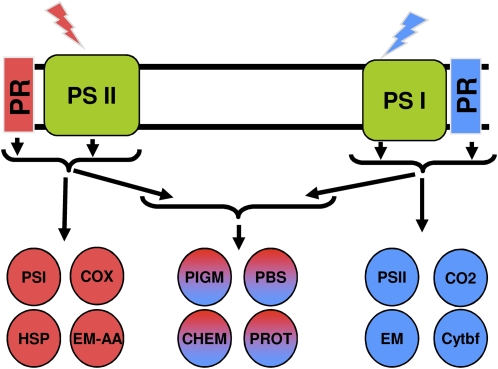
A schematic representation of major cellular processes controlled by PSI and PSII light. Blue and orange circles represent responses associated with PSI light and PSII light, respectively. Circles containing both blue and orange represent cellular processes controlled by both PSI and PSII light. The list of regulated genes belonging to these processes is provided in Supplemental Table S2. CHEM, Chemotaxis; CO2, CO2 fixation; COX, cytochrome oxidase; Cytbf, cytochrome b6f complex; EM, energy metabolism; EM-AA, energy metabolism amino acids; PIGM, pigment biosynthesis; PR, photoreceptor(s); PROT, proteases.
Figure 4.
Figure 4.
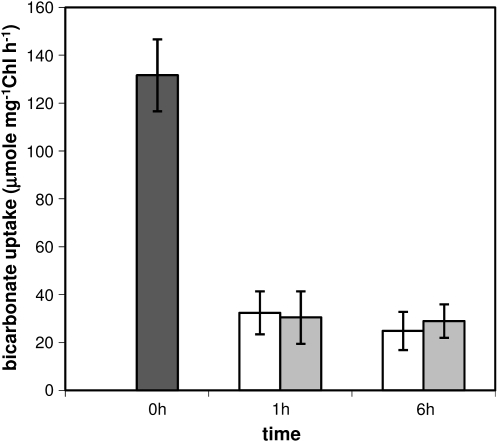
Uptake of [14C]bicarbonate in air-grown Synechocystis under PSI and PSII light. Synechocystis cells grown under white light (dark gray bar) were illuminated with either PSII light (white bars) or PSI light (light gray bars) for 1 and 6 h, and the rate of bicarbonate uptake was measured as described in “Materials and Methods.” Error bars represent sd based on mean values of four independent measurements.
Figure 5.
Figure 5.
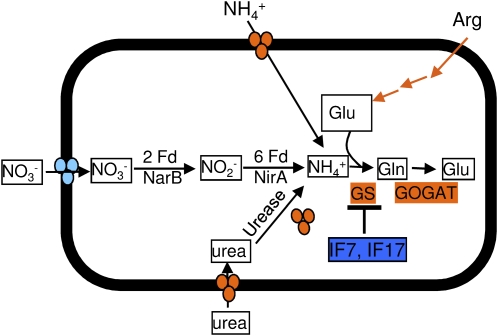
Effects of PSI and PSII light on N assimilation pathways. Pathways controlled by PSII light are colored orange, whereas those controlled by PSI light are colored blue. Transcript levels of genes encoding nitrate transporter are transiently greater under PSI light and are colored light blue. The lists of regulated genes belonging to these processes are provided in Tables I and II.
Figure 6.
Figure 6.
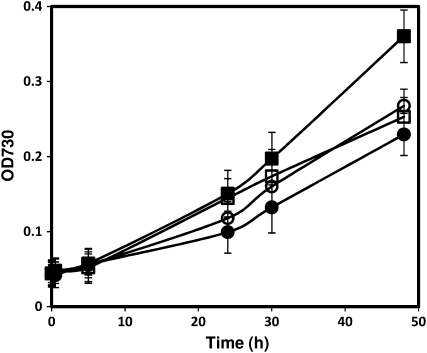
Effects of NH4NO3 and light quality on the growth of Synechocystis. Synechocystis cells were grown under 30 μE m−2 s−1 white light (circles) and 10 μE m−2 s−1 PSII light (squares) in BG11 with (black) or without (white) 2 mm NH4NO3. Cell growth was monitored by measuring absorption (OD [optical density]) at 730 nm. Error bars represent sd based on mean values of three independent growth experiments.
Figure 7.
Figure 7.
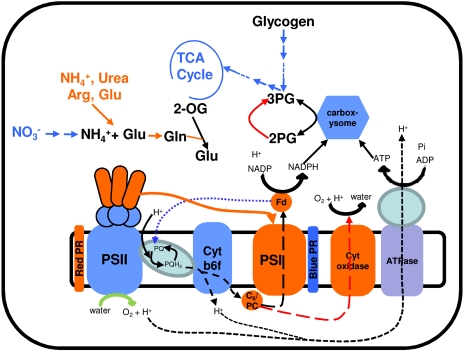
A summary of key cellular adaptations during changes in light quality. Blue and orange colors represent responses associated with PSI light and PSII light, respectively. The photosynthetic linear electron transfer chain is represented by the dotted black line. The dotted blue line (from ferredoxin [Fd] to PQ) denotes the cyclic electron transfer chain under PSI light. The dotted red lines show the electron transfer to cytochrome c oxidase under PSII light. The solid orange line denotes the movement of rod complex to PSI under PSII light. 2-OG, 2-Oxoglutarate; 2PG, 2-phosphoglycolate; 3PG, 3-phosphoglycerate.

References

    1. Adir N (2005) Elucidation of the molecular structures of components of the phycobilisome: reconstructing a giant. Photosynth Res 85 15–32 - PubMed
    1. Alfonso M, Perewoska I, Kirilovsky D (2000) Redox control of psbA gene expression in the cyanobacterium Synechocystis PCC 6803: involvement of the cytochrome b6/f complex. Plant Physiol 122 505–516 - PMC - PubMed
    1. Allen JF (2003) State transitions: a question of balance. Science 299 1530–1532 - PubMed
    1. Anderson JM, Chow WS, Park YI (1995) The grand design of photosynthesis: acclimation of the photosynthetic apparatus to environmental cues. Photosynth Res 46 129–139 - PubMed
    1. Asadulghani, Suzuki Y, Nakamoto H (2003) Light plays a key role in the modulation of heat shock response in the cyanobacterium Synechocystis sp PCC 6803. Biochem Biophys Res Commun 306 872–879 - PubMed

Publication types

MeSH terms

LinkOut - more resources