Review
. 2010 Jan;67(1):89-98.
doi: 10.1007/s00018-009-0152-x. Epub 2009 Sep 10.

Not just angiotensinases: new roles for the angiotensin-converting enzymes

Affiliations
Review

Not just angiotensinases: new roles for the angiotensin-converting enzymes

Daniel W Lambert et al. Cell Mol Life Sci. 2010 Jan.

Abstract

The renin-angiotensin system (RAS) is a critical regulator of blood pressure and fluid homeostasis. Angiotensin II, the primary bioactive peptide of the RAS, is generated from angiotensin I by angiotensin-converting enzyme (ACE). A homologue of ACE, ACE2, is able to convert angiotensin II to a peptide with opposing effects, angiotensin-(1-7). It is proposed that disturbance of the balance of ACE and ACE2 expression and/or function is important in pathologies in which angiotensin II plays a role. These include cardiovascular and renal disease, lung injury and liver fibrosis. The critical roles of ACE and ACE2 in regulating angiotensin II levels have traditionally focussed attention on their activities as angiotensinases. Recent discoveries, however, have illuminated the roles of these enzymes and of the ACE2 homologue, collectrin, in intracellular trafficking and signalling. This paper reviews the key literature regarding both the catalytic and non-catalytic roles of the angiotensin-converting enzyme gene family.


Figures

Fig. 1
Fig. 1
Membrane topology and homology between ACE, ACE2 and its homologue collectrin. The ACE isoforms somatic ACE (sACE) and germinal ACE (gACE), ACE2 and its homologue collectrin, are type I transmembrane proteins with an intracellular C-terminal domain and an extracellular N-terminal domain. In the case of the ACE isoforms and ACE2, the N-terminal extracellular domains contain HEMGH zinc-dependent catalytic domains (denoted as ‘Pacman’ symbols); two in ACE and one in both gACE and ACE2. Collectrin contains no catalytic residues. Germinal ACE is entirely homologous to the C-terminal domain of sACE except for an O-glycosylated region at its N-terminus. ACE2 shares homology in its ectodomain with the N-terminal domain of sACE but has no homology with its C-terminal cytoplasmic domain; instead, it shares a number of residues with the intracellular domain of collectrin
Fig. 2
Fig. 2
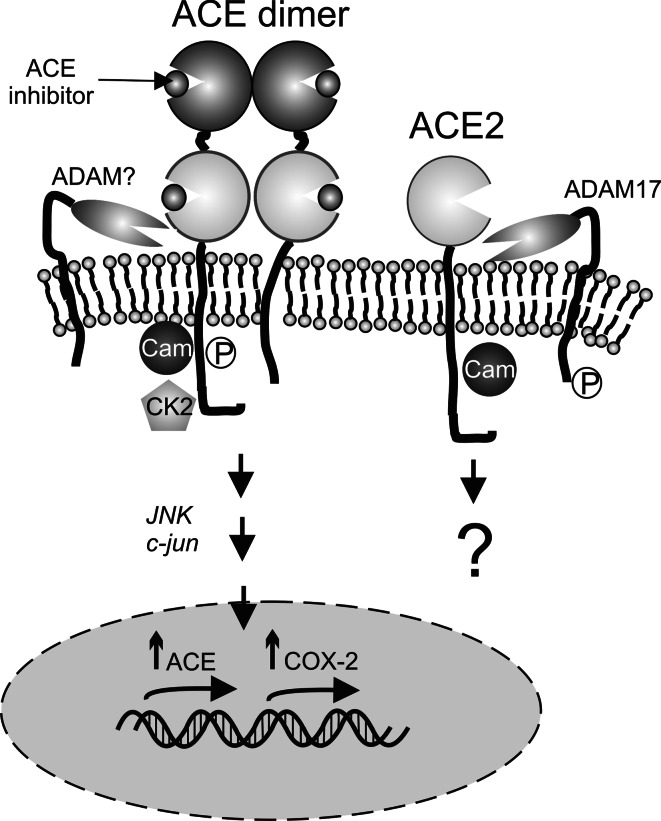
ACE and ACE2 as outside-in signalling molecules. Both ACE and ACE2 are subject to regulated ectodomain shedding involving members of the ADAM family of proteinases. The identity of the ACE sheddase remains to be established. Shedding of both enzymes is regulated by calmodulin (Cam) and may generate intracellular signals. The intracellular domain of ACE is known to dimerise, become phosphorylated and associate with CK2 (casein kinase-2) in response to inhibitor binding, triggering downstream signalling events involving JNK (c-Jun NH2-terminal kinase) and c-Jun and culminating in transcriptional upregulation of ACE and COX-2 (cyclooxygenase-2) in endothelial cells. In adipocytes, inhibitor binding to ACE results in upregulation of CRBP (cellular retinol binding protein) and adiponectin expression (not shown). A role for ACE2 in intracellular signalling modulation is unclear
Fig. 3
Fig. 3
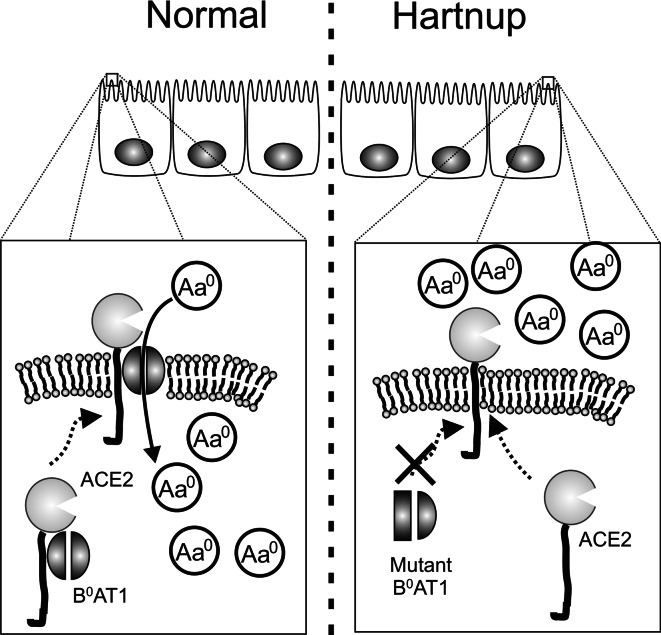
ACE2 is a critical regulator of amino acid transporter function in small intestine. ACE2 regulates the function of the amino acid transporters B0AT1 and B0AT3 in the small intestinal enterocyte brush border. Mutations in a number of residues in the B0AT1 transporter block the association between ACE2 and the transporter and lead to the amino acid uptake defect observed in human Hartnup disorder. The ACE2 homologue, collectrin, carries out this role in the tubular cells of the kidney and is similarly influenced by mutations in B0AT1 (not shown in this diagram)

References

    1. Lever AF, Hole DJ, Gillis CR, McCallum IR, McInnes GT, MacKinnon PL, Meredith PA, Murray LS, Reid JL, Robertson JW. Do inhibitors of angiotensin-I-converting enzyme protect against risk of cancer? Lancet. 1998;352:179–184. doi: 10.1016/S0140-6736(98)03228-0. - DOI - PubMed
    1. Khakoo AY, Sidman RL, Pasqualini R, Arap W. Does the renin-angiotensin system participate in regulation of human vasculogenesis and angiogenesis? Cancer Res. 2008;68:9112–9115. doi: 10.1158/0008-5472.CAN-08-0851. - DOI - PubMed
    1. Nguyen G, Danser AH. Prorenin and (pro)renin receptor: a review of available data from in vitro studies and experimental models in rodents. Exp Physiol. 2008;93:557–563. doi: 10.1113/expphysiol.2007.040030. - DOI - PubMed
    1. Lambert DW, Hooper NM, Turner AJ. Angiotensin-converting enzyme 2 and new insights into the renin-angiotensin system. Biochem Pharmacol. 2008;75:781–786. doi: 10.1016/j.bcp.2007.08.012. - DOI - PMC - PubMed
    1. Santos RA, Simoes e Silva AC, Maric C, Silva DM, Machado RP, de Buhr I, Heringer-Walther S, Pinheiro SV, Lopes MT, Bader M, Mendes EP, Lemos VS, Campagnole-Santos MJ, Schultheiss HP, Speth R, Walther T. Angiotensin-(1–7) is an endogenous ligand for the G protein-coupled receptor Mas. Proc Natl Acad Sci USA. 2003;100:8258–8263. doi: 10.1073/pnas.1432869100. - DOI - PMC - PubMed

Publication types

MeSH terms

LinkOut - more resources