


p-Isothiocyanatobenzyl-desferrioxamine: a new bifunctional chelate for facile radiolabeling of monoclonal antibodies with zirconium-89 for immuno-PET imaging
- PMID: 19763566
- PMCID: PMC2816257
- DOI: 10.1007/s00259-009-1263-1
p-Isothiocyanatobenzyl-desferrioxamine: a new bifunctional chelate for facile radiolabeling of monoclonal antibodies with zirconium-89 for immuno-PET imaging
Abstract
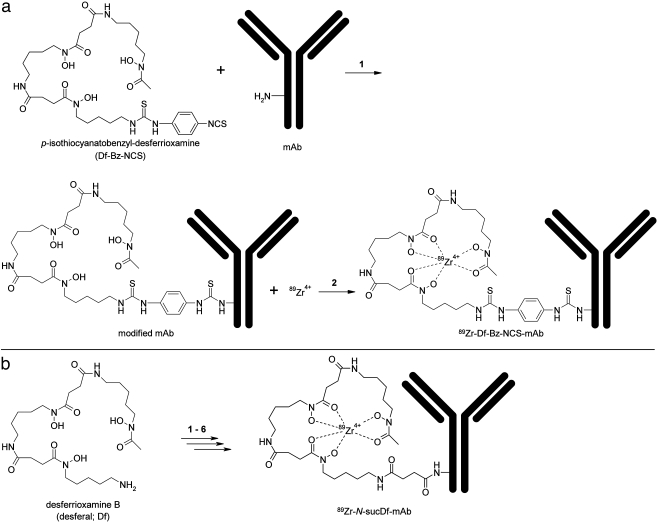
Purpose: Immuno-PET is an emerging imaging tool for the selection of high potential antibodies (mAbs) for imaging and therapy. The positron emitter zirconium-89 ((89)Zr) has attractive characteristics for immuno-PET with intact mAbs. Previously, we have described a multi-step procedure for stable coupling of (89)Zr to mAbs via the bifunctional chelate (BFC) tetrafluorophenol-N-succinyldesferal (TFP-N-sucDf). To enable widespread use of (89)Zr-immuno-PET, we now introduce the novel BFC p-isothiocyanatobenzyl-desferrioxamine B (Df-Bz-NCS) and compare its performance in (89)Zr-immuno-PET with the reference BFC TFP-N-sucDf.
Methods: Three mAbs were premodified with Df-Bz-NCS and labeled with (89)Zr at different pHs to assess the reaction kinetics and robustness of the radiolabeling. Stability of both (89)Zr-Df-Bz-NCS- and (89)Zr-N-sucDf-conjugates was evaluated in different buffers and human serum. Comparative biodistribution and PET studies in tumor-bearing mice were undertaken.
Results: The selected conjugation conditions resulted in a chelate:mAb substitution ratio of about 1.5:1. Under optimal radiolabeling conditions (pH between 6.8-7.2), the radiochemical yield was >85% after 60 min incubation at room temperature, resulting in radioimmunoconjugates with preserved integrity and immunoreactivity. The new radioimmunoconjugate was very stable in serum for up to 7 days at 37 degrees C, with <5% (89)Zr release, and was equally stable compared to the reference conjugate when stored in the appropriate buffer at 4 degrees C. In biodistribution and imaging experiments, the novel and the reference radioimmunoconjugates showed high and similar accumulation in tumors in nude mice.
Conclusions: The novel Df-Bz-NCS BFC allows efficient and easy preparation of optimally performing (89)Zr-labeled mAbs, facilitating further exploration of (89)Zr-immuno-PET as an imaging tool.
Figures


References
-
- Verel I, Visser GWM, Boellaard R, Stigter-van Walsum M, Snow GB, van Dongen GAMS. 89Zr immuno-PET: comprehensive procedures for the production of 89Zr-labeled monoclonal antibodies. J Nucl Med. 2003;44:1271–1281. - PubMed
Publication types
MeSH terms
Substances
LinkOut - more resources
Full Text Sources
Other Literature Sources
Miscellaneous
