Arginase: an emerging key player in the mammalian immune system
- PMID: 19764983
- PMCID: PMC2765586
- DOI: 10.1111/j.1476-5381.2009.00291.x
Arginase: an emerging key player in the mammalian immune system
Abstract
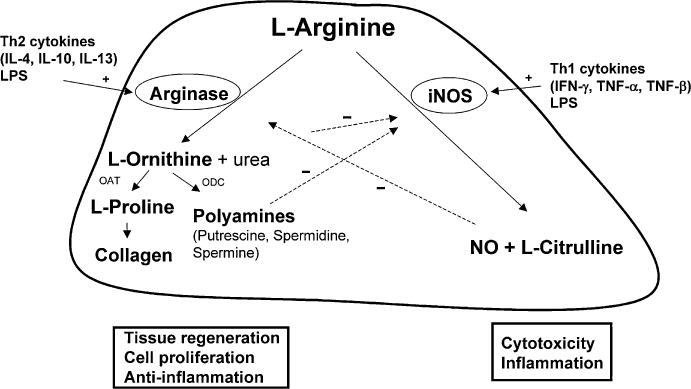
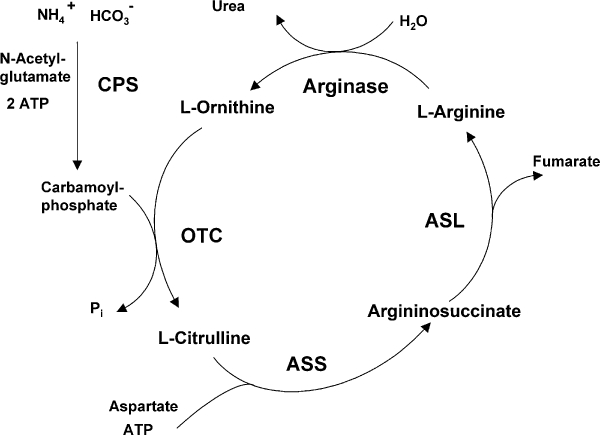
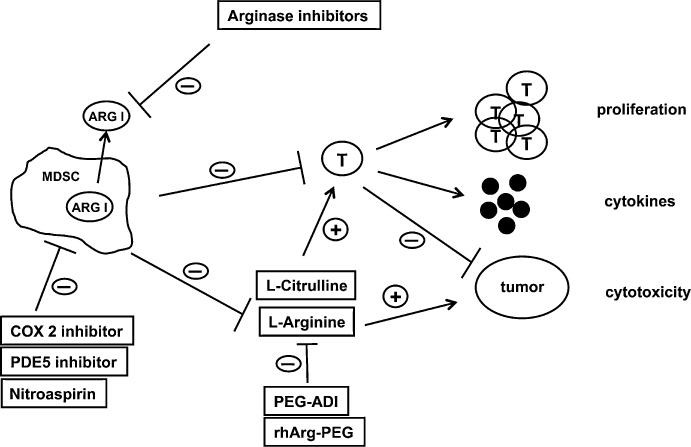
The enzyme arginase metabolizes L-arginine to L-ornithine and urea. Besides its fundamental role in the hepatic urea cycle, arginase is also expressed the immune system of mice and man. While significant interspecies differences exist regarding expression, subcellular localization and regulation of immune cell arginase, associated pathways of immunopathology are comparable between species. Arginase is induced in murine myeloid cells mainly by Th2 cytokines and inflammatory agents and participates in a variety of inflammatory diseases by down-regulation of nitric oxide synthesis, induction of fibrosis and tissue regeneration. In humans, arginase I is constitutively expressed in polymorphonuclear neutrophils and is liberated during inflammation. Myeloid cell arginase-mediated L-arginine depletion profoundly suppresses T cell immune responses and this has emerged as a fundamental mechanism of inflammation-associated immunosuppression. Pharmacological interference with L-arginine metabolism is a novel promising strategy in the treatment of cancer, autoimmunity or unwanted immune deviation.
Figures
Comment in
-
Arginase: a key enzyme in the pathophysiology of allergic asthma opening novel therapeutic perspectives.Br J Pharmacol. 2009 Oct;158(3):652-64. doi: 10.1111/j.1476-5381.2009.00374.x. Epub 2009 Aug 24. Br J Pharmacol. 2009. PMID: 19703164 Free PMC article. Review.
References
-
- Ascierto PA, Scala S, Castello G, Daponte A, Simeone E, Ottaiano A, et al. Pegylated arginine deiminase treatment of patients with metastatic melanoma: results from phase I and II studies. J Clin Oncol. 2005;23:7660–7668. - PubMed
-
- Ash DE. Structure and function of arginases. J Nutr. 2004;134:2760S–2764S. 2765S–2767S. - PubMed
-
- Aulak KS, Mishra R, Zhou L, Hyatt SL, de Jonge W, Lamers W, et al. Post-transcriptional regulation of the arginine transporter Cat-1 by amino acid availability. J Biol Chem. 1999;274:30424–30432. - PubMed
-
- Averous J, Bruhat A, Jousse C, Carraro V, Thiel G, Fafournoux P. Induction of CHOP expression by amino acid limitation requires both ATF4 expression and ATF2 phosphorylation. J Biol Chem. 2004;279:5288–5297. - PubMed
Publication types
MeSH terms
Substances
LinkOut - more resources
Full Text Sources
Other Literature Sources
Medical