


Association of TP53 and MDM2 polymorphisms with survival in bladder cancer patients treated with chemoradiotherapy
- PMID: 19764997
- PMCID: PMC11159677
- DOI: 10.1111/j.1349-7006.2009.01331.x
Association of TP53 and MDM2 polymorphisms with survival in bladder cancer patients treated with chemoradiotherapy
Abstract
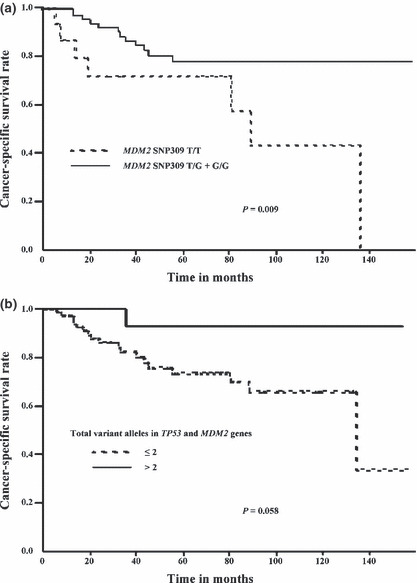
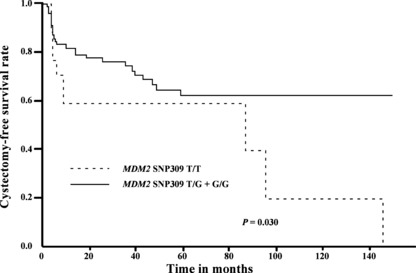
Platinum-based chemoradiotherapy (CRT) as bladder conservation therapy has shown promising results for muscle-invasive bladder cancer. However, CRT might diminish survival as a result of the delay in cystectomy for some patients with non-responding bladder tumors. Because the p53 tumor suppression pathway, including its MDM2 counterpart, is important in chemotherapy- and radiotherapy-associated effects, functional polymorphisms in the TP53 and MDM2 genes could influence the response to treatment and the prognosis following CRT. We investigated associations between two such polymorphisms, and p53 overexpression, and response or survival in bladder cancer patients treated with CRT. The study group comprised 96 patients who underwent CRT for transitional cell carcinoma of the bladder. Single nucleotide polymorphisms (SNPs) in TP53 (codon 72, arginine > proline) and MDM2 (SNP309, T > G) were genotyped using PCR-RFLP, and nuclear expression levels of p53 were examined using immunohistochemistry. None of the genotypes or p53 overexpression was significantly associated with response to CRT. However, patients with MDM2 T / G + G / G genotypes had improved cancer-specific survival rates after CRT (P = 0.009). In multivariate analysis, the MDM2 T / G + G / G genotypes, and more than two of total variant alleles in TP53 and MDM2, were independently associated with improved cancer-specific survival (P = 0.031 and P = 0.015, respectively). In addition, MDM2 genotypes were significantly associated with cystectomy-free survival (P = 0.030). These results suggest that the TP53 and MDM2 genotypes might be useful prognostic factors following CRT in bladder cancer, helping patient selection for bladder conservation therapy.
Figures
References
-
- Rodel C, Grabenbauer GG, Kuhn R et al. Combined‐modality treatment and selective organ preservation in invasive bladder cancer: long‐term results. J Clin Oncol 2002; 20: 3061–71. - PubMed
-
- Shipley WU, Kaufman DS, Tester WJ, Pilepich MV, Sandler HM. Overview of bladder cancer trials in the Radiation Therapy Oncology Group. Cancer 2003; 97: 2115–9. - PubMed
-
- Shipley WU, Winter KA, Kaufman DS et al. Phase III trial of neoadjuvant chemotherapy in patients with invasive bladder cancer treated with selective bladder preservation by combined radiation therapy and chemotherapy: initial results of Radiation Therapy Oncology Group 89‐03. J Clin Oncol 1998; 16: 3576–83. - PubMed
-
- Tester W, Caplan R, Heaney J et al. Neoadjuvant combined modality program with selective organ preservation for invasive bladder cancer: results of Radiation Therapy Oncology Group phase II trial 8802. J Clin Oncol 1996; 14: 119–26. - PubMed
-
- Kachnic LA, Kaufman DS, Heney NM et al. Bladder preservation by combined modality therapy for invasive bladder cancer. J Clin Oncol 1997; 15: 1022–9. - PubMed
Publication types
MeSH terms
Substances
LinkOut - more resources
Full Text Sources
Other Literature Sources
Medical
Research Materials
Miscellaneous
