


Review
doi: 10.1016/j.febslet.2009.09.030.
System-level design of bacterial cell cycle control
Affiliations
- PMID: 19766635
- PMCID: PMC2795017
- DOI: 10.1016/j.febslet.2009.09.030
Item in Clipboard
Review
System-level design of bacterial cell cycle control
FEBS Lett.
.
Abstract
Understanding of the cell cycle control logic in Caulobacter has progressed to the point where we now have an integrated view of the operation of an entire bacterial cell cycle system functioning as a state machine. Oscillating levels of a few temporally-controlled master regulator proteins in a cyclical circuit drive cell cycle progression. To a striking degree, the cell cycle regulation is a whole cell phenomenon. Phospho-signaling proteins and proteases dynamically deployed to specific locations on the cell wall are vital. An essential phospho-signaling system integral to the cell cycle circuitry is central to accomplishing asymmetric cell division.
Figures
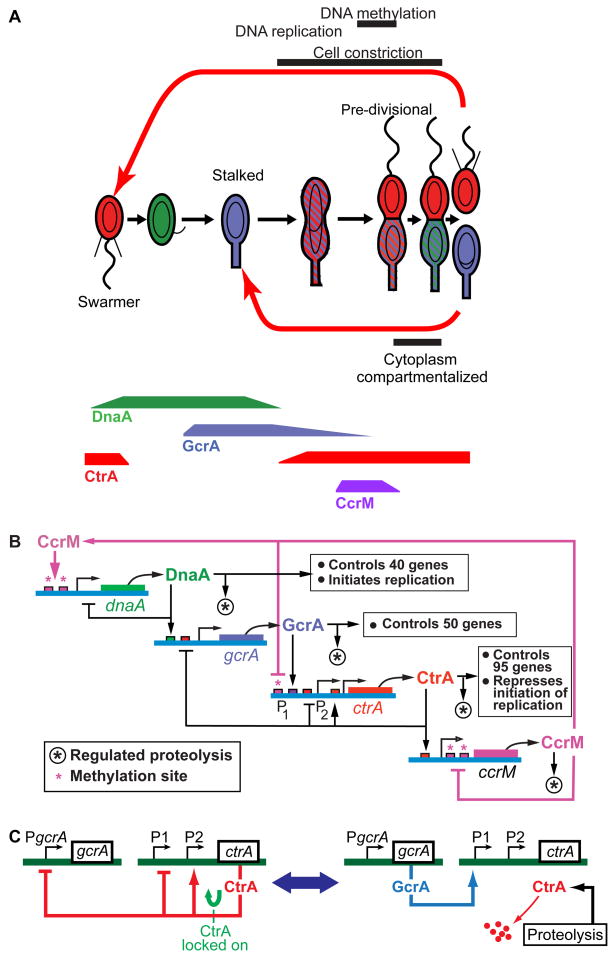
(A) Caulobacter cell cycle. The stalked daughter cell always re-enters the cell cycle as a stalked cell. In contrast, the swarmer daughter cell has an interval of motility before differentiating into a stalked cell equivalent to its sibling and entering the stalked cell cycle. Shading shows temporal and spatial localization patterns of the DnaA, CtrA, and GcrA regulatory proteins. Varying protein concentrations over the cell cycle are indicated below for four master regulators. The circles and theta structures inside the cell depict progression of chromosome replication. (B) Four proteins (DnaA, GcrA, CtrA, and CcrM) create a cyclical genetic circuit, the “core engine” that drives the Caulobacter cell cycle [3,8]. DnaA, GcrA, and CtrA are transcriptional regulators that control activation of modular subsystems, and CcrM is a DNA methyltransferase. (C) Simplified illustration of the bistable switch that causes alternate synthesis and destruction of CtrA. A tightly coupled phospho-signaling pathway (see Fig. 2) controls both the activation of proteolysis and the phosphorylation state of CtrA.
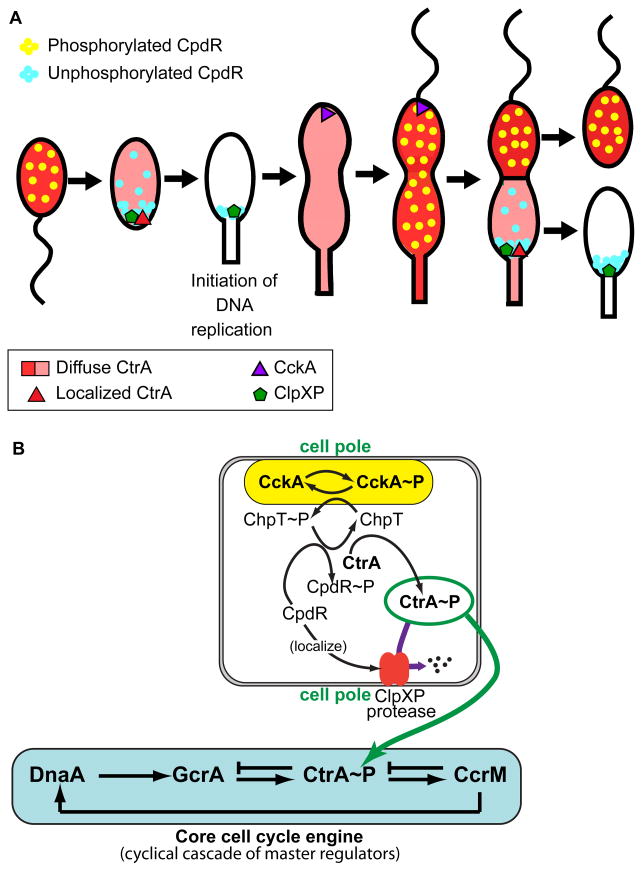
(A) Dynamic changes in the complement of phospho-signaling proteins localized at the swarmer cell pole and stalked pole drive polar organelle development and switching between accumulation and destruction of the key master regulator CtrA~P. Localization and activation of the ClpXP protease occurs in the newly differentiated stalked cell and in the daughter stalked cell compartment prior to the completion of cell division. (B) A phospho-signaling pathway originating at the polar-localized CckA histidine kinase controls both localization/activation of the ClpXP protease and the phosphorylation state of CtrA.

Key requirements are to establish the cell’s axis of polarity, orient the chromosome, distributed critical proteins spatially along the polarity axis, and divide the cell. The asymmetrically sequestered proteins direct the ongoing differential development of the distinctive daughter cells.
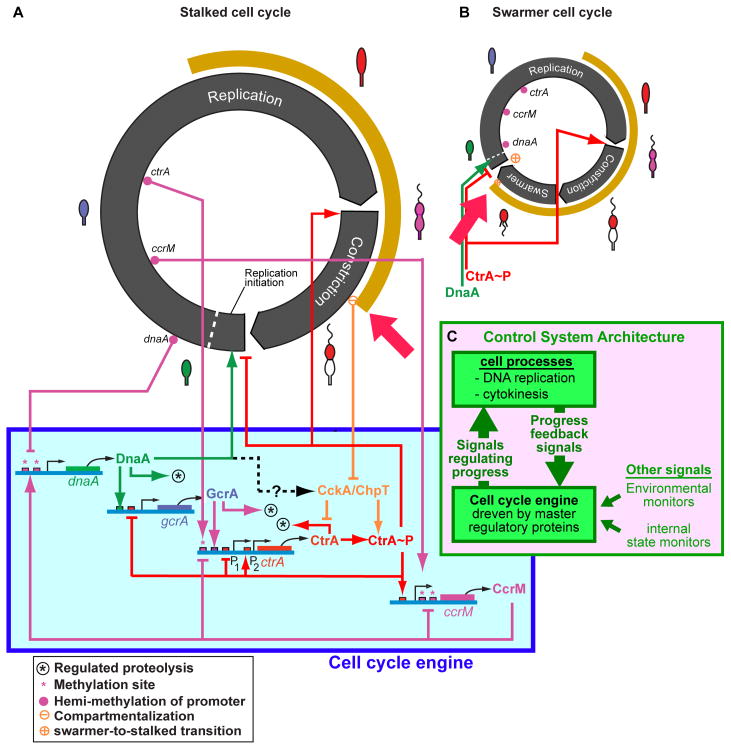
The cell cycle engine drives both the stalked (A) and swarmer (B) cell cycles by activating numerous subsystems in a precisely controlled order. The duration of DNA replication and FtsZ-ring constriction in the cell cycle are approximately to scale. The cell cycle engine shown below the stalked cell cycle controls activation of the processive reactions that implement DNA replication and cell constriction. Feedback signals (C) activated by events in the progression of the cell cycle synchronize the system. The circuit design assures that timing errors do not occur, by halting or slowing the cell cycle engine so that subsystems are not activated until necessary precursor events have occurred [2]. Cell stage is indicated by the cell-type icons on the perimeter. The distinct difference in timing of the presence of CtrA (tan arcs and red arrows) in the swarmer and stalked cell cycles is controlled by the phospho-signaling mechanisms shown in Figure 2.
References
-
- Rouse WB. Engineering complex systems: Implications for research in systems engineering. Transactions on Systems, Man, and Cybernetics--Part C. 2003;33:154–156.
-
- Holtzendorff J, Hung D, Brende P, Reisenauer A, Viollier PH, McAdams HH, Shapiro L. Oscillating global regulators control the genetic circuit driving a bacterial cell cycle. Science. 2004;304:983–7. - PubMed
Publication types
MeSH terms
Substances
Grants and funding
LinkOut - more resources
Full Text Sources
