. 2009 Nov;191(22):7063-73.
doi: 10.1128/JB.00892-09. Epub 2009 Sep 18.

The dlt operon of Bacillus cereus is required for resistance to cationic antimicrobial peptides and for virulence in insects

Affiliations

The dlt operon of Bacillus cereus is required for resistance to cationic antimicrobial peptides and for virulence in insects

Z Abi Khattar et al. J Bacteriol. 2009 Nov.

Abstract

The dlt operon encodes proteins that alanylate teichoic acids, the major components of cell walls of gram-positive bacteria. This generates a net positive charge on bacterial cell walls, repulsing positively charged molecules and conferring resistance to animal and human cationic antimicrobial peptides (AMPs) in gram-positive pathogenic bacteria. AMPs damage the bacterial membrane and are the most effective components of the humoral immune response against bacteria. We investigated the role of the dlt operon in insect virulence by inactivating this operon in Bacillus cereus, which is both an opportunistic human pathogen and an insect pathogen. The Delta dlt(Bc) mutant displayed several morphological alterations but grew at a rate similar to that for the wild-type strain. This mutant was less resistant to protamine and several bacterial cationic AMPs, such as nisin, polymyxin B, and colistin, in vitro. It was also less resistant to molecules from the insect humoral immune system, lysozyme, and cationic AMP cecropin B from Spodoptera frugiperda. Delta dlt(Bc) was as pathogenic as the wild-type strain in oral infections of Galleria mellonella but much less virulent when injected into the hemocoels of G. mellonella and Spodoptera littoralis. We detected the dlt operon in three gram-negative genera: Erwinia (Erwinia carotovora), Bordetella (Bordetella pertussis, Bordetella parapertussis, and Bordetella bronchiseptica), and Photorhabdus (the entomopathogenic bacterium Photorhabdus luminescens TT01, the dlt operon of which did not restore cationic AMP resistance in Delta dlt(Bc)). We suggest that the dlt operon protects B. cereus against insect humoral immune mediators, including hemolymph cationic AMPs, and may be critical for the establishment of lethal septicemia in insects and in nosocomial infections in humans.


Figures

FIG. 1.
FIG. 1.
The dlt operon involved in the d-alanylation of TAs is part of the core genome of gram-positive bacteria, whereas it is located in plastic regions in gram-negative bacterial genomes. Shown are the organization and genomic environment of the dlt operon in several gram-positive bacterial species (Bc, Bacillus cereus ATCC 14579 [GenBank accession no. AE016877]; Bt, Bacillus thuringiensis subsp. konkukian strain 97-27 [AE017355]; Ba, Bacillus anthracis strain Sterne [AE017225]; Bl, Bacillus licheniformis ATCC 14580 [AE017333]; Bs, Bacillus subtilis 168 [AL009126]; Sp, Streptococcus pneumoniae R6 [AE007317]; Sag, Streptococcus agalactiae 2603V/R [AE009948]; Saur, Staphylococcus aureus JH1 [CP000736]; Lc, Lactobacillus casei BL23 [FM177140]; Ef, Enterococcus faecalis V583 [AE016830]; and Lmo, Listeria monocytogenes EGD-e [AL591824]) (A) and in several gram-negative bacterial species (Eca, Erwinia carotovora subsp. atroseptica SCRI1043 [GenBank accession no. BX950851]; Pl, Photorhabdus luminescens TT01 [BX470248]; Bp, Bordetella pertussis Tohama I [BX470248]; Bpp, Bordetella parapertussis 12822 [BX470249]; and Bbr, Bordetella bronchiseptica RB50 [BX470250]) (B). Black blocks and arrows indicate the core genome, gray blocks indicate regions of genomic plasticity, horizontal arrows indicate the different dlt genes, and white vertical arrowheads indicate core genome genes or operons flanking the dlt region in gram-negative bacteria. kb, kilobases.
FIG. 2.
FIG. 2.
Phenotypes of the wild-type B. cereus and ΔdltBc strains. (A) Photograph of B. cereus ATCC 14579 wild-type (Bc WT) colonies and B. cereus dlt mutant (ΔdltBc) colonies grown on LB agar for 15 h at 37°C. The corresponding phase-contrast transmission micrographs of Bc WT and ΔdltBc in the exponential growth phase are shown. Note the smaller sizes of ΔdltBc mutant colonies and bacteria than of the wild type. (B) Growth curves for the wild-type (black diamond) and the dlt knockout mutant (ΔdltBc) (white square) B. cereus strains, grown in LB medium at 37°C with shaking. Absorbances (A600) were scored with a real-time microplate reader system (Tecan Infinite). Means and standard errors of the means (bars) of results from triplicate experiments are shown. (C) Autolysis rates of the wild-type (black diamond) and the dlt knockout mutant (ΔdltBc) (white square) B. cereus strains in the presence of Triton X-100. Autolysis rates were determined by a microplate reader system (Tecan Infinite) monitoring decreases in OD600 over a period of 2 h (120 min) in PBS at 37°C, without shaking. Means and standard errors of the means (bars) of results from triplicate experiments are shown.
FIG. 3.
FIG. 3.
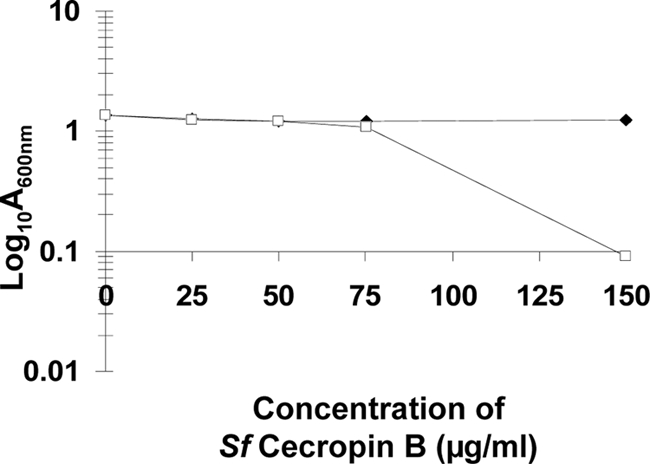
MICs of S. frugiperda (Sf) Cec B for the wild-type (black diamond) and dlt knockout mutant (ΔdltBc) (white square) B. cereus strains. All strains were diluted (1:100) in LB medium containing the indicated concentration of S. frugiperda Cec B. Real-time changes in A600 were monitored with a microplate reader system (Tecan Infinite) at 37°C, with shaking. Data represent A600 values scored at 15 h of incubation, and results are means for three different experiments. Standard errors of the means (bars) are shown.
FIG. 4.
FIG. 4.
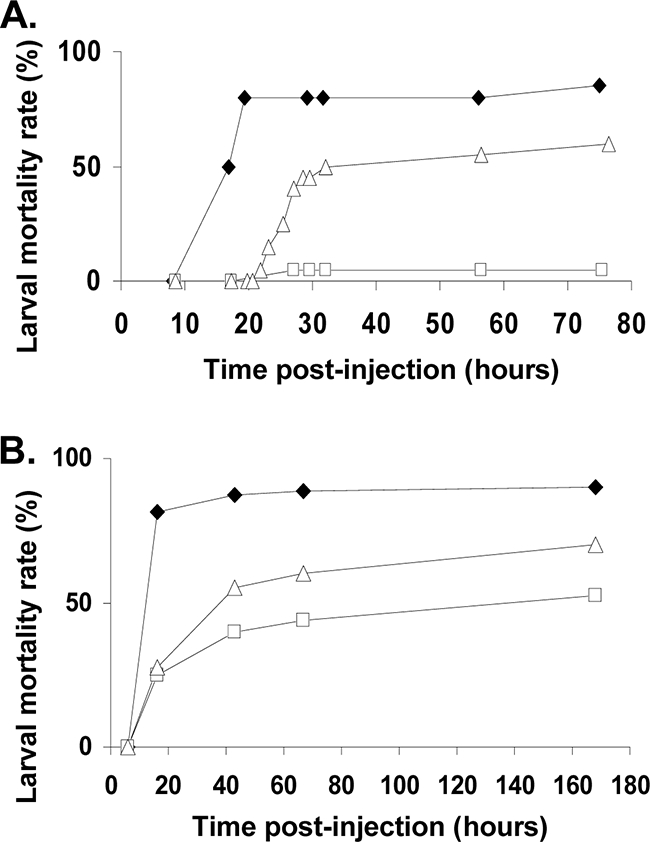
Mortality of insect larvae injected with the wild-type, ΔdltBc/pHT315 mutant, and complemented ΔdltBc/pHT315-dltBc mutant B. cereus strains. Bacteria were collected at the end of the exponential phase and injected into 20 fifth-instar larvae. All experiments were repeated at least three times, and data represent one representative experiment. (A) Mortality kinetics of S. littoralis after injection with 3 × 10³ to 1 × 10⁴ CFU of the wild-type (black diamond), ΔdltBc/pHT315 mutant (white square), and complemented ΔdltBc/pHT315-dltBc mutant (white triangle) B. cereus strains. The mortality values presented correspond to the result obtained over a period of 3 days after injections. (B) Mortality kinetics of G. mellonella after injection with 1 × 10⁴ CFU of the wild-type (black diamond), ΔdltBc/pHT315 mutant (white square), and complemented ΔdltBc/pHT315-dltBc mutant (white triangle) B. cereus strains. The mortality values presented correspond to the result obtained over a 6-day period after injection.

References

    1. Abachin, E., C. Poyart, E. Pellegrini, E. Milohanic, F. Fiedler, P. Berche, and P. Trieu-Cuot. 2002. Formation of D-alanyl-lipoteichoic acid is required for adhesion and virulence of Listeria monocytogenes. Mol. Microbiol. 43:1-14. - PubMed
    1. Arantes, O., and D. Lereclus. 1991. Construction of cloning vectors for Bacillus thuringiensis. Gene 108:115-119. - PubMed
    1. Arnaud, M., A. Chastanet, and M. Debarbouille. 2004. New vector for efficient allelic replacement in naturally nontransformable, low-GC-content, gram-positive bacteria. Appl. Environ. Microbiol. 70:6887-6891. - PMC - PubMed
    1. Bell, K. S., M. Sebaihia, L. Pritchard, M. T. Holden, L. J. Hyman, M. C. Holeva, N. R. Thomson, S. D. Bentley, L. J. Churcher, K. Mungall, R. Atkin, N. Bason, K. Brooks, T. Chillingworth, K. Clark, J. Doggett, A. Fraser, Z. Hance, H. Hauser, K. Jagels, S. Moule, H. Norbertczak, D. Ormond, C. Price, M. A. Quail, M. Sanders, D. Walker, S. Whitehead, G. P. Salmond, P. R. Birch, J. Parkhill, and I. K. Toth. 2004. Genome sequence of the enterobacterial phytopathogen Erwinia carotovora subsp. atroseptica and characterization of virulence factors. Proc. Natl. Acad. Sci. USA 101:11105-11110. - PMC - PubMed
    1. Bouillaut, L., N. Ramarao, C. Buisson, N. Gilois, M. Gohar, D. Lereclus, and C. Nielsen-Leroux. 2005. FlhA influences Bacillus thuringiensis PlcR-regulated gene transcription, protein production, and virulence. Appl. Environ. Microbiol. 71:8903-8910. - PMC - PubMed

Publication types

MeSH terms

LinkOut - more resources