


Mmp-20 and Klk4 cleavage site preferences for amelogenin sequences
- PMID: 19767579
- PMCID: PMC2751868
- DOI: 10.1177/0022034509342694
Mmp-20 and Klk4 cleavage site preferences for amelogenin sequences
Abstract
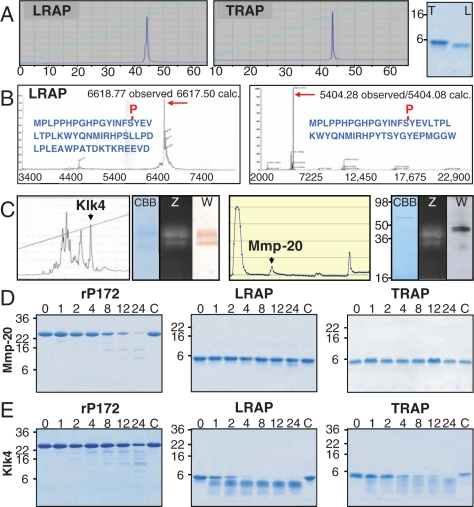
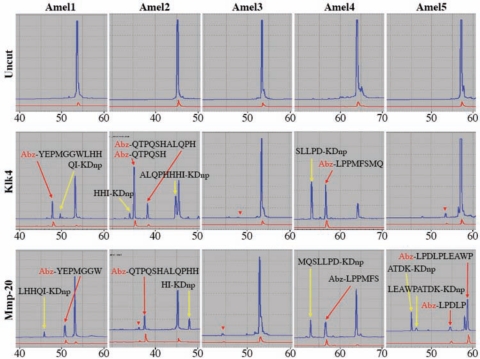
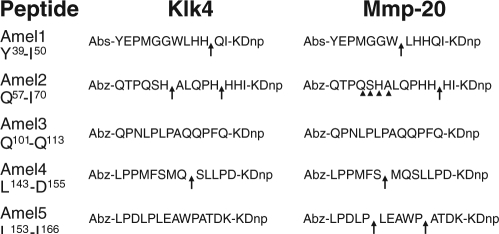
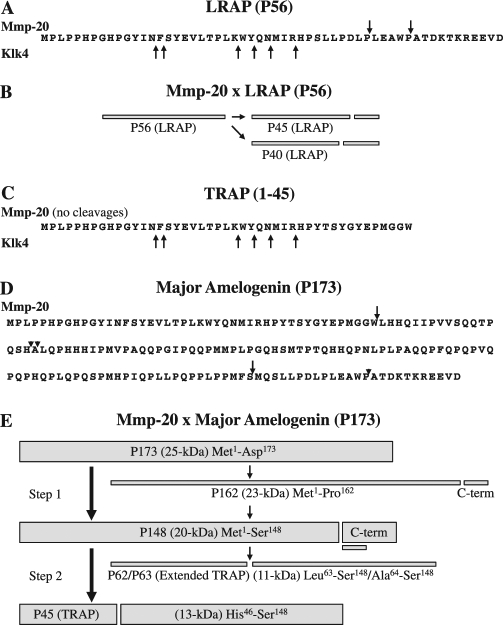
Mmp-20 and Klk4 are the two key enamel proteases. Can both enzymes process amelogenin to generate the major cleavage products that accumulate during the secretory stage of amelogenesis? We isolated Mmp-20 and Klk4 from developing pig teeth and used them to digest the tyrosine-rich amelogenin polypeptide (TRAP), the leucine-rich amelogenin protein (LRAP), and 5 fluorescence peptides. We characterized the digestion products by LC-MSMS, SDS-PAGE, and C18 RP-HPLC monitored with fluorescence and UV detectors. Mmp-20 cleaves amelogenin sequences after Pro(162), Ser(148), His(62), Ala(63), and Trp(45). These cleavages generate all of the major cleavage products that accumulate in porcine secretory-stage enamel: the 23-kDa, 20-kDa, 13-kDa, 11-kDa, and 6-kDa (TRAP) amelogenins. Mmp-20 cleaves LRAP after Pro(45) and Pro(40), producing the two LRAP products previously identified in tooth extracts. Among these key cleavage sites, Klk4 was able to cleave only after His(62). We propose that Mmp-20 alone processes amelogenin during the secretory stage.
Conflict of interest statement
All authors declare that there are no conflicting interests.
Figures
References
-
- Bartlett JD, Simmer JP. (1999). Proteinases in developing dental enamel. Crit Rev Oral Biol Med 10:425-441 - PubMed
-
- Bartlett JD, Simmer JP, Xue J, Margolis HC, Moreno EC. (1996). Molecular cloning and mRNA tissue distribution of a novel matrix metalloproteinase isolated from porcine enamel organ. Gene 183:123-128 - PubMed
-
- Bègue-Kirn C, Krebsbach PH, Bartlett JD, Butler WT. (1998). Dentin sialoprotein, dentin phosphoprotein, enamelysin and ameloblastin: tooth-specific molecules that are distinctively expressed during murine dental differentiation. Eur J Oral Sci 106:963-970 - PubMed
-
- Caterina JJ, Skobe Z, Shi J, Ding Y, Simmer JP, Birkedal-Hansen H, et al. (2002). Enamelysin (matrix metalloproteinase 20)-deficient mice display an amelogenesis imperfecta phenotype. J Biol Chem 277:49598-49604 - PubMed
-
- Daculsi G, Kerebel B. (1978). High-resolution electron microscope study of human enamel crystallites: size, shape, and growth. J Ultrastruct Res 65:163-172 - PubMed
Publication types
MeSH terms
Substances
Grants and funding
LinkOut - more resources
Full Text Sources
